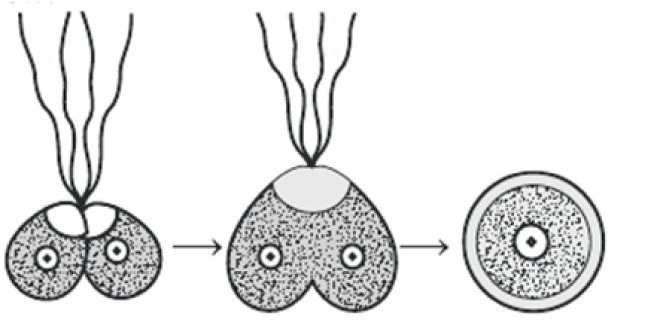
REPRODUCTION IN ORGANISMS

1. The period from birth to the natural death of an organism represents(a) gametophytic phase(b) sporophytic phase(c) life span(d) life cycle 2. Which ot the following has the longest life span ?(a) Butterfly(b) Crocodile(c) Parrot(d) Tortoise 3. In all the methods of asexual reproduction(a) offsprings produced are genetically identical to the parents.(b) offsprings produced are genetically different from the parents.(c) offsprings produced may or may not be identical to the parents.(d) None of the above 4. A clone is a group of individuals obtained through(a) self-pollination(b) hybridization(c) asexual reproduction(d) cross-pollination 5. The term clone is used to describe such ___________and ________ similar individual.(a) chemically, genetically(b) physiologically, chemically(c) morphologically, genetically(d) morphologically, metabolically 6. Asexual reproduction is common among(a) single celled organisms only.(b) plants only.(c) animals with simple organization.(d) single celled animals, plants and animals with simple organization. 7. In protists and monerans, asexual reproduction occurs by(a) budding(b) binary fission(c) conidia(d) multiple fission 8. In yeast cell division results in a small cell called(a) bud(b) clone(c) branch(d) offspring 9. Fleshy buds produced in the axil of leaves, which grow to form new plants when shed and fall on ground are called(a) Bulbs(b) Bulbils(c) Tubers(d) Offset 10. The term ‘Terror of Bengal’ is used for(a) Bengal tiger(b) water hyacinth(c) algal bloom(d) aquatic fauna 11. In which of the following pairs the plants can be vegetative propagated by leaf buds?(a) Bryophyllum and Kalanchoe(b) Chrysanthemum and Agave(c) Agave and Kalanchoe(d) Asparagus and Bryophyllum 12. In sexual reproduction, offsprings resemble the parents(a) structurally but not functionally.(b) functionally but not structurally.(c) both structurally and functionally.(d) neither structurally nor functionally. 13. Oestrus cycle is seen in(a) cows and sheep(b) rats and deers(c) dogs and tiger(d) all of the above 14. The end of vegetative phase in plants which marks the Beginning of the reproductive phase can be easily seen in the higher plants when they come to(a) flower(b) fertilize(c) pollinate(d) None of the above 15. Sexual reproduction can be grouped into _______ distinct states.(a) two(b) three(c) four(d) five 16. In flowering plants both male and female gametes are non-motile. The method to bring them together for fertilization is(a) water(b) air(c) pollination(d) apomixis 17. The terms homothallic and monoecious are used to denote(a) bisexual condition (b) unisexual condition(c) staminate flowers (d) pistillate flowers 18. Syngamy means(a) fusion of similar spores.(b) fusion of gametes.(c) fusion of dissimilar spores.(d) fusion of cytoplasm. 19. Development of an egg without fertilization is called(a) gametogenesis(b) metagenesi(c) oogenesis(d) parthenogenesis 20. Which of the followings is a post-fertilization event in flowering plants ?(a) Transfer of pollen grains(b) Embryo development(c) Formation of flower(d) Formation of pollen grains 21. Viviparity is found in(a) whale(b) lizards(c) frogs(d) birds 22. Which of the following statement about animal reproduction is incorrect ?(a) Species that reproduce sexually cannot reproduce asexually.(b) Viviparity, but not ovoviviparity, is common in mammals.(c) Male insects can remove spermatophores deposited in a female by other males.(d) Oogenesis and spermatogenesis both occur simultaneous in hermaphrodites. 23. Which of the following statements about animals that utilize external fertilization is incorrect ?(a) They are divided equally between terrestrial and aquatic species.(b) Many produce large numbers of gametes to ensure successful reproduction.(c) The behaviours associated with mating are often highly synchronized.(d) The probability of any one egg being fertilized and developing into an adult can be low. 24. Which of the following statement is correct in the process of fertilization ?(a) Only one sperm reaches the egg and enters it.(b) The entry of sperm activates the egg for completing meiosis.(c) Two haploid nuclei fuse and immediately divide to produce two nuclei which are again haploid.(d) Only the acrosome of the sperm enters the egg. 25. Which of the following definitions about oviparity is incorrect ?(a) Only birds and reptiles are oviparous.(b) The large amount of yolk provides the nutrients for the developing embryo.(c) The shell protects the egg from dehydration.(d) Both oxygen and carbon dioxide can diffuse through the shell. 26. Select the incorrect statemen.(a) Anisogametes differ either in structure, function or behaviour.(b) In oomycetes, female gamete is smaller and motile, while male gamete is larger and non-motile.(c) Chlamydomonas exhibits both isogamy and anisogamy and Fucus shows oogamy.(d) Isogametes are similar in structure, function and behaviour. 27. Select the incorrect statements.(a) Cucurbits and coconuts are monoecious plants.(b) Papayas and date palms are dioecious plants.(c) Leeches and tapeworms are bisexual animals.(d) Sponges and coelenterates are unisexual animals. 28. Which of the following statements is/are correct ?(i) The genetic constitution of a plant is unaffected in vegetative propagation.(ii) Rhizome in ginger serves as an organ of vegetative reproduction.(iii) Totipotency of cells enables us to micropropagate plants.(a) (i) and (ii)(b) (ii) and (iii)(c) (ii) only(d) All of these 29. Which of the following statement(s) is/are incorrect about internal fertilization?(i) Male gametes are motile.(ii) Male gametes are non-motile.(iii) Male gametes are produced in large number.(iv) Male gametes are produced in small number.(v) There is a significant reduction in the number of eggs produced.(a) (i), (iii) and (v)(b) (iii) and (iv)(c) (ii) and (iv)(d) Only (v) 30. Which of the following statements is incorrect ?(i) Bamboo species flower only once in their life time, generally after 50-100 years and produce large number of fruits and die.(ii) In animals, the juvenile phase is followed by morphological and physiological changes prior to active reproductive behaviour.(iii) The reproductive phase is of same duration in all organisms.(iv) Juvenile phase is the period of growth between the birth of an individual till it reaches reproductive maturity.(a) Only (i)(b) Only (ii)(c) Only (iii)(d) Only (iv) 31. Which of these statement(s) is/are correct ?(i) Stamens are male reproductive part whereas carpels are female reproductive parts.(ii) In Spirogyra, asexual reproduction takes place by fragmentation.(iii) Vegetative propagation by leaves occurs in sweet potato.(a) (i) and (ii)(b) (ii) and (iii)(c) (i) and (iii)(d) All are correct 32. Which one of the following option is correct regarding the given statements ?(i) The plant was introduced in India because of its beautiful flowers and shape of leaves.(ii) It can propagate vegetatively at a phenomenal rate and spread all over water body in a short period.(iii) It is very difficult to get rid off these plants.(iv) It is associated with flowering plants.(a) Dahlia(b) Water hyacinth(c) Azolla (water fern)(d) Mosses 33. Read the following statements and select the correct ones.(i) Conidia are the asexual propagules restricted to kingdom Fungi.(ii) A piece of potato tuber having at least one eye (or node) is capable of giving rise to a new plant.(iii) Ginger propagates vegetatively with the help of its underground roots.(iv) Fleshy buds which takes part in vegetative propagation are called bulbils, present in Dioscorea, Agave, etc.(a) (ii) and (iii)(b) (i) and (iv)(c) (i), (ii) and (iv)(d) (i), (ii) and (iii) 34. Read the following statements regarding sexual reproduction and selects the incorrect ones.(i) Sexual reproduction does not always require two individuals.(ii) Sexual reproduction generally involves gametic fusion.(iii) Meiosis never occurs during sexual reproduction.(iv) External fertilization is a rule during sexual reproduction.(a) (i) and (iii)(b) (iii) and (iv)(c) (i), (ii) and (iii)(d) (ii), (iii) and (iv) 35.Which of the following statements regarding the given terms are correct?Runners, Tubers, Offsets(a) These all are incapable of giving rise to new individuals and formation of these structures does not involve two parents.(b) These all are capable of giving rise to new individuals and formation of these structures does not involve two parents.(c) These all are capable of giving rise to new individuals but formation of these structures involves two parents for reproduction.(d) These are all incapable of giving rise to new individuals but formation of these structures involves two parents for reproduction. 36. Which of the following statements regarding the asexual reproduction is incorrect?(a) Both mitotic and meiotic division occurs.(b) It does not contribute to evolution and speciation.(c) It is uniparental and usually occurs in unicellular organisms.(d) There is no variation and the offsprings havesame phenotype and genotype. In the following questions, a statement of Assertion is followed statement of Reason.If both Assertion and Reason are true and the Reason is the correct explanation of the Assertion.If both Assertion and Reason are true but the Reason is not the correct explanation of the Assertion.If Assertion is true but Reason is false.If both Assertion and Reason are false. 37. Assertion: A plant can be retained and multiplied indefinitely without any change or variation through asexual reproduction.Reason: Asexual Reproduction does not involve meiosis and syngamy. 38. Assertion: Zygote is the link between two generations.Reason: Zygote is the product of two gametes and producer of next generation. 39. Assertion: Zygote is a single cell.Reason : Two haploid cell fused to form two diploid cell. 40. Assertion: Ants, bees and termite show parthenogenesis.Reason: Parthenogenesis is the process in which new organism is formed without fertilization. 41. Assertion: Embryogenesis refers to the develop of mentembryo from the zygote.Reason: During Embryogenesis zygote undergoes cell division (mitosis) and cell differentiation. 42. Match column-I with column-II and select the correct answer using the codes given below.
Column-I Column-II
A. Animals which give birth to young oneI. Hydra
B. Animal which produces budII. Planaria
C. An animal which shows regeneration III. Viviparous
D. Provides nutrition to the developing embryo from the motherIV. Placenta
(a) A – I; B – III; C – II; D – IV(b) A – III; B – I; C – II; D – IV(c) A – III; B – I; C – IV; D – II(d) A – III; B – IV; C – I; D – II 43. Match the terms given in column-I with their examples in column-II and choose the correct option.
Column-I(Terms) Column-II(Examples)
A. Binary fissionI. Algae
B. ZoosporeII. Amoeba
C. Conidium III. Hydra
D. BuddingIV. Penicillium
E. GemmuleV. Sponge
(a) A – I; B – IV; C – V; D – III; E – II(b) A – II; B – I; C – IV; D – III; E – V(c) A – II; B – IV; C – III; D – V; E – I(d) A – I; B – IV; C – III; D – II; E – V 44. Match column-I with column-II and select the correct option.
Column-I(Name of the organism) Column-II(Haploid chromosome number in gamete)
A. Ophioglossum (fern)I. 23
B. RiceII. 24
C. PotatoIII. 12
D. ManIV. 630
(a) A – I; B – II; C – III; D – IV(b) A – II; B – III; C – IV; D – I(c) A – III; B – IV; C – II; D – I(d) A – IV; B – III; C – II; D – I 45. Match the organisms (given in column I) with their approximate life span (given in column II) and choose the correct combination from the options given below.
Column-I (Organism) Column-II(Approximate life span)
A. ButterflyI. 60 years
B. CrowII. 140 years
C. ParrotIII. 15 years
D. CrocodileIV. 1-2 weeks
(a) A – IV; B – III; C – I; D – II(b) A – II; B – III; C – IV; D – I(c) A – III; B – II; C – I; D – IV(d) A – IV; B – III; C – II; D – I 46. Match the name of the organism given in column I with their chromosome number in meiocytes choose the correct combination from the options given below.
Column-I (Name of the organism) Column-II(Chromosome number in meiocyte)
A. ButterflyI. 60 years
B. CrowII. 140 years
C. ParrotIII. 15 years
D. CrocodileIV. 1-2 weeks
(a) A – II; B – III; C – IV; D – I(b) A – III; B – IV; C – II; D – I(c) A – IV; B – III; C – I; D – II(d) A – IV; B – III; C – II; D – I 47. Match the organisms given in column-I with their reproductive structure/mode of reproduction given in column-II and select the correct option from the codes given below :
Column-I (Name of the organism) Column-II(Chromosome number in meiocyte)
A. SpongeI. Tuber
B. YeastII. Offset
C. PotatoIII. Gemmules
D. Water hyacinthIV. Budding
(a) A – IV; B – I; C – II; D – III(b) A – III; B – I; C – IV; D – II(c) A – III; B – IV; C – I; D – II(d) A – III; B – IV; C – II; D – I 48. Match the definition (given in column I) with their correct term (given in column II) and choose the correct combination from the options given.
Column-I Column-II
A. The pollen transferred from one flower to anotherI. Germination
B. The Process in which embryo develops into seedlingII. Pollination
C. Fertilized egg in humans gets implanted inIII. Menstuation
D. When egg in humans is not fertilized process occurIV. Uterus
(a) A – II; B – I; C – IV; D – III(b) A – I; B – II; C – IV; D – III(c) A – I; B – II; C – III; D – IV(d) A – I; B – III; C – II; D – IV 49. Which one of the following pair is correctly matched?(a) Onion – Bulb(b) Ginger – Sucker(c) Chlamydomonas – Conidia(d) Yeast – Zoospores 50. Find out the incorrectly matched pair.(a) Tuber – Potato(b) Rhizome – Ginger(c) Bulbil – Agave(d) Leaf buds – Banana 51. Match the column I contain str uctures of male reproductive system and column II contains its feature. Select the correct option.
Column-I Column-II
A. GameteI. Result of fusion of male and female gametes
B. BuddingII. Division of body into two equal halves
C. FissionIII. Germ cells
D. FertilizationIV. The fusion of male and female gametes
E. ZygoteV. An unequal division of organisms in which individual arises as an outgrowth from the parent
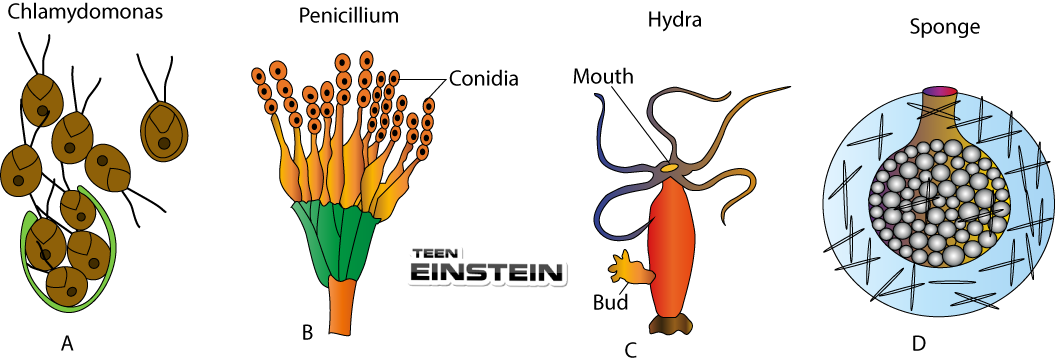
(a) A - I; B - II; C - III; D - IV; E – V(b) A - III; B - V; C - II; D - IV; E – I(c) A - III; B - I; C - V; D - II; E – IV(d) A - V; B - IV; C - III; D - I; E – II 52. The given figures show the members of fungi and simple plants such as algae which undergo asexual reproduction. Identify the correct asexual reproductive structures found in the members A, B, C and D.
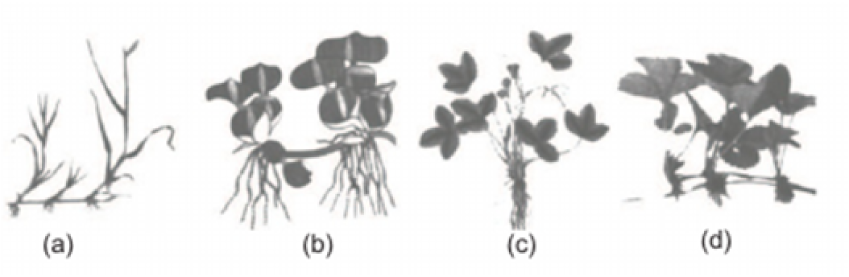
(a) A-Zoogamete, B-Conidia, C-Bud, D-Gemmule(b) A-Zoospore, B-Conidia, C-Bud, D-Gemmule(c) A-Zoospore, B-Conidiosporangium, C-Bud, D-Gemmule(d) A-Aplanospore, B-Conidia, C-Bud, D-Gemmule 53. The given figures show some examples of angiosperms as A, B, C and D. All these are capable of giving rise to new offsprings with the help of vegetative propagules. Identify the correct unit of vegetative propagules present in these angiosperms.
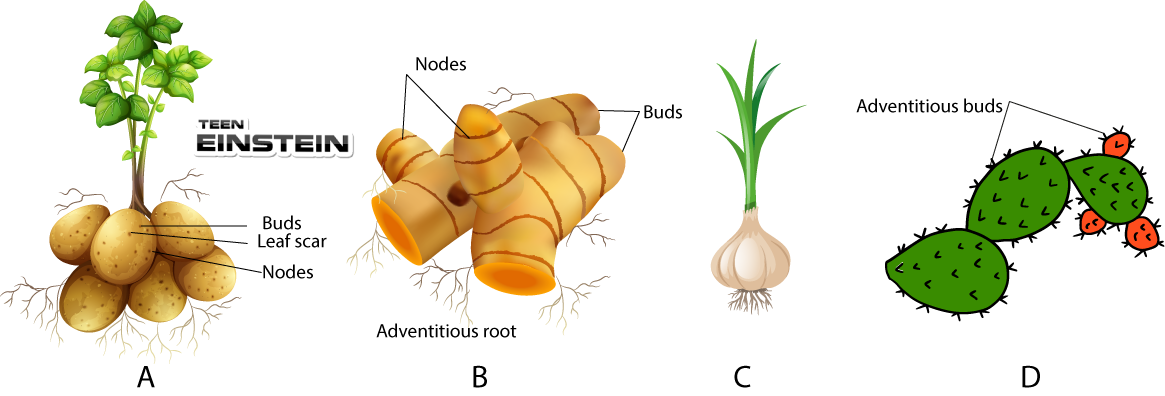
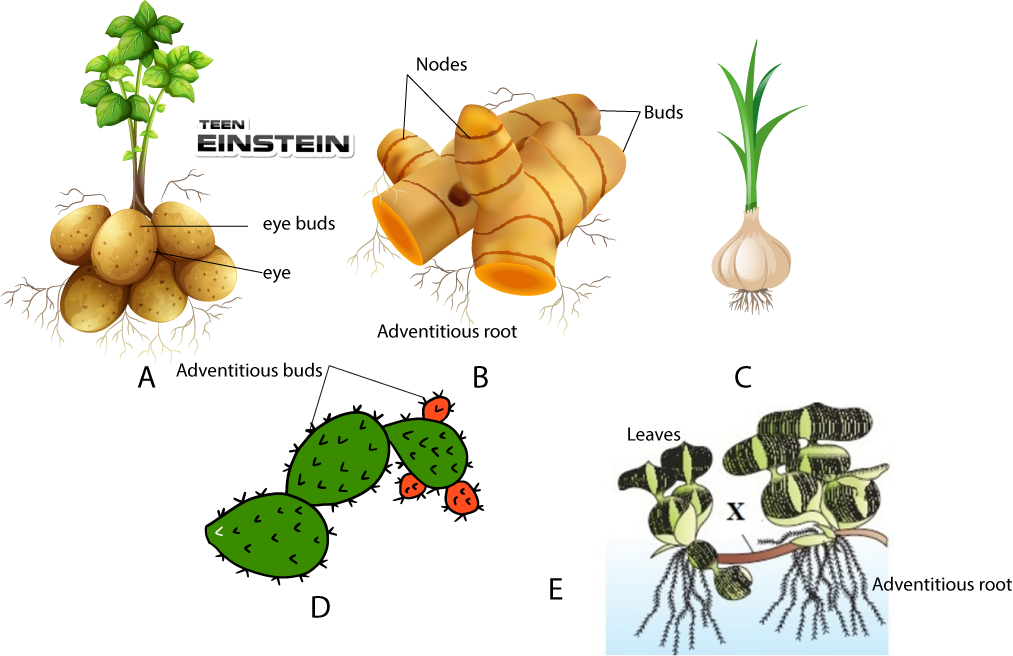
(a) Tuber Rhizome Bulb Leaf buds(b) Offset Sucker Stolon Leaf buds(c) Offset Stolon Sucker Leaf buds(d) Tuber Rhizome Bulbil Leaf buds 54. The given figure represents the events marked as (A, B, C and D) in the life of general reproduction. Identify the events A, B, C and D.
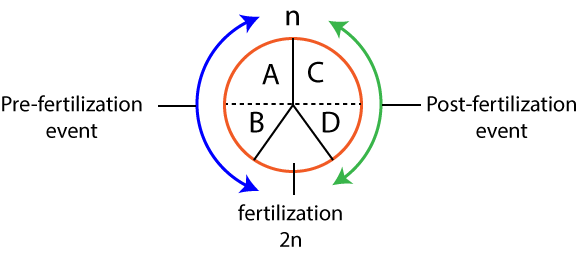
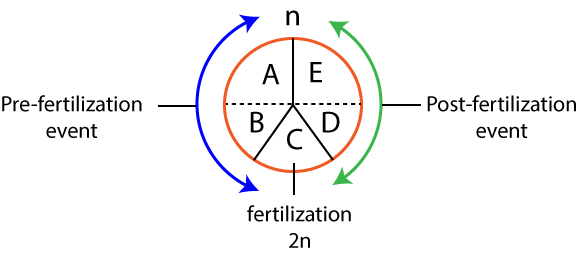
(a) A-Gamete transfer, B-Gametogenesis, C-Zygote formation, D-Embryogenesis(b) A-Gametogenesis, B-Gamete transfer, C-Zygote formation, D-Embryogenesis(c) A-Gametogenesis, B-Zygote formation, C-Gamete transfer, D-Embryogenesis(d) A-Gametogenesis, B-Gamete transfer, C- Embryogenesis, D-Zygote formation. 55. The given figure refers to which type of reproduction in yeast?
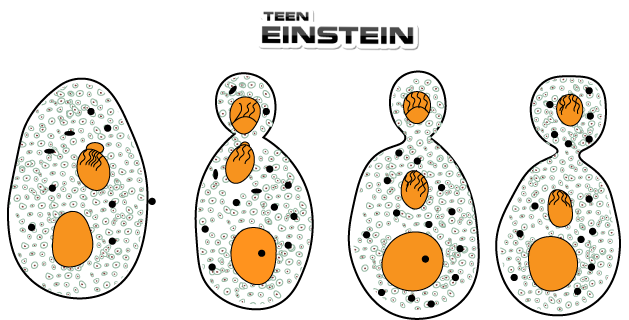
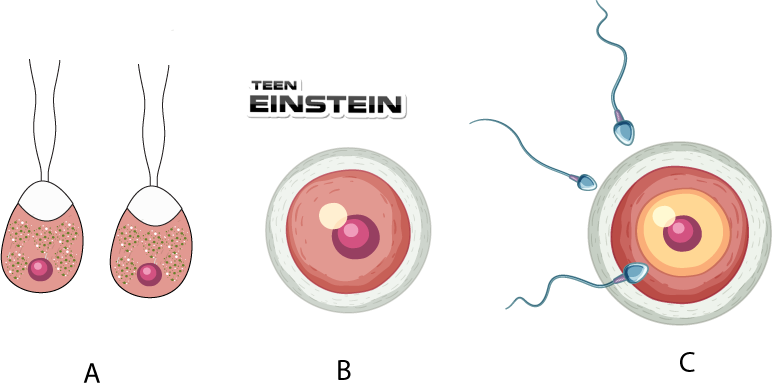
(a) Binary fission(b) Budding(c) Layering(d) Fusion 56. The given figures (A, B and C) are types of gametes of different organisms. Identify gametes (A, B and C) respectively.
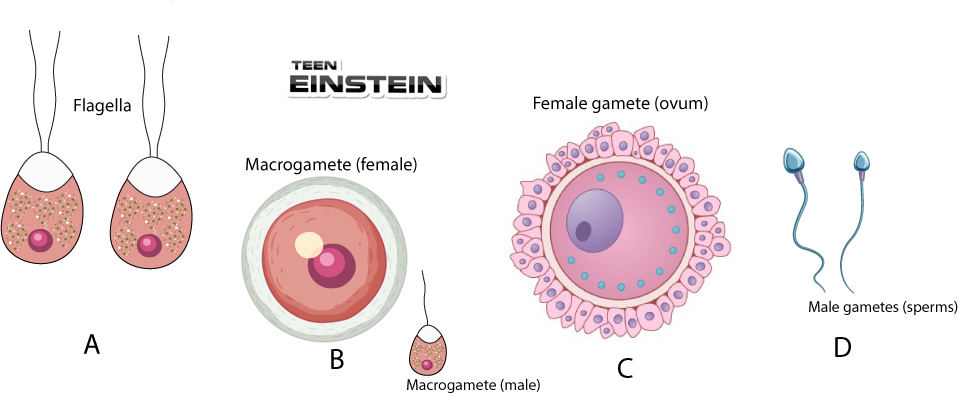
(a) Heterogametes, Isogametes, Homogametes(b) Isogametes, Homogametes, Heterogametes(c) Homogametes, Isogametes, Heterogametes(d) Homo/Isogametes, Heterogametes, Heterogametes 57. The given figures (i to v) represent the process of binary fission in Amoeba.
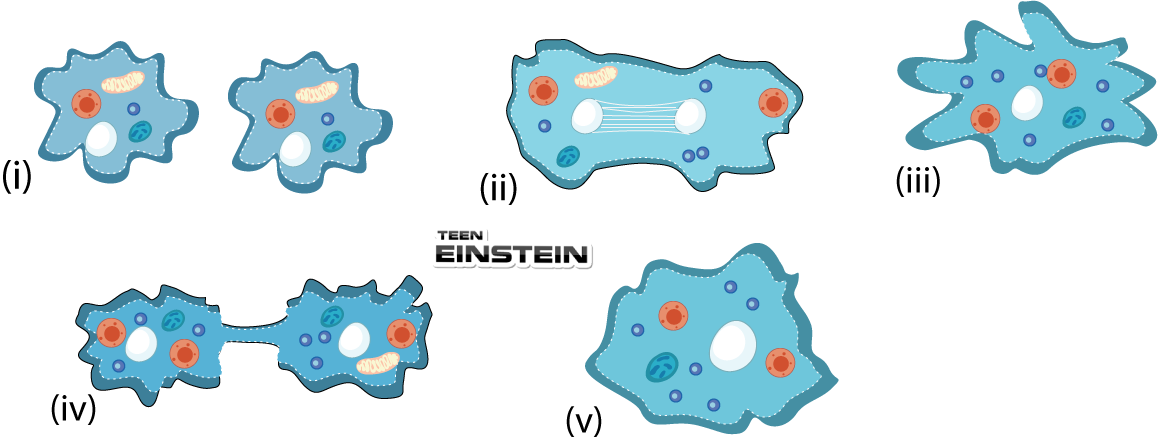
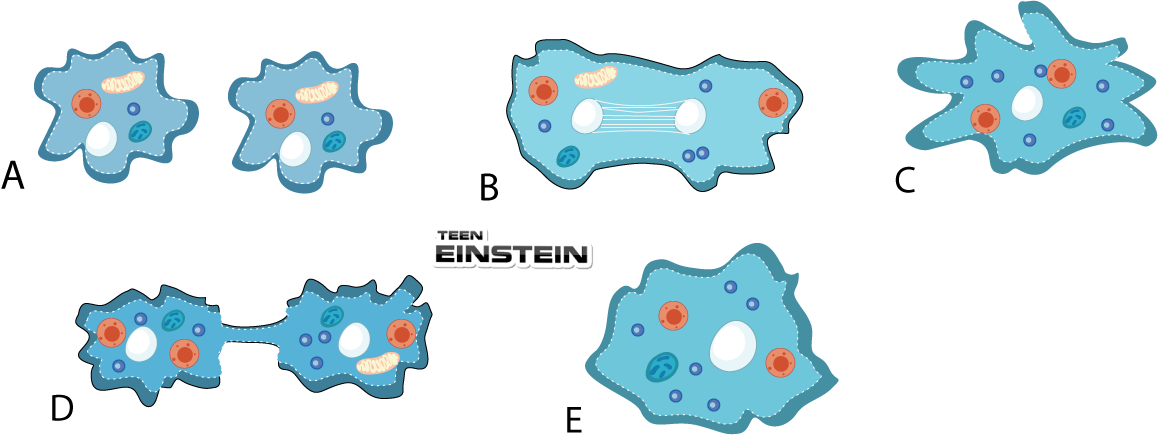
Arrange the figures in the correct sequence and choose the correct option.(a) (iv) --> (iii) --> (i) --> (ii) --> (v)(b) (iii) --> (iv) --> (i) --> (ii) --> (v)(c) (iii) --> (v) --> (ii) --> (iv) --> (i)(d) (iv) --> (iii) --> (ii) --> (v) --> (i) 58. Which of the labelled parts (X and Y) in the transverse section of pea plant is/are diploid ?
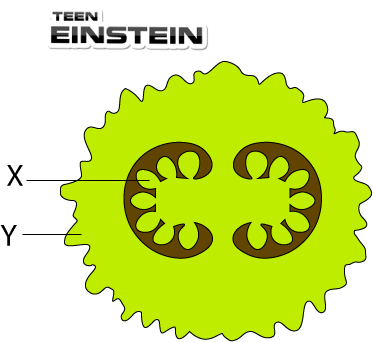
(a) X(b) Y(c) Both X and Y(d) None of these 59. The given figures P (plant Chara) and Q (earthworm) have label A, B, C and D as their reproductive organs. Select the option which correctly identifies male reproductive organs of the two organisms.
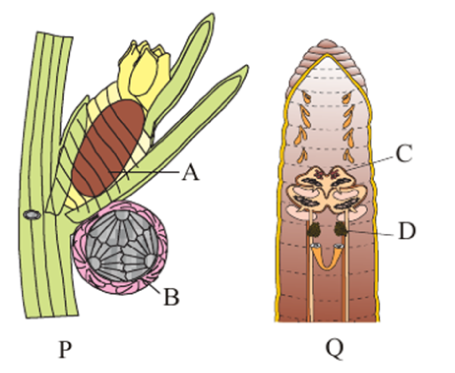
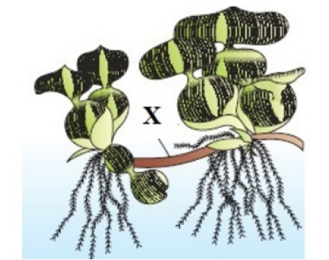
(a) A and B(b) B and C(c) A and C(d) B and D 60. In the given figure of water hyacinth, a structure is marked as "X". This structure is involved in vegetative propagation as a unit of vegetative propagules. Identify the type of unit.
(a) Tuber(b) Offsets(c) Sucker(d) Rhizome 61. If basal half of an onion bulb is removed and upper half is sown in the ground then the new plant will(a) emerge normally.(b) not emerge.(c) be without leaves. (d) be without flowers. 62. If soil around stem of potato plant is constantly removed from very young stage then only roots remain in the soil then the potato tubers in plant will(a) be larger(b) be smaller(c) be formed normally (d) not be formed 63. The site of origin of the new plantlets in potato, dahlia, ginger and banana is(a) floral buds present on stem.(b) internodes of modified stem.(c) nodes of modified stem.(d) adventitious buds present on root. 64. Which is the most common method of reproduction in majority of fungi and bacteria ?(a) Binary fission(b) Multiple fission(c) Budding(d) Spore formation 65. A feature of reproduction that is common to Amoeba, Spirogyra and yeast is that(a) they reproduce asexually.(b) they are all unicellular.(c) they reproduce only sexually.(d) they are all multicellular. 66. Sexual reproduction involves(a) meiosis only.(b) meiosis and fusion of gametes.(c) both mitosis and meiosis.(d) all of the above 67. Some organisms are capable of asexual or sexual reproduction. Under favourable conditions, reproduction proceeds asexually. When conditions become more stressful reproduction switches to a sexual mode. Why?(a) Sexual reproduction is simple and more rapid allowing larger numbers of offspring to be produced.(b) Sexual reproduction requires two separate individuals, who can mutually provide nutrient support during stress.(c) Sexual reproduction produces individuals with new combinations of recombined ch romosomes increasing diversity.(d) Asexual reproduction requires more energy. 68. Seeds are regarded to be the product of sexual reproduction because they(a) can be stored for a long period.(b) give rise to new plants.(c) are the result of fusion of male gamete with the female gamete.(d) none of the above 69. After culturing the anther of a plant, a few diploid plants were found along with haploid plants. The diploid plants could have arisen from(a) generative cell of pollen.(b) cells of anther wall.(c) vegetative cell of pollen.(d) exine of pollen wall. 70. "X" is the vital link that ensures continuity of species between organisms of one generation to the next. Every sexually reproducing organism begins life as a single cell "X". Identify "X".(a) Zygote(b) Gamete(c) Embryo(d) None of the above 71. Which of the following has to occur if a diploid body has to produce haploid gametes?(a) Meiosis (b) Mitosis(c) Fertilization(d) Embryo transfer 72. Development of zygote depends on(a) life cycle of the organism(b) environment it is exposed to(c) both (a) and (b)(d) nutrition of organism 73. Meiocytes is observed in all except(a) human egg(b) blue-green algae(c) equisetum(d) dicot plant 74. In a practical test, a student has to identify the organisms in which syngamy does not occur. In those organisms the female gamete undergoes development to form neworganisms without fertilization. This phenomenon is called "X". Identify the organisms and the phenomenon "X".(a) Frog, Parthenogenesis(b) Lizards, Gametogenesis(c) Rotifers, Embryogenesis(d) Honeybee, Parthenogenesis 75. Which of the followings sequences are correct for plants and animals?(i) animals Juvenile phase ® Senescent phase ® Reproductive phase(ii) animals Juvenile phase ® Reproductive phase ® Senescent phase(iii) plants Reproductive phase ® Juvenile phase ® Senescent phase(iv) plants animals Vegetative phase ® Reproductive phase ® Senescent phase (a) (i) and (iii)(b) (i) and (iv)(c) (ii) and (iii)(d) (ii) and (iv) 76. Offsprings of oviparous animals are at greater risk as compared to offsprings of viviparous animals because(a) proper embryonic care and protection is lesser.(b) embryo is not developed.(c) progenies are with more variation.(d) progenies are larger. 77. Find out the correct statement -(a) Life spans of organisms are necessarily correlated with their sizes(b) The sizes crows and parrots are not very different, so their life spans are almost similar(c) A peepal tree has much shorter life span as compared to a mango tree(d) Reproduction is essential for continuity cf species on the earth 78. Find out the organism with highest life span -(a) Tortoise(b) Horse(c) Dog(d) Fruit fly 79. "How organisms reproduce" - depends upon –(a) Habitat of organisms.(b) Internal physiology of organisms(c) Genetic make up(d) All of the above factors 80. Which of the following parts are used for reg. repdn in pistia-(a) Runners(b) Offsets(c) Suckers(d) Stolar 81. Bamboo species Hovers-(a) Every year(b) Once is 12 years(c) Only once in life tim(d) Twice is in 50-100year 82. Which of the following is a false statement?(a) All organisms have evolved similar mechanism to multiply and produce offsprings(b) Asexual reproduction is uniparental(c) Sexual reproduction is biparental(d) In asexual reproduction no fertilization occurs 83. Asexual reproduction is common -(a) Among single celled organisms only(b) Among plants only(c) Among single celled organisms, plants and all animal(d) Among single celled animals, plants and animals with simple organizations 84. Seeds are called products of semual reproduced because they-(a) Give rise to new plants(b) Are formed by fusion of gametes(c) Can be stored for a long time(d) Are formed by fusion of pollar tubes 85. The chromosome number in Laploid in-(a) Gameter(b) Zygote(c) Seed(d) Embargo 86. The above figure refers to which type of reproduction in yeast?
(a) Binary fission(b) Budding(c) Layering(d) Embargo 87. In animals and other simple organisms uniparental reproduction is called, called _______ reproduction(a) vegetative, asexual(b) Asexual, vegetative(c) Parthenogenetic, Amphimictic(d) A" phimictic, Apomictic 88. Which of the following is not vegetative propagule?(a) Rhizome and sucker(c) bulbil (e.g. in Agave), leaf buds, bulb(b) Tuber and offset(d)Antherozoid 89. Examine the figures given below and select the right options out of (a - d); in which all the 4 items A, B, C and D are identified correctly -
(a) Tuber, Rhizome, Bulb, Leaf buds(b) Offset, Sucker, Stolon, Leaf buds(c) Offset, Sucker, Stolon, Leaf buds(d) Tuber, Rhizome, Bulbil, Leaf buds 90. Vegetative propagation in mint occurs by-(a) offset(b) Rhizome(c) Sucker(d) Runner 91. In which of the following organism, self fertilisation in seen.(a) Fish(b) Roundworm(c) Earth worm(d) River flike 92. A. The plant was introduced in India because of its beautiful flowers and shape of leavesB. It can propagate vegetatively at a phenomenal rate and spread all over water body in a short periodC. It is very difficult to get rid off these plants A to C points are related to -(a) Dahlia(b) Water hyacinth(c)Azolla (water fern)(d) Mosses 93. The fastest method to obtain clones is through -(a) induced mutation(b) parasexual hybridization(c) parthenogenesis(d) vegetative reproduction 94. Some organisms are capable of asexual or sexual reproduction. Under favourable conditions, reproduction proceeds asexually.When conditions become more stressful reproduction switches to a sexual mode. Why?(a) Sexual reproduction is simple and more rapid allowing larger numbers of offspring to be produced(b) Sexual reproduction requires two separate individuals, who can mutually provide nutrient support during stress(c) Sexual reproduction produces individuals with new combinations of recombined chromosomes increasing diversity(d) Asexual reproduction requires more energy 95. Identify A to D in given diagrams showing asexual reproductive structure
(a) A - Zoogamete, B - Conidia, C - Bud, D – Gemmule(b) A - Zoospore, B - Conidia, C - Bud, D – Gemmuie(c) A - Zoospore, B - Conidiosporangium, C - Bud, D – Gemmule(d) A-Aplanospore, B - Conidia, C - Bud, D - Gemmule 96. Among the following which one is not a method of asexual reproduction(a) Budding (e.g. yeast)(b) Layering(c) Sowing(d) Binary fission 97. In Monerans (e.g. bacteria) and Protists (Amoeba, Paramecium, Euglena, etc) asexual reproduction occurs by-(a) Budding(b) Multi fission(c) Binary fission(d) Amphimixis 98. Clone is the product of-(a) Sexual reproduction(b) Sexual or asexual reproduction(c) Amphimixis(d) Asexual reproduction 99. Individuals of a clone-(a) Are genetically similar but morphologically different(b) Are morphologically similar but genetically different(c) Are morphologically and genetically similar(d) Are genetically and phenotypically different 100. A scion in grafted on stock. The quality of fruits produced will be determined by the gero type of-(a) Stock(b) Scion(c) Both Stock and Scion(d) Neither stock or scion 101. Which of the following sequences of organisms is correct in respect of life spans?(a) Banyan tree > Parrot > Elephant > Crocodile > Crow (b) Crow > Crocodile > Elephant > Parrot > Banyan tree(c) Banyan tree > Elephant > Crocodile > Parrot > Crow (d) Crow > Parrot > Elephant > Crocodile > Banyan tree 102. No individual is immortal except-(a) Single celled organisms (b) Green plants(c) Sponges(d) Drones 103. The period from birth to the natural death of an organism represents-(a) Reproductive phase(b) Life cycle(c) Life span(d) Life style 104. Which of the following statements is false?(a) Asexual reproduction is simpler than sexual reproduction(b) Asexual reproduction occurs by fission, budding and fragmentation(c) In most of the animals both asexual and sexual modes of reproduction are found(d) Vegetative and sexual modes of reproduction are exhibited by the higher plants 105. Which of the following is cultivated through vegetative propagation -(a) Potato and Sugarcane(b) Banana and Ginger(c) Dahlia and Rose(d) All 106. Which of the following animal is laving longitudinal binary fission.(a) Euglena(b) Plasmodium(c) Planaria(d) Paramoecium 107. Select the correct sequence from the following.I. Juvenile phase —> Senescent phase —> Reproductive phaseII. Juvenile phase —> Reproductive phase —•> Senescent phaseIII. Reproductive phase —» Juvenile phase —> Senescent phaseIV Vegetative phase —> Reproductive phase —> Senescent phase(a) I and II(b) I and IV(c) III and IV(d) II and.IV 108. Select the correct sequence from the following -(a) Gametogenesis —» Syngamy -—> Zygote —» Embryogenesis(b) Gametogenesis —» Syngamy —» Embryogenesis —> Zygote(c) Zygote —> Embryogenesis —> Gametogenesis(d) Syngamy —> Gametogenesis —> Zygote —> Embryogenesis 109. Spermatids are transformed into spermatozoa by-(a) Spermitation(b) Supermatogenesis(c) Supermiogenesis(d) Supermatosis 110. Which of the following plants do not show clear cut vegetative, reproductive and senescent phase?(a) Perennial plants(b) Annual plants(c) Biennial plants(d) Either b or c 111. Which of the following is correct about Strobilanthus kunthiana?(a) It flowers once in 12 years.(b) The plant came to flower last time in September-October 2006.(c) Its mass flowering converted large hilly tracts of Kerala, Karnataka and Tamil Nadu into blue stretches that attracted a large number of tourists(d)AII 112. Which of the following regulates the reproductive processes and the associated behavioural expressions of organisms?(a) Hormones(b) Environmental factors(c) Abiotic components(d) Interaction between hormones and environmental factors 113. Identify the events (A, B, D and E) in life of genera! reproduction -
(a) A- Gamete transfer, B - Gametogeneis, D - Zygote formation, E –Embryogenesis(b) A- Gametogeneis, B - Gamete transfer, D - Zygote formation, E –Embryogenesis(c) A- Gametogeneis, B - Zygote formation, D - Gamete transfer, E -Embryogenesis(d) A- Gametogeneis, B - Gamete transfer, D - Embryogenesis, E - Zygote formation 114. Which of the following in a hermaphrodite-(a) Ant(b) Aphids(c) Earthworms(d) Cockroach 115. Identify gametes (A, B and C) respectively -
(a) Heterogametes, isogametes, Homogametes(b) Isogametes, homogametes, heterogametes(c) Homogametes, isogametes, heterogametes(d) Homo / Isogametes, heterogametes, heterogametes 116. Which of the following statements is true about water hyacinth?(a) It gives useful products to be used in medicine(b) It is a marine plant(c) It takes oxygen from water which causes death of fishes(d) It is being cultivated in sea water for biogas 117. In flowering plants both male and female gametes are non-motile. The method to bring them together foffertilization is (a) Water only(b) Air only(c) Pollination(d)Apomixis 118. Meiosis-(a) does not take place in organisms showing asexual reproduction only(b) takes place in sexually reproducing haploid organism(c) takes place in sexually reproducing diploid organism(d) all of the above are correct 119. Offsprings of oviparous animals are at greater risk as compared to offsprings of viviparous animals because -(a) Proper embryonic care and protection is lesser(b) Embryo is not developed(c) Progenies are with more variation(d) Progenies are larger 120. In majority of organisms male gamete is _______ and female gamete is ________.(a) Motile, motile(b) Non-motile, non-motile(c) Non-motile, motile(d) Motile, stationary (non-motile) 121. Transverse binary fission occurs in-(a) Euglena(b) Amoeba(c) Hydra(d) Paramecium 122. Oestrus cycle is seen in -(a) Cows and sheep(b) Rats and deers(c) Dogs and tiger(d) AII 123. Menstrual cycle is reported in -(a) Only humans(b) Only apes(c) Only monkey(d) Primates like humans, apes and monkey 124. Animals which give birth to young ones are said to be -(a) Viviparous(b) Amphibious(c) Coelomates(d) Oviparous 125. Ploidy of ovary, anther, egg, pollen, male gamete and zygote are respectively -(a)2n, 2n, n, 2n, n,2n(b) 2n, 2n, n, n, n, 2n(c) 2n, n, n, n, n, n(d) 2n, 2n r n, 2n, 2n, 2n 126. Which of the following is viviparous?(a) Reptiles(b)Frog(c) All mammals(d) Majority of mammals 127. In small flies such as Miastor, reproduction occurs in larval stage, it is called-(a) neoteny(b) paedogenesis(c) patherogenesis(d) patherocoupy 128. Find the covert combination-(a) Zoospore in sponge(b) Conidia in Algae(c) Genmules in Pericillium(d) Buds in hydra 129. The motile reproductive structure of algae and fungi, which directly give rise to new individuals one called-(a) Cysts(b) Conidia(c) Buds(d) Zoospores 130. Ciliated motile spores are called-(a) Aplanospores(b) Conidia(c) Zoospores(d) Oospones 131. In grafting contact in made between-(a) Cambium(b) Flower(c) Xylen(d) Phloem 132. In grafting process, the callus is-(a) Formed by proliferation of exposed parachymateads cells of stock and scion(b) The protective padding fied around the plant(c) The tissue produced theo culture of explant and tied around the joint of stock and scion(d) Developed by the activity of the cambium of scion and stock 133. Birds in captivity (as in poultry farms) can be made to lay eggs throughout the year. In this case laying eggs is -(a) Related to reproduction and a commercial exploitation for human welfare.(b) Neither related to reproduction nor a commercial exploitation for human welfare.(c) Not related to reproduction but a commercial exploitation for human welfare(d) Related to reproduction but not a commercial exploitation for human welfare. 134. Which of the following are seasonal breeders?(a) frogs(b) Birds(c) Lizards(d) AII 135. In which of the following fertilized eggs are covered by hard calcareous shell?(a) Frog(b) Reptiles and birds(c) Mammals(d) Frog and Toad 136. Which of the following is a unisexual animal-(a) Clamworm (Nevis)(b) Earthworm (Phoretima) (c) Leach (Hiudinamia) (d) All the above 137. In which of the following water is essential for fertilization -(a) Algae(b) Bryophytes(c) Pteridophytes(d)AII 138. In heterogamous organisms the male gamete and female gametes are called respectively -(a) Spermatogonia, oogonia(b) Spermatid, ootid(c)Antherozoid (sperm), Egg (ovum)(d) Sperm and oospore 139. In grafting, the newly propagated plant cavies the genetic character-(a) Scion(b) Stock(c) Combination of stock and scion(d) The Lybind of stock and scion 140. Grafting in not possible in monocots as they-(a) one herbaceous(b) Lack cambium(c) have scattered vascular bindles(d) Lave parallel venation 141. In a majority of sexually reproducing organisms, the gametes are -(a) Isogametes(b) Homogametes(c) Hemigametes(d) Heterogametes 142. In grafted plant, stock lad 48 chromosome, while scion has 24 chromosomes the chromosome number in loot cells and eggs are-(a) 48 and 12(b) 24 and 12(c) 24 and 24(d) 48 and 24 143. Life span of may fly is-(a) 1 weak(b) 1 day(c) 1 month(d) 1 year 144. Life span of crocodile in-(a) 60 years(b) 30 years(c) 45 years(d) 15 years 145. "Nothing lives forever yet continues", explains the role-(a) Repoln is nature(b) Decomposition in nature(c) Adaptation is nature(d) Nutrition is nature 146. Which of the following groups of plants are propagated through undergoend root(a) Bupophyllum and kalnctoe(b) Geiger, potato, anion and zamikard(c) Pistia, chrysanthemum and pineapple(d) Sweet potato, Asparagines, Tapioca, Dahlia 147. Mater List I with List II and select the covert options.List-I List-IIA. Gemmules 1. AgaveB. Leaf buds 2. PericilliumC. Bulbil 3. planter hyacinthD. Offset 4. SpongesE. Conidia 5. Beyoptyllun (a) A-4, B-5, C-1, D-3, E-2(b) A-4, B-3, C-2, D-1, E-5(c) A-3, B-5, C-4, D-2, E-1(d) A-4, B-1, C-5, D-3, E-2 148. The diagram
(a) It is a type of parthenogenesis(c) The offsprigs can also be called as clave(b) It is a type of asexual reproduction(d) Both (a) and (c) 149. 1 Lifespan of tortoise is(a) 100-150 years(b) 250 years(c) 20 years(d) 1 year 150. Single-celled animals are said to be immortal because(a) they grow indefinitely in size(b) they can tolerate any degree of change in temperature(c) they can reproduce throughout their lifespan(d) they continue to live as their daughter cells 151. Arrange the organisms shown below in the increasing order of their lifespans.
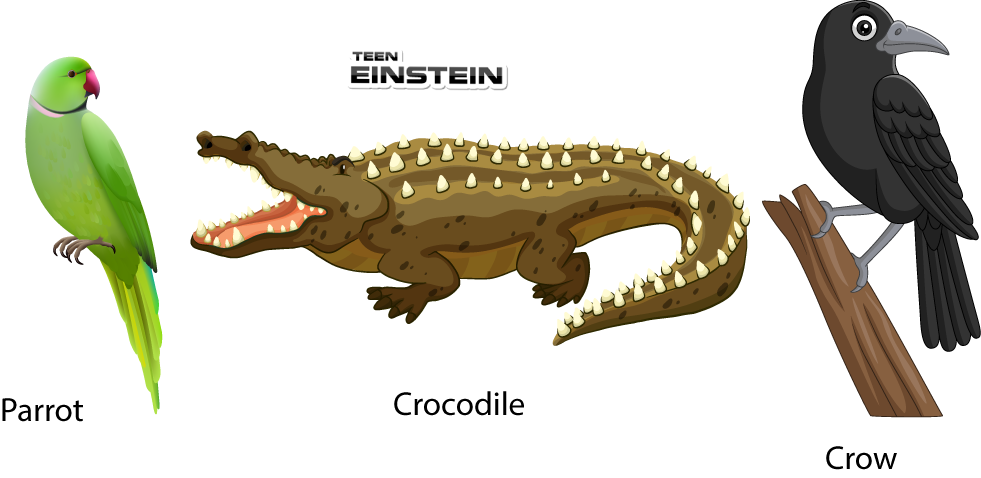
(a) Parrot < Crow < Crocodile(b) Crow < Crocodile < Parrot(c) Crocodile < Parrot < Crow(d) Parrot < Crocodile < Crow 152. Reproduction can be considered as(a) a biological process(b) a cycle of birth, growth and death(c) a process that enables continuity of species(d) All of the above 153. Study the given figures and processes representing the binary fission in Amoeba.
A. Daughter cells formationB. Enlargement of nucleusC. Parent cellD. Constricted cell formationE. Minimisation of pseudopodiaArrange the figures and processes in the correct sequence and select the correct answer.(a) D → C → A → B → E(b) C → D → A → B → E(c) C → E → B → D → A(d) D → C → B → E → A 154. Asexual reproduction is a method of reproduction in which participation of ……… takes place.(a) one individual(b) two individuals (same species)(c) multi-individuals(d) two individuals (different species) 155. Clones are(a) morphologically similar individuals(b) genetically similar individuals(c) Both (a) and (b)(d) None of the above 156. ....... is the fastest method to obtain clones.(a) Induced mutation(b) Parasexual hybridisation(c) Vegetative reproduction(d) Parthenogenesis 157. Asexual reproduction is common in(a) single-celled organisms(b) plants with relatively simple organisation(c) animals with relatively simple organisation(d) All of the above 160. Cell division is the mode of reproduction in(a) monerans(b) protists(c) Both (a) and (b)(d) None of the above 161. Reproduction in Amoeba is carried out through(a) gemmule formation (b) binary fission(c) budding (d) plasmotomy 162. In Amoeba, under unfavourable conditions, …A… takes place but under favourable conditions …B… occurs. Identify A and B. A B(a) Sporulation Encystation(b) Encystation Sporulation(c) Binary fission Encystation(d) Multiple fission Encystation 163. Zoospores are(a) motile gametes of Chlamydomonas(b) non-motile gametes of sponges(c) motile gametes of Hydra(d) non-motile gametes of Penicillium 164. Asexual reproductive structures found in Penicillium are(a) conidia (b) buds(c) gemmules (d) zoospore 165. Gemmule formation is a common mode of reproduction in(a) Hydra (b) sponge(c) Penicillium (d) Amoeba 166. Hydra reproduces by(a) Budding (b) Fragmentation(c) Gemmule formation (d) Both (a) and (b) 167. Study the following diagram and the information given below.
A. Zoospore of Chlamydomonas.B. Conidia of Penicillium.C. Buds in Hydra.D. Gemmules in sponge.All the above are(a) bodies involved in sexual reproduction(b) bodies involved in asexual reproduction(c) bodies of young ones(d) All the above are correct 168. Refer the given figures which show three different types of fission.
A. Longitudinal fissionB. Transverse fissionC. Multiple fissionSelect the option which correctly matches them with the organism in which they occur. A B C(a) Euglena Plasmodium Amoeba(b) Plasmodium Paramecium Euglena(c) Euglena Paramecium Escherichia(d) Euglena Paramecium Amoeba 169. 19 Which one of the following pairs is not correctly match?Modes of reproduction Examples(a) Offset Water hyacinth(b) Rhizome Banana(c) Binary fission Sargassum(d) Conidia Penicillium 170. Offsets are produced by (a) parthenocarpy (b) mitotic divisions(c) meiotic divisions (d) parthenogenesis 171. Refer to the given figures and identify X and Y in these.
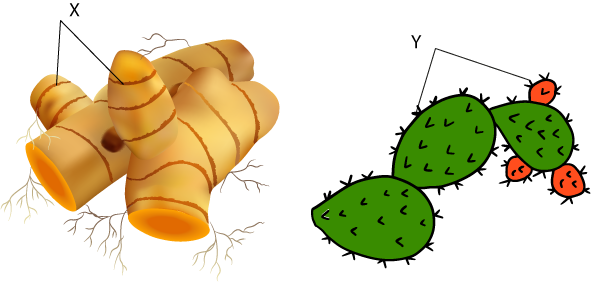
(a) X–Buds, Y–Nodes(b) X–Nodes, Y–Adventitious buds(c) X–Nodes, Y–Adventitious roots(d) X–Eyes, Y–Nodes 172. Which one of the following is correctly matched?(a) Onion – Bulb(b) Ginger – Sucker(c) Chlamydomonas – Conidia(d) Yeast – Zoospores 173. Choose the option with correct identification of A, B, C, D and E given below.
ABCDE
(a) TuberRhizomeEyesLeaf budsOffset
(b) OffsetEyesLeaf budsStolonSucker
(c) OffsetLeaf budsEyesStolonSucker
(d) TuberRhizomeBulbilLeaf budsOffset
174. Which of the following is not a vegetative propagule(a) Offset (b) Antherozoid(c) Rhizome (d) Bulbil 175. If a leaf cell of Agave have X chromosome, then what will be the number of chromosomes in a cell of its bulbil? (a) 2X (b) X (c) X/4 (d) X/2 176. Identify the plant which contains the features given below.I. The plant was introduced in India because of its beautiful flowers and shape of leaves.II. It can propagate vegetatively at a phenomenal rate and spread all over water body in a short period.III. It is very difficult to get rid of these plants.
175. The site of origin of the new plantlets in potato, Dahlia, ginger and banana is(a) floral buds present on stem(b) internodes of modified stem(c) nodes of modified stem(d) adventitious buds present on root 176. Which one of the following options shows two plants in which new plantlets arise from the same organ?(a) Guava and ginger(b) Potato and sweet potato(c) Dahlia and mint(d) Potato and sugarcane 177. Some organisms are capable of asexual or sexual reproduction. Under favourable conditions, reproduction proceeds asexually. When conditionsbecome more stressful reproduction switches to a sexual mode. Why?(a) Sexual reproduction is simple and more rapid allowing larger numbers of offspring to be produced(b) Sexual reproduction requires two separate individuals, who can mutually provide nutrient support during stress(c) Sexual reproduction produces individuals with new combinations of recombined chromosomes increasing diversity(d) Asexual reproduction requires more energy 178. A scion is grafted to a stock. The quality of fruits produced will be determined by the genotype of(a) stock (b) scion(c) Both (a) and (b) (d) Neither (a) nor (b) 179. Which one of the following generates new genetic combinations leading to variation? (a) Vegetative reproduction(b) Parthenogenesis(c) Sexual reproduction(d) Nucellar polyembryony 180. Sexual reproduction involves formation of male and female gametes by(a) same individual(b) different individual of opposite sex(c) Both (a) and (b)(d) All of the above 181. The growth phase of an organism before attaining sexual maturity is referred to as(a) juvenile phase (b) pre-reproductive phase(c) Both (a) and (b) (d) None of these 182. Select the correct sequence from the following.I. Juvenile phase→Senescent phase→Reproductive phaseII. Juvenile phase→Reproductive phase→Senescent phaseIII. Reproductive phase→Juvenile phase→Senescent phaseIV. Pre-reproductive phase→Reproductive phase→Senescent phase(a) I and II (b) I and IV(c) III and IV (d) II and IV 183. Which one of the following flowers only once in its lifetime? (a) Mango (b) Jackfruit(c) Bamboo species (d) Papaya 184. Strobilanthes kunthiana is also called(a) Neelakurinji (b) Peela kuranji(c) Hara kuranji (d) Kala kuranji 185. Oestrus cycle is cyclic change in the activities of ovaries and accessory duct in non-primates during(a) reproductive (seasonal) period(b) maturation period(c) ageing period(d) juvenile period 186. Organisms reproducing throughout the year are called …… breeders, e.g. … and those who show recurring sexual activity are called …… breeders, e.g. … .(a) continuous, sparrow, seasonal, hen(b) seasonal, lizard, continuous, hen(c) continuous, man, seasonal, tiger(d) seasonal, hen, continuous, tiger 187. Select the correct sequence of events.(a) Gametogenesis→ Gamete transfer → Syngamy → Zygote → Cell division (Cleavage) → Cell differentiation → Organogenesis(b) Gametogenesis→ Gamete transfer → Syngamy → Zygote → Cell divison (Cleavage) → Organogenesis→ Cell differentiation(c) Gametogenesis→ Syngamy → Gamete transfer → Zygote → Cell division (Cleavage) → Cell differentiation → Organogenesis(d) Gametogenesis→ Gamete transfer → Syngamy → Zygote → Cell differentiation → Cell division (Cleavage) → Organogenesis 188. Identify the events (A, B, D and E) of sexual reproduction given below.Choose the correct option.
(a) A–Gamete transfer, B–Gametogeneis, D–Zygote formation, E–Embryogenesis(b) A–Gametogeneis, B–Gamete transfer, D–Zygote formation, E–Embryogenesis(c) A–Gametogeneis, B–Zygote formation, D–Gamete transfer, E–Embryogenesis(d) A–Gametogeneis, B–Gamete transfer, D–Embryogenesis, E–Zygote formation 189. Identify the type of gametes shown in figure A, B and C, respectively.
(a) A–Heterogametes, B–Isogametes, C–Homogametes(b) A–Homogametes, B–Isogametes, C–Heterogametes(c) A–Isogametes, B–Heterogametes, C–Heterogametes(d) A–Heterogametes, B–Heterogametes, C–Isogametes 190. Name the type of gametes found in algae.(a) Homogametes (b) Heterogametes(c) Anisogametes (d) All of these 191. What is male gamete called in heterogametic condition?(a) Antherozoid (b) Sperm(c) Egg (d) Both (a) and (b) 192. The condition, in which, both male and female reproductive organs are found on the same plant, is called(a) unisexual (b) bisexual(c) monoecious (d) Both (b) and (c) 193. Figure P represents the reproductive organs of a plant, Chara and figure Q represents the reproductive organs of an animal, earthworm. Select the option which correctly identifies male reproductive organs of the two organisms.
(a) A and D (b) B and C (c) A and C (d) B and D 194. The condition in which male and female parts are present on different organisms, is called(a) heterothallic (b) dioecious(c) unisexual (d) All of these 195. In flowering plants, the unisexual male flower is called …A… while the female is called …B… . Flowering plants may be monoecious, e.g. …C… or dioecious, e.g. …D… .Complete the paragraph by filling up the blanks.(a) A–staminate, B–pistillate, C–date palm, D–coconut(b) A–pistillate, B–staminate, C–date palm, D–papaya(c) A–pistillate, B–staminate, C–Cucurbita, D–coconut(d) A–staminate, B–pistillate, C–Cucurbita, D–papaya 196. Name the type of gametes formed in staminate and pistillate flower, respectively.(a) Stamen, pollen (b) Antherozoid, egg(c) Stamen, ovum (d) Ovum, antherozoid 197. Which of the following is hermaphrodite?(a) Ant (b) Aphids (c) Earthworm (d) Cockroach 198. Which among the following is unisexual species?(a) Tapeworm (b) Leech(c) Cockroach (d) All of these 199. 51 If the parent body is haploid then the gametes are(a) haploid (b) diploid(c) triploid (d) None of these 200. In diploid organism the gamete producing cells are called
(a) gamete mother cell (b) meiocytes(c) Both (a) and (b) (d) None of these 201. Which of the following is an incorrect combination of organism with its correct chromosome number in meiocyte and in gamete?
Name of OrganismsChromosomes number in meiocyteChromosomes number in gamete
(a) Butterfly380190
(b) Potato1608
(c) Maize2010
(d) Apple3417
202. Identify the sequence of events shown in the diagram below.(a) Fission of gametes→ New individual → Zygote(b) Fusion of gametes→ Zygote → New individual (cell 2n)(c) Fission of gametes→ Zygote → New individual (cell 2n)(d) Stages in the gametogenesis 203. Self-fertilisation occurs in the(a) bisexual flower (b) unisexual flower(c) Both (a) and (b) (d) dioecious flower 204. In which of the following organisms self-fertilisation is seen?(a) Peas(b) Mustard(c) Sweet potato (d) All of these 205. Which of the following options is/are correct about pollination?(a) Occurs in almost all flowering plants(b) Facilitates pollen transfer to stigma(c) Both (a) and (b)(d) None of the above 206. Essential and most critical event in sexual reproduction is(a) fertilisation(b) division in male and female gametes(c) Both (a) and (b)(d) None of the above 207. Fusion of male and female gametes is called(a) syngamy (b) fertilisation(c) Both (a) and (b) (d) heterogamy 208. In some plants, the female gamete develops into embryo without fertilisation. This phenomenon is known as(a) parthenocarpy (b) syngamy(c) parthenogenesis (d) autogamy 209. Syngamy may occur in ………… .(a) external medium (b) internal medium(c) Both (a) and (b) (d) None of these 210. ‘Organisms exhibiting external fertilisation release a large number of gametes’. Why?(a) These organisms shows great synchrony between the sexes(b) In order to enhance the chances of syngamy(c) To produce large number of offsprings as they are vulnerable to predators(d) All of the above 211. Internal fertilisation is the one in which syngamy(a) occur outside the body(b) occur inside the body(c) is followed by meiosis(d) None of the above 212. Diploid zygote is universal in(a) All sexually reproducing organisms(b) All asexually reproducing organisms(c) All sexually and asexually reproducing organism(d) Only plants and animals 213. Life begins in all sexually reproducing organism from a(a) single-celled zygote (b) double-celled zygote(c) thick-walled zygote (d) All of these 214. Embryogenesis involves(a) formation of embryo from zygote(b) cell division via meiosis and differentiation(c) Both (a) and (b)(d) None of the above 215. Choose the incorrect pair.(a) Cell division in embryo – Increase the number of cells(b) Cell differentiation – Form specialised tissues and organs(c) Eggs covered by hard calcareous shell – Oviparous animals(d) Zygote develops outside the body –Viviparous animals 216. Chances of survival of young ones are more in the case of............. individuals.(a) oviparous (b) viviparous(c) ovoviviparous (d) None of these 217. Offsprings of oviparous animals have less chances of survival as compared to those of viviparous animals because(a) proper embryonic care and protection is absent(b) embryo does not develop completely(c) progenies are of smaller size(d) genetic variations do not occur 218. What does ‘P’ signifies in the diagram given below?
(a) Pistil (b) Thick pericarp(c) Thin pericarp (d) Pollen tube ■ Direction (Q. No. 219-228) In each of the following questions, a statement of Assertion (A) is given followed by corresponding statement of Reason (R).Of the statements, mark the correct answer as(a) If both A and R are true and R is correct explanation of A(b) If both A and R are true, but R is not the correct explanation of A(c) If A is true, but R is false(d) If A is false, but R is true 219. Assertion (A) A plant can be retained and multiplied indefinitely without any change or variation through asexual reproduction.Reason (R) Asexual reproduction does not involve meiosis and syngamy. 220. Assertion (A) Offspring formed by asexual reproduction are called clones.Reason (R) Clones are morphologically similar. 221. Assertion (A) Reproduction by zoospores occur in some higher fungi.Reason (R) Zoospores are motile and flagellated spores. 222. Assertion (A) Zygote is the link between two generations.Reason (R) Zygote is the product of two gametes and the producer of the next generation. 223. Assertion (A) Vegetative reproduction is a kind of asexual reproduction in plants.Reason (R) Vegetative propagules give rise to offspring. 224. Assertion (A) In perennial plant species, it is difficult to define vegetative, reproductive and senescent phases.Reason (R) Perennial plants have very short lifespan. 225. Assertion (A) Gametes formed in sexual reproduction are haploid in nature.Reason (R) Meiocytes undergo meiosis to form gametes. 226. Assertion (A) Papaya is a dioecious plant.Reason (R) Dioecious plants are those that have their reproductive structures on same plants. 227. Assertion (A) In external fertilisation, syngamy occurs inside the female.Reason (R) The offspring produced by external fertilisation are vulnerable to predators. 228. Assertion (A) In flowering plants, zygote is formed inside the ovule.Reason (R) The ovule develops into seed after fertilisation. 229. Which one of the following statements regarding post-fertilisation development in flowering plants is incorrect?(a) Zygote develops into embryo(b) Central cell develops into endosperm(c) Ovules develop into embryo sac(d) Ovary develops into fruit 230. Choose the incorrect statement about gemmules.(a) They resist dessication (b) They are internal buds(c) They are asexual structure which are produce by binary fission(d) They can give rise to new organisms 231. Which of the following statements is correct?(a) All the individuals of a species have exactly the same lifespan(b) Smaller organisms always have shorter lifespan and vice-versa(c) Lifespan of an organism is the time period from its birth to its natural death(d) No organism may have a lifespan of several hundred years 232. 84 Which one of the following statements is incorrect(a) Offspring produced by the asexual reproduction are called clone(b) Microscopic motile asexual reproductive structures are called zoospores(c) In potato, banana and ginger, the plantlets arise from the internodes present in the modified stem(d) Water hyacinth, growing in the standing water, drains oxygen from water that leads to the death of fishes 233. Mark the incorrect statement.(a) Perennial species shows clear cut vegetative, reproductive and senescent phases(b) End of vegetative phase mark the beginning of reproductive phase(c) Bamboo species flower only once in their lifetime(d) The reproductive phase is of variable duration in different organisms 234. Choose the incorrect statement for events in sexual reproduction.(a) All sexually reproducing organisms exhibits events and processess having fundamental similarity(b) Structures associated with sexual reproduction vary among different groups of organisms(c) Pre-fertilisation, fertilisation and post-fertilisation is the exact sequence of events occurring in sexual reproduction(d) None of the above 235. Which one of the following statements is incorrect?(a) Gamete receive only one set of chromosomes(b) Meiosis is a reductional division occurring in both haploid and diploid organisms(c) Male gametes are always produced in less quantity than female gametes(d) In seed plants, pollen grains are the carriers of male gametes 236. Go through the following statements.I. Cell division is a mode of reproduction in algae and fungi.II. Amoeba and Paramecium divide by fragmentation.III. In yeast, cell division is unequal and small buds are produced.IV. Zoospores are macroscopic non-motile structures.Choose the incorrect statements.(a) I and III (b) III and IV(c) I, II and IV (d) Only III 237. Read the following statements about asexual reproduction and select the correct ones.I. It involves a single parent.II. Itis slower than sexual reproduction.III. It produces progeny that are genetically identical with the parent, but not with one anotherIV. The progeny of asexual reproduction can be termed as clones.(a) I and II (b) II and III(c) I and IV (d) I, III and IV 238. Read the following statements and select the correct ones.I. Conidia are the asexual propagules restricted to kingdom–Fungi.II. A piece of potato tuber having at least one eye (or node) is capable of giving rise to a new plant.III. Ginger propagates vegetatively with the help of its underground roots.IV. Fleshy buds which take part in vegetative propagation are called bulbils, present in Dioscorea, Agave, etc.(a) II and III (b) I and IV(c) I, II and IV (d) I, II and III 239. Find out the incorrect statement.I. Lifespans of organisms are necessarily correlated with their sizes.II. The sizes of crows and parrots are not very different, but still their lifespans vary extremely.III. A peepal tree has much shorter lifespan as compared to a mango tree.IV. Reproduction is essential for continuity of species on the earth.(a) I and III (b) I, II and III(c) Only IV (d) II and III 240. Consider the following statements.I. Many plants propagate vegetatively even though they bearseeds.II. Sweet potatoes multiply vegetatively by root tubers.Select the correct option.(a) I is true, but II is false(b) Both I and II are false(c) I is false, but II is true(d) Both I and II are true 241. Read the following statements.I. Organisms exhibiting external fertilisation show great synchrony between the sexes and release a large number of gametes.II. A major disadvantage of external fertilisation is that the offspring are extremely vulnerable to predators.III. In gymnosperms, male gametes reach egg with the help of water as a medium.IV. Zygote is a vital link that ensures continuity of species between organisms of one generation and the next.V. Every sexually reproducing organisms begin their life as a single-celled zygote.Which of the above statements are correct?(a) I, II and III (b) I, II, III and V(c) I, II, IV and V (d) I, II, III and IV 242. Read the following statements.I. Eichhornia contributes extra oxygen to the water bodies which reduces the mortality of fishes.II. Zingiber propagates vegetatively by tap roots.III. Fleshy buds which take part in vegetative propagation are called bulbils, e.g. Agave.IV. A potato tuber having atleast one eye, i.e. axillary bud can form a new plant.V. Bryophyllum posssesss leaf buds.Which of the above statements is/are correct?(a) I, II and III(b) III, IV and V(c) I, II and V(d) I, II, III, IV and V 243. Read the following statements.I. The vegetative phase is of same duration in different organisms.II. Clear-cut vegetative, reproductive and senescent phases can be observed in monocarpic plants.III. Bambusa differs fromStrobilanthes kunthiana (Neelakurinji) in the length of juvenile phase and being monocarpic.IV. The end of juvenile/vegetative phase in angiosperms is seen when they come to flower.V. Sexual mode of reproduction is present in most animals.Which of the above statement is/are incorrect?(a) II, IV and V (b) II and III(c) III, IV and V (d) I and III 244. Read the following statements.I. Interaction between hormones and certain environmentalfactors regulate the reproductive processes and the associated behavioural expression of organisms.II. In animals, but not in plants, hormones are responsible for the transitions between juvenile, reproductive and senescent phases.III. After attainment of maturity, all sexually reproducing organisms exhibit events and processes that have remarkable fundamental similarity, though the structure associated with sexual reproduction are indeed very different.IV. The post-fertilisation events include gametogenesis and gamete transfer.V. In majority of the sexually reproducing organisms, the gametes produced are morphologically distinct types, i.e. heterogametes.Which of the above statements are correct?(a) I, III and V (b) I, II and IV (c) III, IV and V (d) II, III and V 245. Match the following columns.
Column I(Asexual reproduction types)Column II(Examples)
A. Binary fission1. Algae
B. Zoospore2. Amoeba
C. Conidium3. Hydra
D. Budding4. Penicillium
E. Gemmules5. Sponge
CODES
ABCDE
(a)14532
(b)21435
(c)12345
(d)14325
246. Match the following columns.
Column I(Terms)Column II(Examples)
A. Monoecious1. Cladophora
B. Dioecious2. Fucus
C. Isogametes3. Coconut
D. Heterogametes4. Papaya
CODES
ABCD
(a)4312
(b)1324
(c)3412
(d)3421
247. Match the following columns.
Column IColumn II
A. External fertilisation1. Human beings
B. Internal fertilisation2. Algae and fishes
C. Ovipary3. Bryophytes, pteridophytes and birds
D. Vivipary4. Reptiles and birds
CODES
ABCD
(a)4123
(b)3142
(c)2341
(d)4213
248. Match the following columns.
Column IColumn II
A. Oestrus cycle1. Spirogyra
B. Conjugation2. Rose
C. Stem cuttings3. Monkey, apes, humans
D. Menstrual cycle4. Cows, sheeps, rats
CODES
ABCD
(a)1324
(b)4123
(c)4132
(d)2143
249. Match the following columns.
Column I(Organisms)Column II(Number of chromosomes)
A. Human1. 2n=12
B. Fruit fly2. 2n=16
C. Onion3. 2n=46
D. House fly4. 2n=08
CODES
ABCD
(a)1243
(b)1432
(c)2143
(d)3421
250. Match the following columns.
Column I(Organisms)Column II(Reproduce by)
A. Ginger1. Tuber
B. Yeast2. Offset
C. Potato3. Rhizome
D. Water hyacinth4. Budding
CODES
ABCD
(a)4123
(b)3142
(c)3412
(d)4213
251. Match the following columns.
Column I(Floral parts)Column II(Converted to)
A. Ovary1. Pericarp
B. Ovule2. Perisperm
C. Ovary wall3. Fruit
D. Nucellus4. Seed
CODES
ABCD
(a)3412
(b)3214
(c)1234
(d)1324
252. A few statements with regard to sexual reproduction are given below.I. Sexual reproduction does not always require two individuals.II. Sexual reproduction generally involves gametic fusion.III. Meiosis never occurs during sexual reproduction.IV. External fertilisation is a rule during sexual reproduction.Choose the correct statements from the options given below.(a) I and IV (b) I and II (c) II and III (d) II and IV 253. The term ‘clone’ cannot be applied to offspring formed by sexual reproduction because(a) offspring do not possess exact copies of parental DNA(b) DNA of only one parent is copied and passed on to the offspring(c) offspring are formed at different times(d) DNA of parent and offspring are completely different 254. The male gametes of rice plant have 12 chromosomes in their nucleus. The chromosome number in the female gamete, zygote and the cells of the seedling will be, respectively(a) 12, 24, 12 (b) 24, 12, 12(c) 12, 24, 24 (d) 24, 12, 24 255. Amoeba and yeast reproduce asexually by fission and budding, respectively because they are(a) microscopic organisms (b) heterotrophic organisms(c) unicellular organisms (d) uninucleate organisms 256. Appearance of vegetative propagules from the nodes of plants such as sugarcane and ginger is mainly because(a) nodes are shorter than internodes(b) nodes have meristematic cells(c) nodes are located near the soil(d) nodes have non-photosynthetic cells 257. Choose the correct statement from amongst the following.(a) Dioecious organisms are seen only in animals(b) Dioecious organisms are seen only in plants(c) Dioecious organisms are seen in both plants and animals(d) Dioecious organisms are seen only in vertebrates 258. There are various types of reproduction. The type of reproduction adopted by an organism depends on(a) the habitat and morphology of the organism(b) morphology of the organism(c) morphology and physiology of the organism(d) the organism’s habitat, physiology and genetic makeup 259. Which of the following is a post-fertilisation event in flowering plants?(a) Transfer of pollen grains (b) Embryo development(c) Formation of flower (d) Formation of pollen grains 260. A few statements describing certain features of reproduction are given below.I. Gametic fusion takes place.II. Transfer of genetic material takes place.III. Reduction division takes place.IV. Progeny have some resemblance with parents.Select the options that are true for both asexual and sexual reproduction from the options given below.(a) I and II (b) II and III (c) II and IV (d) I and III 261. Asexual method of reproduction by binary fission is common to which of the following?I. Some eukaryotes II. All eukaryotesIII. Some prokaryotes IV. All prokaryotes(a) I and II (b) II and III (c) I and III (d) III and IV 262. A multicellular, filamentous alga exhibits a type of sexual life cycle in which the meiotic division occurs after the formation of zygote. The adult filament of this alga has(a) haploid vegetative cells and diploid gametangia(b) diploid vegetative cells and diploid gametangia(c) diploid vegetative cells and haploid gametangia(d) haploid vegetative cells and haploid gametangia 263. Given below are a few statements related to external fertilisation. Choose the correct statements.I. The male and female gametes are formed and released simultaneously.II. Only a few gametes are released into the medium.III. Water is the medium in a majority of organisms exhibiting external fertilisation.IV. Offspring formed as a result of external fertilisation have better chance of survival than those formed inside an organism.(a) III and IV (b) I and III (c) II and IV (d) I and IV 264. The statements given below describe certain features that are observed in the pistil of flowers.I. Pistil may have many carpels.II. Each carpel may have more than one ovule.III. Each carpel has only one ovule.IV. Pistil have only one carpel.Choose the statements that are true from the options given below.(a) I and II (b) I and III(c) II and IV (d) III and IV 265. Which of the following situations correctly describe the similarity between an angiosperm egg and a human egg?I. Eggs of both are formed once in a lifetime.II. Both the angiosperm egg and human egg are stationaryIII. Both the angiosperm egg and human egg are motile transported.IV. Syngamy in both results in the formation of zygote.Choose the correct answer from the options given below.(a) II and IV(b) Only IV(c) III and IV(d) I and IV 266. Which of the following statements, support the view that elaborate sexual reproductive process appeared much later in the organic evolution?I. Lower groups of organisms have simpler body design.II. Asexual reproduction is common in lower groups.III. Asexual reproduction is common in higher groups of organisms.IV. The high incidence of sexual reproduction in angiosperms and vertebrates.Choose the correct answer from the options given below.(a) I, II and III (b) I, III and IV(c) I, II and IV (d) II, III and IV 267. Offspring formed by sexual reproduction exhibit more variation than those formed by asexual reproduction because(a) sexual reproduction is a lengthy process(b) gametes of parents have qualitatively different genetic composition(c) genetic material comes from parents of two different species(d) greater amount of DNA is involved in sexual reproduction 268. There is no natural death in single-celled organisms like Amoeba and bacteria because(a) they cannot reproduce sexually(b) they reproduce by binary fission(c) parental body is distributed among the offspring(d) they are microscopic 269. Identify the incorrect statement.(a) In asexual reproduction, the offspring produced are morphologically and genetically identical to the parent(b) Zoospores are sexual reproductive structures(c) In asexual reproduction, a single parent produces offspring with or without the formation of gametes(d) Conidia are asexual structures in Penicillium 270. The number of chromosomes in the shoot tip cells of a maize plant is 20. The number of chromosomes in the microspore mother cells of the same plant will be(a) 20 (b) 10(c) 40 (d) 15 Key Answers
1C21A41A61B81C101A121D141D161A181C
2D22A42B62D82A102A122D142D162A182D
3A23A43B63C83D103C123D143B163B183C
4C24B44D64D84B104C124A144A164D184A
5C25A45D65A85A105D125B145A165B185A
6D26B46D66B86B106A126D146D166D186C
7B27D47C67C87B107D127B147A167C187A
8A28D48A68C88D108D128D148D168B188B
9B29C49A69B89D109C129D149A169B189C
10B30C50D70A90C110A130C150D170A190D
11A31A51B71A91D111D131A151B171D191D
12B32B52B72C92B112D132A152D172B192D
13D33C53D73B93D113B133C153C173B193B
14A34B54B74D94C114C134D154A174B194D
15B35B55B75D95B115D135B155C175C195D
16C36A56D76A96C116C136A156C176D196B
17A37A57C77D97C117C137D157D177C197C
18B38A58C78A98D118D138C158C178B198C
19D39C59B79D99C119A139A159B179C199A
20B40A60B80B100B120D140B160B180C200C
201B221D241C261C
202B222A242B262D
203A223B243D263B
204D224C244A264A
205C225A245B265B
206C226C246C266C
207C227D247C267B
208C228A248B268C
209C229C249D269B
210D230C250C270A
211B231C251A
212A232C252B
213A233A253A
214A234D254C
215D235C255C
216B236C256B
217A237C257C
218B238C258D
219A239A259B
220B240D260C