Classification of Elements and Periodicity in Properties
aContents:Dobereiner’s triadsNewland’s law of octavesMendeleev’s ClassificationFeatures of Mendeleev’s Periodic TableMoseley’s WorkModern periodic tablePlacement of Elements based on Electronic ConfigurationsVariation of Electronic Configuration along the periodsVariation of Electronic Configuration in the GroupsClassification of elements into blocks (s, p, d, f)Nomenclature of elements with Atomic numbers > 100Periodic Trends in propertiesAtomic radiusPeriodic Trends in Atomic radius Periodic Trends in Ionic radius Periodic Trend inIonisation energyPeriodic Trend inElectron AffinityPeriodic Trend inElectronegativityPeriodicity of Valence or Oxidation statesAnomalous properties of 2nd period elementsDiagonal relationshipPeriodic Trends &Chemical reactivityAcidic and basic nature of oxides3.1 IntroductionThere are millions of chemical compounds existing in nature with different compositions and properties, formed from less than 100 naturally occurring elements and currently, we have 118 known elements.With such a large number of elements, it is difficult to study the chemistry of these elements and their numerous compounds. Hence, scientists searched for a systematic way to organise their properties and several attempts were made to classify the elements.However, classification based on the atomic weights led to the construction of a proper form of periodic table.The periodic classification follows as a logical consequence of the electronic configuration of atoms.The aim here is to keep the elements of same properties in same place and classification is beneficial for the effective utilization of these elements.3.2 Dobereiner’s triadsDobereiner classified some elements with similar chemical properties into the group of three elements called as triads. In triads, the atomic weight of the middle element is nearly equal to the arithmetic mean of the atomic weights of the remaining two elements. This statement is called the Dobereiner’s law of triads.However, making groups in the form of triad can be applied only to a limited number of elements.
TriadAtomic mass
Lithium7
Sodium23
Potassium39
Atomic mass of Na= (7+39)/2 = 23
TriadAtomic mass
Chlorine 35.5
Bromine80
Iodine127
Atomic mass of Br= (35.5+127)/2 = 81.25
TriadAtomic mass
Calcium40
Strontium88
Barium137
Atomic mass of Sr= (40+137)/2 = 88.5
Limitations:Dobereiner could identify only three triads from the elements known at that time and all elements could not be classified in the form of triads.The law was not applicable to elements having very low atomic mass and very high atomic mass.3.3 Newland’s law of octavesNewlands arranged the then known elements in increasing order of their atomic masses and noted that every 8th element had properties similar to those of 1st. This is called Newland’s law of octaves. He compared this similarity with the octaves of music and arranged the elements having similar properties under the same note.
sa(do)
re(re)
ga(mi)
ma(fa)
pa(so)
da(la)
ni(ti)
H
Li
Be
B
C
N
O
F
Na
Mg
Al
Si
P
S
Cl
K
Ca
Cr
Ti
Mn
Fe
Co & Ni
Cu
Zn
Y
In
As
Se
Br
Rb
Sr
Ce& La
Zr
-
-
LimitationsThe law of octaves holds good for lighter elements up to calcium.Newlands’ table was restricted to only 56 elements and there is no room for new elements.Discovery of inert gases at later stage made the 9th element similar to the 1st one.3.4 Mendeleev’s ClassificationIn 1868, Lothar Meyer had developed a table of the elements having closeresemblance with the modern periodic table. He plotted the physical properties such as atomic volume, melting point and boiling point against atomic weight and observed a periodical pattern in those properties. During same period, Dmitri Mendeleev independently proposed that “the properties of the elements are the periodic functions of their atomic weights” and this is called periodic law. Mendeleev listed the known elements present at that time in several vertical columns in order of increasing atomic weights. Dobereiner started the study of periodic relationship in elements but it was Mendeleev who was responsible for publishing the Periodic Law for the first time.
Group
I
II
III
IV
V
VI
VII
VIII
Oxide Hydride
R2O RH
RO RH2
R2O3 RH3
RO2 RH4
R2O3 RH3
RO3 RH2
R2O7 RH
RO4
Periods
A B
AB
A B
AB
AB
AB
AB
Transition series
1
H 1.008
2
Li 6.931
Be 9.012
B 10.81
C 12.011
N 14.007
O 15.999
F 18.988
3
Na 22.99
Mg 22.99
Al 24.31
Si 28.09
P 30.974
S 32.06
Cl 35.453
41st series2nd series
K 39.102 Cu 63.54
Ca 40.08 Zn 65.54
Sc 44.96 Ga 69.72
Ti 47.90 Ge 72.59
V 50.94 As 74.92
Cr 50.20 Se 78.96
Mn 54.94 Br 79.909
Fe Co Ni 55.8 58.9 8.71
51st series2nd series
Rb 85.47 Ag 107.87
Sr 87.62 Cd 112.40
Y 88.91 In 114.82
Zr 91.22 Sn 118.69
Nb 92.91 Sb 121.60
Mo 95.94 Te 127.60
Tc 99 I 126.90
RuRbPd 101.1102.9 106.4
6 1st series2nd series
Cs 132.90 Au 196.97
Ba 137.34 Hg 200.59
La 138.91 Tl 204.37
Hf 178.40 Pb 207.19
Ta 180.95 Bi 208.98
W 183.85
OsIrPt 190.2192.2 195.1
7
Rn 222
Fr 223
Ra 226
Ac 227
Th 232
Pa 231
U 238
3.4.1 Features of Mendeleev’s Periodic TableIt has eight vertical columns called ‘groups’ and seven horizontal rows called ‘period’.Each group has two subgroups ‘A’ and ‘B’ and all the elements appearing in a group were found to have similar properties.For the first time, elements were comprehensively classified in such a way that elements of similar properties were placed in the same group.Some of the elements did not fit in with his scheme of classification if the order of atomic weight was strictly followed. For example, the atomic mass of Be was known to be 14 but he considered it as 9 and assigned Be a proper place.He left some blank spaces since there were no known elements with the appropriate properties at that time. He and others predicted the physical and chemical properties of the missing elements. e.g: Mendeleev gave names EkaAluminium and Eka Silicon to those elements which were to be placed below Al and Si respectively.Eventually these missing elements; gallium (Ga) and germanium (Ge) were discovered and found to have the predicted properties.
Property
Eka-aluminium (predicted)
Gallium (observed)
Eka-silicon (Predicted)
Germanium (observed)
Atomic wt.
68
70
72
72.59
Density (g/cm3)
5.9
5.94
5.5
5.35
Melting point
Low
29.78 oC
High
947 oC
Formula of oxide
E2O3
Ga2O3
EO2
GeO2
Formula of chloride
ECl3
GaCl3
ECl4
GeCl4
Properties predicted for Eka-aluminium&Eka-silicon3.4.2 Anomalies of Mendeleev’s Periodic Table Non-metallic H was placed along with metals like Li, Na and K. Isotopes were not given separate place as they have different atomic mass. The increasing order of atomic mass could not be maintained. e.g. Co & Ni, Te& I Elements with large difference in properties were included in the same group. e.g: Hard metals like Cu and Ag were placed with soft metals Na and K.3.5 Moseley’s Work
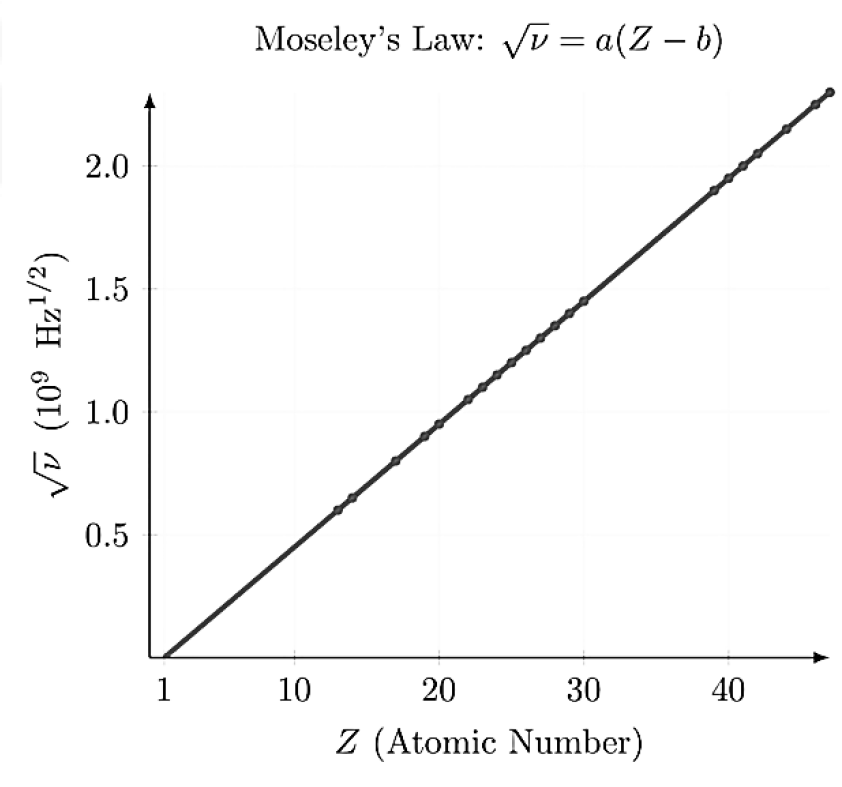
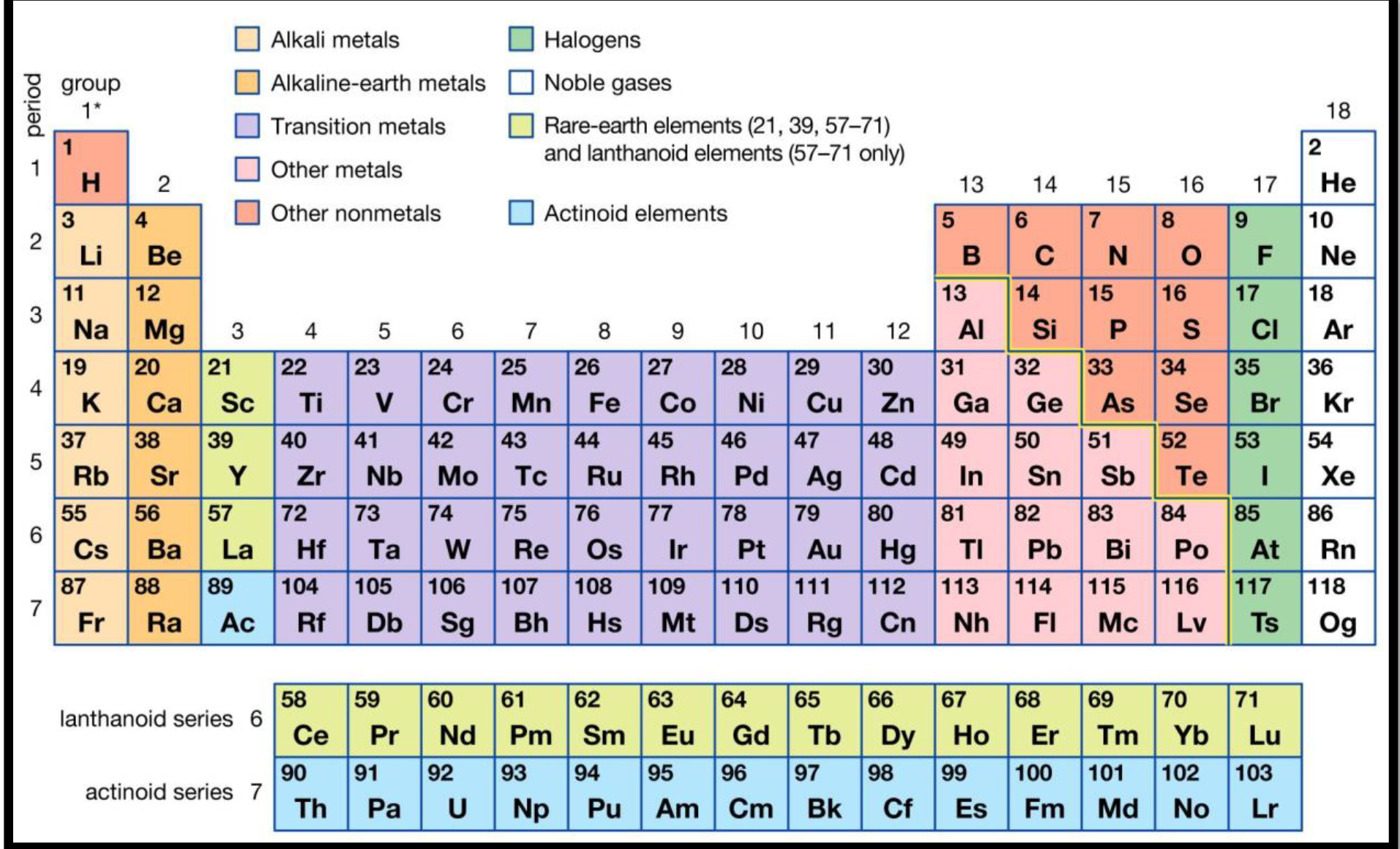
In 1913, Henry Moseley carried out a systematic series of experiments which showed that the frequencies of the X-rays emitted from an elemental target under bombardment by cathode rays were characteristic of that element and could be used to identify the charge on its atomic nucleus.He observed a linear correlation between atomic number and the frequency of X-rays emitted.√ν= a(Z− b)Where, ν is the frequency of the X-rays emitted by the element with atomic number ‘Z’; a and b are constants (same values for all the elements). This led to a modification of the periodic table, with elements now arranged on the basis of atomic number Z rather than atomic weight A.3.6 Modern Periodic tableBased on Moseley’s work, the modern periodic law was developed which states that, “the physical and chemical properties of the elements are periodic functions of their atomic numbers.” The physical and chemical properties of the elements are correlated to the arrangement of electrons in their outermost shell (valence shell). Different elements having similar outer shell electronic configuration possess similar properties. The repetition of physical and chemical properties at regular intervals is called periodicity. Though numerous forms of Periodic Table have been devised from time to time, a modern version, the “long form” of the Periodic Table of the elements is the most convenient and widely used. There are 18 vertical columns called Groups and 7 horizontal rows called Periods. Groups are numbered 1-18 in accordance with the IUPAC recommendation which replaces the old numbering scheme IA to VIIA, IB to VIIB and VIII. Each period starts with ns1 and ends with np6 and this ‘n’ correspond to the period number (principal quantum number).In the modern periodic table, the elements are placed in 7 periods and 18 groups based on the modern periodic law and having direct connection to its outer shell electronic configuration (E.C.).
3.6.1 Variation of Electronic Configuration along the periodsThe period points out the value of n (energy level), the principal Q. N. for the outermost or valence shell. The number of elements in each period is twice the number of atomic orbitals available in the energy level that is being filled.
Period no.(n)
Filling of electrons in orbitals
No. of electrons
Outer shell E. C.
Starts from
Ends with
First element
Last element
1
1s
1s
2
H - 1s1
He – 1s2
2
2s
2p
8
Li - 2s1
Ne – 2s22p6
3
3s
3p
8
Na – 3s1
Ar – 3s23p6
4
4s
3d
4p
18
K – 4s1
Kr – 4s24p6
5
5s
4d
5p
18
Rb – 5s1
Xe – 5s25p6
6
6s
4f 5d
6p
32
Cs – 6s1
Rn – 6s26p6
7
7s
5f 6d
7p
32
Fr – 7s1
Og – 7s27p6
The 1st period starts with the filling of valence electrons in 1s orbital, with accommodation capacity of two electrons. Hence, the 1st period has two elements, namely H and He. The 2nd period starts with the filling of valence electrons in 2s orbital followed by three 2p orbitals with 8 elements from Li to Ne. The 3rd period starts with filling of valence electrons in the 3s orbital followed by 3p orbitals with 8 elements from Na to Ar. The 4th period starts with filling of valence electrons from 4s orbital followed by 3d and 4p orbitals. Here, the filling of 3d orbitals starts with Sc and ends with Zn. These 10 elements are called first transition series. The 5th period (n = 5) similar to the 4th period starts with filling of valence electrons from 5s orbital followed by 4d and 5p orbitals. Here, the filling of 4d orbitals starts with Y and ends with Cd. These 10 elements are called second transition series. In the 6th period the filling of valence electrons starts with 6s orbital followed by 4f, 5d and 6p orbitals. The filling up of 4f orbitals begins with Ce and ends at Lu. These 14 elements constitute the first inner-transition series called Lanthanides. Similarly, in the 7th period 5f orbitals are filled, and its 14 elements constitute the second inner-transition series called Actinides.3.6.2 Variation of Electronic Configuration in the GroupsElements of a group have similar electronic configuration in the outer shell. Having same number of electrons in the outer orbitals, they have similar properties. Some groups can be combined as s, p, d and f block elements on the basis of the orbital in which the last valence electron enters.
1
2
3
4
5
6
7
8
9
10
11
12
13
14
15
16
17
18
ns1
ns2
ns2(n-1)d1
ns2(n-1)d2
ns2(n-1)d3
ns1(n-1)d5
ns2(n-1)d5
ns2(n-1)d6
ns2(n-1)d7
ns2(n-1)d8
ns1(n-1)d10
ns2(n-1)d10
ns2np1
ns2np2
ns2np3
ns2np4
ns2np5
ns2np6
s-Block
d-Block
p-Block
f-Block
Lanthanides 4f1-14 5d0-1 6s2
Actinides 5f0-14 6d0-2 7s2
s-BlockIn s-block, the last electron enters s subshell.The general valence shell electronic configuration isns1-2 and the groups involved are 1 and 2. The group 1 elements are called alkali metals while the group 2 elements are called alkaline earth metals.The s-block metals are soft and they have a low melting and boiling point.These metals are very reactive, highly electropositive and form ionic compounds (except Li and Be).They lose their valence electrons to form cations making them strong reducing agents.Because of high reactivity they are never found pure in nature.p-BlockIn p-block, the last electron enters in p subshells. The general valence shell electronic configuration: ns2np1-6 and the groups involved: 13 to 18. This block together with the s-block elements is called the representative elements or main group elements. The elements of the group 16 and 17 are called chalcogens and halogens respectively. The elements of 18th group contain completely filled valence shell electronic configuration (ns2np6) and are called inert or nobles gases. It is the only block that contains all three types of elements: metals, nonmetals, and metalloids. They make chemical compounds by losing, gaining or sharing valence electrons.d-BlockIn d-block, the valence electrons are in outermost d-subshells. The general valence shell electronic configuration ns1-2(n-1)d1-10 and the groups involved are 3 to 12. They are placed in thecentre of the periodic table. Their properties are intermediate to that of s-block and p-block elements and so they are called transition elements. These elements also show more than one oxidation state and form ionic, covalent and co-ordination compounds. They have high melting points and are good conductors of heat and electricity.f-BlockPart of the group 3 elements have their valence electrons in inner f-subshell and hence, known as inner transition elements. There are two series in f-block elements. The elements that follow La (Lanthanum) are called “Lanthanides” and that follow Ac (Actinium) are called “Actinides”. The general valence shell electronic configuration: Lanthanides - 4f1-145d0-1 6s2 and Actinides 5f0-146d0-27s2. They are placed at the bottom of the periodic table. These elements are metallic in nature and have high melting points. They show variable oxidation states. Actinides are highly radioactive elements.3.7 Nomenclature of elements with Atomic numbers > 100Usually, when a new element is discovered, the discoverer suggests a name following IUPAC guidelines which will be approved. In the meantime, the new element will be called by a temporary name coined using the following IUPAC rules, until the IUPAC approves the new name.The name was derived directly from the atomic number of the new element using the numerical roots mentioned below.
Digit
0
1
2
3
4
5
6
7
8
9
Root
nil
un
bi
tri
quad
pent
hex
sept
oct
enn
Abbreviation
n
u
b
t
q
p
h
s
o
e
The numerical roots corresponding to the atomic numbers are put together and ‘ium’ is added as suffix. The final ‘n’ of ‘enn’ is omitted when it is written before ‘nil’ (enn + nil = enil).Similarly the final ‘i’ of ‘bi’ and ‘tri’ is omitted when it is written before ‘ium’ (tri + ium = trium). The symbol of the new element is derived from the first letter of the numerical roots. Some examples are shown below.
Atomic number
Temporary name
Temporary symbol
Name of the element
Symbol
101
Unnilunium
Unu
Mendelevium
Md
102
Unnilbium
Unb
Nobelium
No
103
Unniltrium
Unt
Lawrencium
Lr
104
Unnilquadium
Unq
Rutherfordium
Rf
105
Unnilpentium
Unp
Dubnium
Db
106
Unnilhexium
Unh
Seaborgium
Sg
107
Unnilseptium
Uns
Bohrium
Bh
108
Unniloctium
Uno
Hassium
Hs
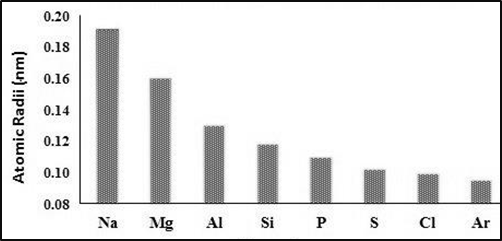
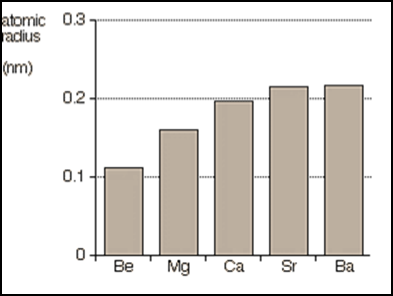
3.8 Periodic Trends in propertiesPeriodic trends exist because of the similar electronic configurations of the elements within their respective group families or periods. Important periodic trends include: atomic radius, ionic radius, electronegativity, ionization energy, electron affinity, melting point, metallic and non-metallic character. Periodic trends are valuable for chemists to quickly predict an element’s properties.3.8.1 Periodic Trend in Atomic radiusVariation in Period:Atomic radius generally decreases from left to right across a period of elements. As we move from left to right along a period, the valence electrons are added to the same shells but also at the same time, protons are being added to the nucleus, making it more positively charged. The effect of increasing proton number is greater than that of the increasing electron number; therefore, there is a greater nuclear attraction. The valence electrons are held closer towards the nucleus of the atom.Variation in Group:The atomic radius of elements generally increases down the group. As we move down a group, new shells are there to accommodate the newly added valence electrons which are now further away from the nucleus. There is also an increase in the positive nuclear charge with increase in the atomic number down a group. However, the effect of the greater number of principal energy levels outweighs the effect of increase in nuclear charge.
Atomic radii of period 3 elements
Atomic radii of group 2 elements3.8.2 Periodic Trends in Ionic radius
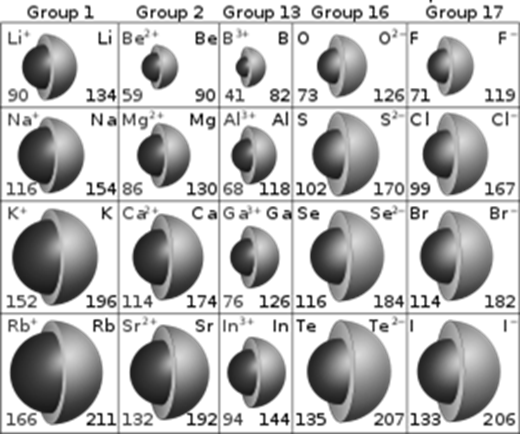
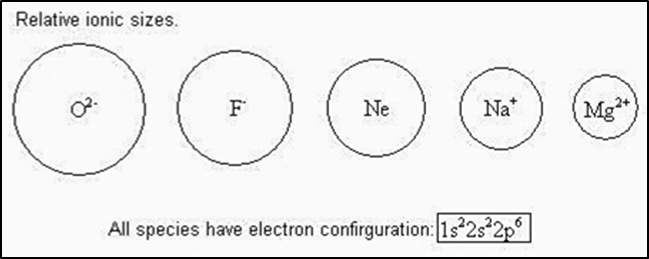
Size of atoms and their ions (in pm)Ionic radius is defined as the distance from the centre of the nucleus of the ion up to which it exerts its influence on the electron cloud of the ion. When a neutral atom gains or loses an electron, creating an anion or cation, the atom’s radius increases or decreases, respectively.In general, the ionic radii of elements exhibit the same trend as the atomic radii. Each atom is unique in its ability to lose or gain an electron. Hence, periodic trends in ionic radii are not as ubiquitous as trends in atomic radii across the periodic table. Here, trends must be isolated to specific groups and considered for either cations or anions.Size of atoms and their ions (in pm)Isoelectronic species:The atoms and ions which contain the same number of electrons are called isoelectronic species.They have same degree of electron-electron repulsion and shielding. But they have differing numbers of protons and thus different nuclear attraction. Their radii would be different because of their different nuclear charges. Below are some examples of isoelectronic species.
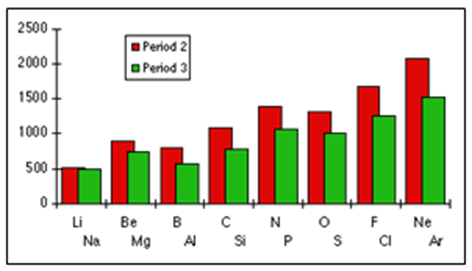
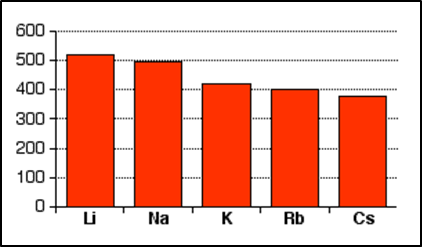
3.8.3 Periodic Trend in Ionization energyIonization energy is defined as the minimum amount of energy required to remove the most loosely bound electron from the valence shell of the isolated neutral gaseous atom in its ground state. In other words, it is the enthalpy change (∆H) for the following reaction: M(g) +IE1 → M+(g) + 1e- where IE1 represents the 1st ionization energyThe minimum amount of energy required to remove an electron from a unipositive cation is called 2ndionzation energy. It is represented by the following equation: M+(g) +IE2 → M2+(g) + 1e-where IE2 represents the 2nd ionization energyEnergy is always required to remove electrons from an atom and hence ionization enthalpies/energies are always positive. The 2nd ionization enthalpy will be higher than the 1st ionization enthalpy because it is more difficult to remove an electron from a positively charged ion than from a neutral atom. Thus the successive ionizationenergies always increase in the following orders IE1 < IE2 < IE3 < ………..To understand the trend of ionization energy in period and group, we have to consider two factors: (i) effective nuclear charge, and (ii) principal quantum number (n). The effective nuclear charge (Zeff or Z*) is the net positive charge experienced by an electron in a multi-electron atom. The term “effective” is used because nuclear charge experienced by a valence electron in an atom will be less than the actual charge on the nucleus because of “shielding” or “screening” of the valence electron from the nucleus by the intervening core electrons.In general, shielding is effective when the orbitals in the inner shells are completely filled or with increase in n value. The increased shielding effect is responsible for the decrease ofZeffon the valence electron by the nucleus. When Zeff decreases, IE decreases and vice versa.Across the period, Zeffincreases but principal quantum number (n) remains the same, so the IE increases. Down the group principal quantum number (n)increases and Zeffincreases slightly; the IE decreases as the overall effect. Both the trends are shown below.
1st ionization energies (kJ/mol) of periods 2 & 3
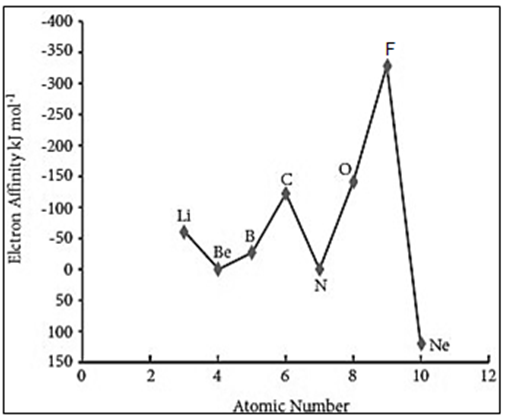
1st ionization energies (kJ/mol) of group 13.8.4 Periodic Trend in Electron AffinityElectron affinity or Electron Gain Enthalpy is defined as the amount of energy released (required in some cases) when an electron is added to the valence shell of an isolated neutral gaseous atom in its ground state to form its anion. A + 1e → A- + EAThe more negative the electron affinity value is, the higher is an atom’s affinity for electrons. The variation of electron affinity is not as systematic as in the case of ionisation energy. Noble gases have stable configuration, and the addition of further electron is unfavourable and electron affinity is positive. Halogens having the general electronic configuration of ns2np5 readily accept an electron to get the stable noble gas electronic configuration and therefore in each period they have high negative electron affinity.Variation in period: Generally, across the period, electron affinity increases (becomes more negative) as Zeff increases or atomic size decreases. However, in case of elements such as beryllium (1s22s2), nitrogen (1s22s22p3); the addition of extra electron will disturb their stable electronic configuration and they have almost zero electron affinity. Noble gases have stable ns2np6 configuration, and the addition of further electron is unfavourable and requires energy. Halogens having the general electronic configuration of ns2np5 readily accept an electron to get the stable noble gas electronic configuration (ns2np6), and therefore in each period the halogen has high electron affinity (high negative values).
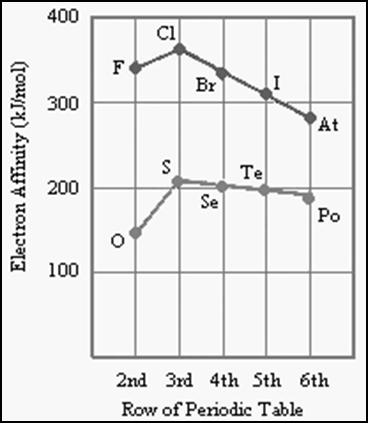
Variation in group:Generally, down the group, electron affinity decreases (becomes less negative) as Zeff decreases or atomic size increases.However, oxygen and fluorine have lower affinity than sulfur and chlorine respectively. The sizes of oxygen and fluorine atoms are comparatively small and they have high electron density.There are strong inter-electronic repulsions in the relatively compact 2p subshell of fluorine. Hence, the incoming electron does not feel much attraction.
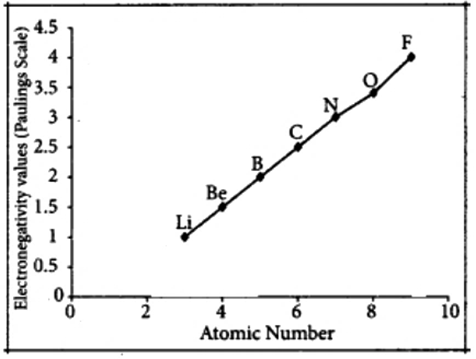
3.8.5 Periodic trend inElectronegativityIt is defined as the relative tendency of an element present in a covalently bonded molecule, to attract the shared pair of electrons towards itself. The electronegativity of any given element is not constant and its value depends on the element to which it is covalently bonded. Electronegativity is not a measurable quantity but a number of scales are available to calculate its value. The one most widely used was developed by Pauling, who assigned arbitrarily a value of 4.0 to fluorine, the element considered to have the highest ability to attract electrons. Based on this the electronegativity values for other elements can be calculated. The electronegativity is inversely related to the metallic properties of elements. Noble gases are assigned zero electronegativity. The electronegativity values play an important role in predicting the nature of the bond.Variation in a period:The electronegativity generally increases across a period from left to right. As discussed earlier, the atomic radius decreases in a period, as the attraction between the valence electron and the nucleus increases. Hence the tendency to attract shared pair of electrons increases. Therefore, electronegativity also increases in a period.
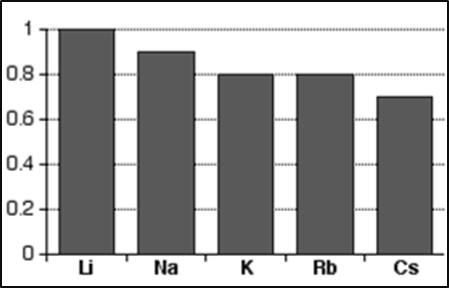
Variation in a group:The electronegativity generally decreases down a group. As we move down a group the atomic radius increases and the nuclear attractive force on the valence electron decreases. Hence, the electronegativity decreases. Noble gases are assigned zero electronegativity. The electronegativity values of the elements of s-block show the expected decreasing order in a group. Except 13th and 14th group all other p-block elements follow the expected decreasing trend in electronegativity.
3.8.6 Periodicity of Valence or Oxidation statesValence/valency of an atom is the combining capacity relative to H atom. The electrons that are present in the outermost shell or valence shell of an atom are called as the valence electrons. The number of valence electrons (VE) or (8-VE) is used to compute the valency of an element in the s-block and p-block of the periodic table. For the d-block and f-block elements, valency is decided not only by the valence electrons but also by d and f orbital electrons.The maximum number of electrons that an atom may lose or gain to form a bond with another atom is known as the oxidation state. So, oxidation state of an element in a particular compound is the charge present on the atom as a result of the gain or loss of electrons based on electronegativity values of the combining atoms in that molecule. A pure element’s oxidation state is always zero.As the number of valence electrons remains same for the elements in same group, the maximum valence also remains the same. Some elements in p-block show some other oxidation states beside the common oxidation state. Similarly transition metals and inner transition metals also show variable oxidation states.
Group
13
14
15
16
17
18
General E.C.
ns2np1
ns2np2
ns2np3
ns2np4
ns2np5
ns2np6(for He 1s2)
General Oxd. state
+3
+4
+5
+6
+7
+8
Other Oxd. state
+1
+2, -4
+3, -3
+4, +2, -2
+5, +3, +1, -1
+6, +4, +2
In a period the number of valence electrons increases, hence the valence increases but it is not a smooth increase. After carbon, the valency is mainly obtained by 8-VE.
Elements
Li Be B Na Mg Al
C Si
N O F Ne P S Cl Ar
No. of VE
1 2 3
5 6 7 8
Valency
No. of VE 1 2 3
4
8-VE 3 2 1 0
Noble gas E.C. can be acquired by
Losing electrons
Sharing electrons
Gaining electrons
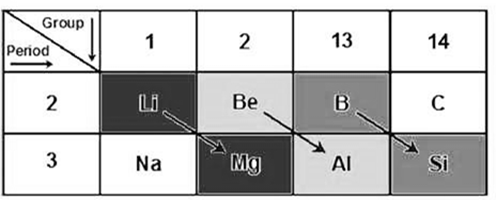
3.9 Anomalous properties of 2nd period elementsThe elements of the same group show similar physical and chemical properties. However, the first element of each group 1 (Li) and 2 (Be) and groups 13-17 (B to F) differs from other members of the group in certain properties. The reasons behind this are Small atomic size Large (charge/radius) ratio High electronegativity Absence of d-orbtials in the valence shellFor example, Li and Be form more covalent compounds, unlike the other member which predominantly form ionic compounds. The important anomalous properties of 2nd period elements are: diagonal relationship, maximum covalence of 4 and ability to form pπ-pπ multiple bonds.The elements of the 2nd period have only 2s and 2p orbitals in the valence shell and can have a maximum co-valence of 4, whereas the other members of the subsequent periods have more orbitals in their valence shell and can show higher valences.For example,boron and aluminium belong to 2nd and 3rd periods respectively. Boron forms [BF4]–with fluoride ionsbutaluminium forms [AlF6]3-. 2nd period elements can form pπ-pπ multiple bondsbetween same elements (C=C, C≡C, N=N, N≡Ν) or to other 2nd period elements (C=O, C=N, C≡N, N=O)but this type of pπ-pπ bonds are not observed in case of 3rd period elements.3.9.1 Diagonal relationshipIn these anomalous properties they resemble the second element of the following group (diagonal relationship). Elements behave similarly if they have similar ionic or atomic radii, electronegativity and polarizing power (ratio of charge by size). As these factors work in opposite directionsacross the period and down the group, diagonally these two changes balance each other.
Properties
Across the period
Down the group
Electronegativity
Increases
Decreases
Size
Decreases
Increases
Charge
Increases
Same
Charge/Size
increases
Decreases
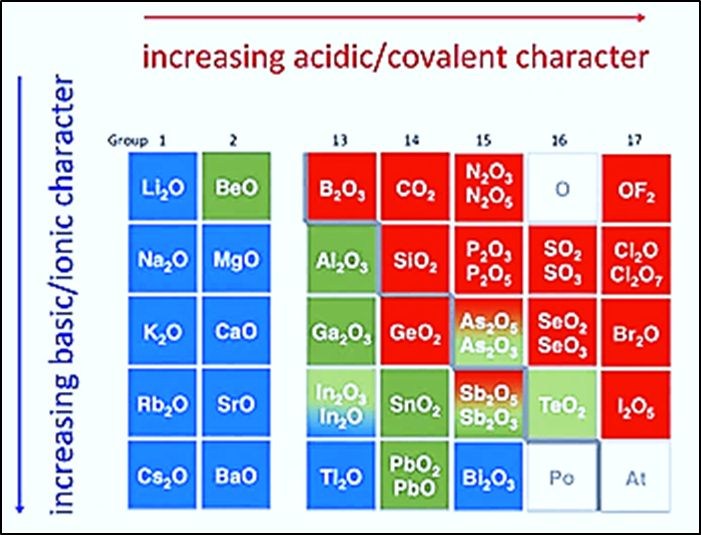
3.10 Periodic Trends & Chemical reactivityThe physical and chemical properties of elements depend on the valence shell electronic configuration. During compound formation, the electrons between the elements are shared, or the elements loss or gain the electrons. The higher the reactivity of the element, the easier it is to combine with other elements. Hence, the electronegativity and the ionisation energy determine a chemical reaction. The elements on the left side of the periodic table have low IE and readily lose their valence electrons (metallic character). The elements on right side of the periodic table have high EA and readily accept electrons (non-metallic character). As a result, elements of these two extremes show high reactivity compared to the elements present in the middle. The noble gases having completely filled electronic configuration neither accept nor lose their electron readily and hence they are chemically inert in nature.3.11 Acidic and basic nature of oxidesWhat will be the nature of the oxides formed by taking two elements from two extremes (alkali metals and halogens) of the periodic table is shown below.4Na + O2 → 2Na2O 2Cl2 + 7O2 → 2Cl2O7NaO is a basic oxide as it reacts with water to give strong base.Conversely Cl2O7 is an acidic oxide as it gives strong acid called perchloric acid upon reaction with water. Na2O + H2O → 2NaOH Cl2O7 + H2O → 2HClO4Oxides of elements in the centre are amphoteric (e.g., Al2O3, As2O3) or neutral (e.g., CO, NO, N2O).As we move down the group, the IE decreases and the electropositive character of elements increase. The hydroxides of group 2 elements show following properties: Be(OH)2 amphoteric; Mg(OH)2 weakly basic; Ba(OH)2 strongly basic. Oxides of group 15 : NO2, P2O3 - acidic, As2O3, Sb2O3 -amphoteric , Bi2O3 - basic.In a given period of the periodic table, the oxides change from basic to amphoteric and finally to acidic. For example, for 3rd period elements: Na2O &MgO - basic, Al2O3 - amphoteric, SiO2 - weakly acidic, P2O5, P2O3, SO2, SO3, Cl2O and Cl2O7 - acidic.Acidity also increases with an increase in the oxidation number of the same element’s oxides. Examples: Mn2O7> Mn2O3 >MnO; As2O5> As2O3; Sb2O5> Sb2O3
Subscribe
Would you like to receive our Newsletter, NEET- IIT Videos, STEM Materials, NEET-IIT Solved previous year question papers.
Book Your Demo Class
Try for 1 Month @
Rs 2,000 only few seats available. Offer Ends Soon.
Book now and get your free unlimited TeenEinstein Portal Access.
You are now subscribed to our Newsletter etc.
Would you like to continue Free Trial.
TeenEinstein Stem Platform Portal access for 30 days Would you like to get the Portal access free trial for 30 days .
TakeBreak
You have watched Screen for 30 minutes, please relax your eyes by watching any other object at 20 feet for 20 secs.