aContents:1. Importance of chemistry2. Classification of Matter3. Physical and Chemical properties4. Uncertainty in measurement5. Laws of Chemical Combinations6. Dalton’s Atomic Theory7. Atomic and Molecular masses8. Mole concept and Molar mass9. Percentage Composition10. Empirical & Molecular Formula11. Gram Equivalent concept12. Terms used in volumetric calculations13. Stoichiometry and Stoichiometric Calculations1.1 Importance of chemistry:It is the branch of science which deals with the composition, structure and properties of matter. Chemistry has a direct impact on our life and has wide range of applications in different fields. Food to eat, cloth to wear and place to live: chemistry plays a major role in providing these three basic needs of human life and also helps us to improve the quality oflife. As chemistry plays an important role in our day-to-day life, it is important for us to understand the basic principles of chemistry to address the contribution to a large extent in the development and growth of a nation. The main branches of chemistry are physical, organic, inorganic and analytical chemistry. In addition to these, biochemistry, nuclear chemistry, forensic chemistry, earth chemistry etc., are other branches of chemistry.1.2 Classification of Matter• The physical state of matter can be converted into one another by modifying the temperature and pressure suitably. Example: the solid, liquid and vapor state of H2O are called ice, water and water vapor respectively.• Matter chemically can be divided to pure substance and mixture (impure).• Pure substances are composed of simple atoms or molecules. They can be further divide to element and compound.• An element consists of only one type of atom. Element can exist as monatomic (atom) or polyatomic (molecules).It may be a metal,non-metal or a metalloid. Example: Monatomic - Gold (Au), Copper (Cu); Polyatomic - Hydrogen (H2), Phosphorous (P4) and Sulphur (S8).• Compounds are made up of molecules which contain two or more atoms of different elements. The properties of a compound are altogether different from the constituting elements.Example: Carbon dioxide (CO2), Glucose (C6H12O6), Hydrogen sulphide (H2S).• Mixtures consist of more than one chemical entity present without any chemical interactions. They can be further classified based on their physical appearance. A mixture is said to be homogeneous if it has a uniform composition throughout and without any visible boundaries of separation between the constituents.A mixture is said to be heterogeneous if it does not have uniform composition throughout and has visible boundaries of separation between the various constituents. The different constituents of a heterogeneous mixture can be seen even with naked eye.1.2.1 Inorganic and Organic compoundsInorganic Compounds are the compounds which are obtained from non-living sources such as rocks and minerals. These are in fact the compounds of all the elements except hydrides of carbon and their derivatives. Examples: Common salt, gypsum, washing soda etc.Organic Compounds are the compounds which are derived from living sources in plants and animals. These are the hydrides of carbon (hydrocarbons) and their derivatives. Example: Carbohydrates, proteins, oils, fats etc.1.3 Physical and Chemical propertiesPhysical properties can be measured or observed without changing the identity or the composition of the substance. Examples: color, odour, melting point, boiling point etc. Chemical properties require a chemical change to occur. The examples of chemical properties are characteristic reactions of different substances. Example: acidity, basicity, combustibility etc.To express the measurement of any physical quantity two things are considered: (i) Its unit, and (ii) The numerical value.1.3.1Fundamental & Derived Units• There are two types of units: Fundamental/Basic and Derived. • Fundamental/Basic Units: The units which can neither be derived from other units nor they can be further resolved into simpler units are called fundamental units.
Quantity
Unit
Symbol
Length
meter
m
Time
second
s
Electric current
Ampere
A
Temperature
Kelvin
k
Amount of subsance
Mole
mol
Mass
Kilogram
kg
Examples of Fundamental units (SI system)• Derived units: Derived units are those which depend on the fundamental units or which can be expressed in terms of the fundamental units.
Quantity
Unit
Symbol
Volume
cubic meter
m3
Density
kilograms per cubic meter
kg/m3
Speed
meter per second
m/s
Energy
Joule (kg.m/s2)
J
pressure
Pascal (kg/(ms2))
Pa
Examples of Derived units (SI system)1.4 Uncertainty in measurementAll the experimental data during measurements have a certain degree of uncertainty associated with it because of two factors, the limitation of the measuring instrument and the manual error. There are meaningful ways which can help in handling these numbers conveniently and practically with minimal uncertainty.1.4.1 Scientific notationScientific notation is a form of presenting a few numbers (very large or very small) in a simpler form. The form is multiplication of single-digit numbers and 10 raised to the power of the respective exponent. It is represented in the form N x 10n(where n is an exponent having positive or negative values and N can vary between 1 to 10. 1 ≤ N < 10).The exponent is positive if the number is very large and it is negative if the number is very small.213,000,000 = 2.13 x 10⁸ 0.00872 = 8.72 x 10⁻³Here, 2.13 and 8.72 are coefficients, 10 is base, 8 and -3 are exponents.1.4.2 Calculations using Scientific notationMultiplication = (5.7 x 106) x (4.2 x 105) = (5.7x 4.2) (106+5) = 23.94 x10¹¹Division = (5.7 x 10⁶) / (4.2 x 10³) = (5.7/4.2) x 106-3 = 1.357 x 10³Subtraction = (4.5 x 10⁻³) - (2.6 x 10⁻⁴) = (4.5 x 10⁻³) - (0.26 x 10⁻³) = (4.5 - 0.26) x 10-3 = 4.24 x 10⁻³Addition = (4.56 x 10³) + (2.62 x 10²) = (45.6 x 10²) + (2.62 x 10²) = (45.6 + 2.62) x 102= 48.22 x 1021.4.3 Significant FiguresSignificant figures are the meaningful digits in a measured or calculated quantity. It includes all those digits that are known with certainty plus one more which is uncertain or estimated. Greater the number of significant figures in a measurement, smaller the uncertainty.Rules for determining the number of significant figures are:• Zeros at the end or right of a number are significant when they are on the right side of the decimal point. e.g., 0.132, 0.0132 and 15.0, all have 3 significant figures.• Zeros preceding to first non-zero digit are not significant. Such zeros indicates the position of decimal point. For example, 0.03 has one significant figure and 0.0052 has two significant figures.• All non-zero digits are significant. For example, in 285 cm, there are three significant figures and in 0.25 mL, there are two significant figures.• Zeros between two non-zero digits are significant. Thus, 5.005 have four significant figures.• Exact numbers that are used to count not measure have infinite significant figures.
Number
Significant figures
Number
Significant figures
0.00085
2
83.90
4
8001
4
0.085600
5
7.00
3
8900000000
2
700
1
8900.00000
9
700.
3
6.2300 x 10⁻⁴
5
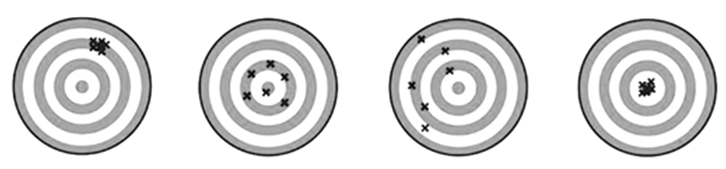
1.4.3.1Rounding off the numerical resultsWhen a number is rounded off, the number of significant figures is reduced. the last digit retained is increased by 1 only if the following digit is ≥ 5 and is left as such if the following digit is ≤ 4. For example, 12.696 can be written as 12.7, 18.35 can be written as 18.4, 13.93 can be written as 13.9.1.4.3.2Precision and AccuracyPrecision refers the closeness of the set of values obtained from identical measurements of a quantity. Precision is simply a measure of reproducibility of an experiment.Precision = Individual value – Arithmetic mean valueAccuracy is the agreement of a particular value to the true value of the result. It is a measure of the difference between the experimental or the mean value of a set of measurements and the true value.Accuracy = Mean value – True valueIn physical measurements, accurate results are generally precise but precise results don’t assure good accuracy.
Precise but not accurate
Accurate but not precise
Neither accurate nor precise
Both precise and accurate
1.4.4 Dimensional AnalysisSometimes, while calculating, there is a need to convert units from one system to other. The method used to accomplish this is called factor label method/unit factor method/dimensional analysis. Information sought = Information given *Conversion factor
Length (SI unit meter)
Mass (SI unit kilogram)
Temperature (SI unit kelvin)
1 km = 0.62137 miles (mi)
1 kg = 2.2046 lb
0 K = -273.15° C
1 mi = 1.6093 km
1 lb =0.454 kg
0 K = -459.67° F
1 in = 2.54 cm
1 amu = 1.6605 x 10⁻²⁴ g
K = oC + 273.15
1 cm = 0.3937 in
°C = (5/9 x °F) - 32
1 Ao = 10-10 m
°F = (9/5 x °C) + 32
Energy (derived)
Pressure (derived)
Volume (derived)
SI unit: Joule (J)
SI unit: Pascal (Pa)
SI unit: cubic meter (m3)
1 J = 1 kg.m2/s2
1 Pa = 1 N/m2 = 1 kg/(ms2)
1 L = 10-3 m3 = 1 dm3 = 103 cm3
1 J = 0.239 cal
1 atm = 101.325 kPa = 760 torr
1 cm3 = 1 ml
1 cal = 4.184 J
1 bar = 100kPa
1 in3 = 16.4 cm3
1 ev = 1.602x10⁻¹⁹ J
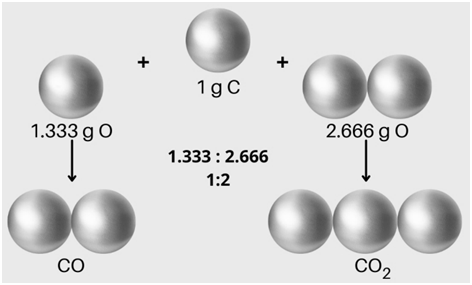
1.5 Laws of Chemical CombinationsThe combination of different elements to form compounds is governed by certain basic rules. These rules are referred to as laws of chemical combination. They are• Law of Conservation of Mass • Law of Definite Proportions • Law of Multiple Proportions • Law of Reciprocal proportions • Gay Lussac’s Law of Gaseous Volume • Avogadro’s Law1.5.1 Law of Conservation of Mass The law says “Matter can neither be created nor destroyed in a chemical reaction”. For any chemical change total mass of active reactants are always equal to the mass of the product formed.Based on the data Lavoisier obtained after carefully studying numerous combustion reactions - In all physical and chemical changes, there is no net change in mass during the process.It is a derivation of Dalton’s atomic theory ‘atoms neither created nor destroyed’.The exception to this law is nuclear reactions where mass is converted into energy (E= mc2).Total masses of reactants = Total masses of products + Masses of unreacted reactants.NaCl + AgNO3→ NaNO3 +AgClThe total mass of reactants = (23x1 + 35.5x1) + (108x1 + 14x1 + 16x3) = 228.5The total mass of products = (23x1 + 14x1 + 16x3) + (108x1 + 35.5) =228.51.5.2 Law of Definite ProportionsThe law says “A pure chemical compound obtained by different sources always consists of the same elements combined together in a fixed proportion by weight.” The law is the basis for the study of stoichiometry in Chemistry. The validity of this law has been confirmed by various experiments. It is sometimes also referred to as Law of Definite Composition/Law of Constant Composition. For example, CO2 can be produced by burning coke in air or by decomposition of limestone on heating. In both cases, the weight ratio of C and O is same.By burning coke in airC (s) + O2 (g) → CO2 (g)By decomposition of limestone (CaCO3) CaCO3 (s) →CaO (s) + CO2 (g)1.5.2.1 Limitations of the Lawof Definite ProportionsThe law is not true if different isotopes of elements are involved in making a chemical compound. This is also not applicable when there are possibilities of making two or more compounds from the same elements. For example – Ethanol and dimethyl ether; both the compounds have the same chemical formula C2H6O and the elements C, H, and O are present in the same ratio, that is, 12:3:8 in mass.1.5.3 Law of Multiple ProportionsThe law says “When two elements A and B combine to form two or more than two different compounds then the different masses of A, which separately combines with a fixed mass of B are in simple whole number ratio.” Here carbon and oxygen combine to form two different oxides CO and CO2. Different masses of oxygen which separately combines with a fixed mass of carbon are in the ratio 1:2.
1.5.4 Law of Reciprocal proportions Avogadro’s LawThe law says “When two elements (say X and Y) combine separately with the same weight of a third element (say Z), the ratio in which they do so is the same or simple multiple of the ratio in which they (X and Y) combine with each other.”For example, consider three compound CH4, CO2 and H2O. In CH4, 4 g of H reacts with 12 g of C. In CO2, 32 g of O reacts with 12g of C. In H2O, 2g of H reacts with 16g of O. So, H and O combine separately with a fixed weight of C (12 g) in the ratio 1:8 (4:32). When H and O combine with each other forming H2O, they combine in the ration 1:8.1.5.5 Gay Lussac’s Law of Gaseous VolumeThe law says “At given temperature and pressure the volumes of all gaseous reactants and products bear a simple whole number ratio to each other.”N2 (g) + 3H2 (g) → 2NH3 (g)1 volume 3 volumes 2 volumesRatio = 1:3:21.5.6 Gay Lussac’s Law of Gaseous VolumeThe law says “Equal volumes of gases at the same temperature and pressure should contain equal number of molecules.”As the law states: volume and the amount of gas (moles) are directly proportional to each other at constant volume and pressure, the statement can be mathematically expressed as: V1/n1 =V2/n2ar constant P and Tv1 and v2 are initial and final volumes of the gas. n1 and n2 are initial and final number of molecules of the gas.1.6 Dalton’s Atomic TheoryThis theory was based on laws of chemical combinations. The basic postulates are• All substances are made up of tiny, indivisible particles, called atoms.• All the atoms of a given element have identical properties including identical mass. • Atoms of different elements differ in mass.• Compounds are formed when atoms of different elements combine in a fixed whole number ratio.• Chemical reactions involve reorganization of atoms. • These are neither created nor destroyed in a chemical reaction.1.6.1 Limitations of the theoryIn light of the current state of knowledge in the field of chemistry, the theory has following limitations.• The discovery of subatomic particles disproved this postulate as it says atoms are indivisible.• As per Dalton’s atomic theory, all atoms of an element have identical masses and densities. However, different isotopes of elements have different atomic masses (H, D, and T).• It is possible for two different elements to share the same mass number such as 40Ar and 40Ca (Isobars) but the theory states that the masses of the atoms of two different elements must differ. • Elements need not combine in simple, whole-number ratios to form compounds: Certain complex organic compounds do not feature simple ratios of constituent atoms. Example: sugar/sucrose (C12H22O11).• The differences in the properties of diamond and graphite (allotropes), both of which contain only carbon, cannot be explained by Dalton’s atomic theory.1.7 Atomic and Molecular masses1.7.1 Atomic massAs atoms are too small (diameter of 10-10 m) and weigh approximately 10-277 kg, it is not possible to measure their mass directly. Hence, it is proposed to have relative scale based on a standard atom. The C-12 atom is considered as standard by the IUPAC, and it’s mass is fixed as 12 amu/unified mass (u). The amu/u mass is defined as 1/12 of the mass of a Carbon-12 atom in its ground state. 1 amu or 1 u ≈ 1.6605 × 10⁻²⁷ kg. Mass of an atom of H = 1.6736×10⁻²⁴ g. Thus, in terms of amu, the mass of H atom(1.6736 x 10⁻²⁴ g)/ (1.66056 x 10⁻²⁴ g) = 1.0078 amu = 1.0080 amu1.7.2 Average atomic massSince most of the elements consist of isotopes that differ in mass, we use average atomic mass. It is defined as the average of the atomic masses of all atoms in their naturally occurring isotopes in a naturally occurring sample of the element. For example, there are three isotopes of Mg. Isotope 1 – 23.985 amu (78.99%)Isotope 2 – 24.986 amu (10.00%)Isotope 3 – 25.982 amu (11.01%)The average atomic mass of Mg = (23.985 x 0.7899) + (24.986 x 0.1000) + (25.982 x 0.1101) = 18.95 amu + 2.499 amu + 2.861 amu = 24.31 amu1.7.3 Molecular massMolecular mass is the sum of atomic masses of the elements present in a molecule. It is obtained by multiplying the atomic mass of each element by number of its atoms and adding them together. For example, the molecular mass of ammonium Sulphate (NH4)2SO4= 2(14 × 1 + 1 × 4)+ 32 + 16 × 4= 2(14+4)+32+64= (2 × 18) +32+64= 132 amu1.8 Mole concept and Molar masses1.8.1 Concept of moleAs atoms and molecules are extremely small in size, their numbers in even a small amount of any substance is really very large. To handle such large numbers, a unit of convenient magnitude is required. As we use the term ‘dozen’ to represent 12 entities, we can use the term ‘mole’ to represent 6.022x10²³ entities (atoms/molecules/ions/electrons etc.). Mole is the SI unit to represent a specific amount of a substance.One mole contains exactly 6.02214076 × 10²³ elementary entities.This number is the fixed numerical value of the Avogadro constant (NA). It is also called Avogadro number when expressed in the unit mol-1.1.8.2 Molar massThe mass of one mole of a substance in grams is called its molar mass. Molar mass of an atom is also known as gram atomic mass for monoatomic element. Molar mass of an atom is also known as gram molecular mass. One mole of a substance has the same mass in grams that one atom or molecule has in amu unit. The numbers in the periodic table that we identified as the atomic masses of the atoms not only tell us the mass of one atom in u but also tell us the mass of 1 mol of atoms in grams. The molar mass in g is numerically equal to atomic/molecular/formula mass in u.For example, molar mass of NaOH = 23 (Na) + 16 (O) + 1.008 (H) = 23.008 g mol-1.1.9 Percentage CompositionThe percentage composition of a given compound is defined as the ratio of the amount of each element to the total amount of individual elements present in the compound multiplied by 100. Here, the quantity is measured in terms of grams of the elements present. We can check the purity of a given sample by analysing this data.Mass % of an element = (Mass of that element in the compound/Molar mass of the compound) x 100Molar mass of H2O = 2x1 + 16 = 18 g Mass % of H = (2/18)x100 = 11.11%, Mass % of O = (16/18) x 100 = 88.89%1.9.1 Empirical & Molecular FormulaEmpirical formula of a compound is the formula written with the simplest ratio of the number of different atoms present in one molecule of the compound as subscript to the atomic symbol.Molecular formula of a compound is the formula written with the actual number of different atoms present in one molecule as a subscript to the atomic symbol.Elemental analysis of a compound gives the mass percentage of atoms present in the compound. Using the mass percentage, we can determine the empirical formula of the compound. Molecular formula of the compound can be arrived at from the empirical formula using the molar mass of the compound.
Molecular formula
Empirical formula
C3H6O3
CH2O
C10H14N2
C5H7N
C12H22O11
C12H22O11
1.10 Gram Equivalent conceptAs mole concept is based on molecular mass, gram equivalent concept is based on equivalent mass. Gram equivalent mass of an element, compound or ion is the mass that combines or displaces 1.008 g H or 8 g O or 35.5 g Cl. Gram equivalent concept which is similar to mole concept, also widely used in chemistry especially in analytical chemistry. Equivalent mass has no unit but gram equivalent mass has the unit g eq-1.Mole = Given mass / Molar mass g. eq. = Given mass / Equivalent mass Equivalent mass = Molar mass / n g. eq. = (Given mass/Molar mass) x ng. eq.= (no. of moles) x nHere, n = Equivalence factor or n-factor. It can be valency for element, acidity for base and basicity for acid, etc.1.11 Terms used in Volumetric calculationsThere are several ways by which we can describe the concentration of the solution quantitatively. They are Percentage (w/w), Percentage (v/v) , Percentage (w/v), Molarity, Normality, Molality, Formality, Mole fraction.1.11.1Mass percentage (w/w):It is defined as the amount of solute in grams present in 100 grams of the solution. For example, a 10% solution of sugar by mass means that 10 g of sugar is present in 100 grams of the solution, i.e., 10 g of sugar has been dissolved in 90 g of water.Mass% = (Mass of solute/Mass of solution) x 100= {Mass of Solute/(Mass of solute+Mass of solvent)} x 1001.11.2Volume percentage (V/V): It is defined as the volume of solute in mL present in 100 mL solution. For example, a 10% solution of HCl by volume means that 10 mL of liquid HCl is present in 100 mL of the solution.Volume% = (Volume of solute/Volume of solution) x 1001.11.3Mass by volume percentage (w/V): It is defined as the mass of solute present in 100 mL solution. For example, a 10% mass by volume solution of NaCl means that 10 g NaCl is present in 100 mL of solution.Mass by volume % = (Mass of solute/Volume of solution) x 1001.11.4Molarity: It is defined as number of moles of solute dissolved in one litre (or one cubic decimetre) of solution. For example, 2 (M) solution of KCl means that 2 mol of KCl is dissolved in 1 L of water. Unit of molarity: mol L-1. Molarity is dependent on volume; therefore, it depends on temperature.Molarity (M)= Number of moles of solute/Volume of solution in L1.11.5Molality: It is defined as the number of moles of solute dissolved in 1 Kg of the solvent.Molality is the most convenient method to express the concentration because it involves the mass of liquids rather than their volumes. It is also independent of the variation in temperature.Molarity (m) = Number of moles of solute/Mass of solvent in kg1.11.6 Normality:It is defined as the number of gram equivalents of the solute present in one litre of the solution.Normality (N) = Number of gram equivalent of solute/Volume of solution in L1.11.7 Formality:It is the number of formula mass in grams present per litre of solution. In case formula mass is equal to molecular mass, formality is equal to molarity. Like molarity and normality, the formality is also dependent on temperature.Fomality = (Weight of solute in g/Formula weight of solute) x (1/Volume of solution in L)1.11.8Mole fraction: The mole fraction of any component in a solution is the ratio of the number of moles of that component to the total number of moles of all components.Mole fraction of a component = Number of moles of the component/Total number of moles of all the componentsFor a binary solution of A and B, Mole Fractionof A (XA) =nA/(nA+nB) and Mole Fraction of B (XA) =nB/(nA+nB)1.12 Stoichiometry and Stoichiometric Calculations1.12.1 StoichiometryStoichiometry is the quantitative relationship between reactants and products in a balanced chemical equation in moles. The quantity of reactants and products can be expressed in moles or in terms of mass unit or as volume. If we divide given mass by molar mass, we get number of moles. When numbers of moles are multiplied by 22.4 litres we get volume (in case of gas) at 0° C and 1 atm pressure as 1 mol of any gas occupy 22.4 litres volume at 0°C/273 K and 1 atm pressure. So, these three units are interconvertible. 1.12.2Stoichiometric Calculations
CH4 (g) + 2O2 (g) → CO2 (g) + 2H2O (g)
Content
Reactants
Products
CH4 (g)
O2 (g)
CO2 (g)
H2O (g)
Stoichiometric coefficients
1
2
1
2
Mole-mole relationship
1 mole
2 moles
1 mole
2 moles
Mass-mass relationship
1 mol x 16 g mol-1 = 16g
2mol x 32 g mol-1 = 64g
1mol x 44 g mol-1 = 44g
2mol x 18 g mol-1 =36g
Volume-volume relationship
22.4 L
44.8 L
22.4 L
22.4 L
1.12.3 Limiting ReagentsIf any reaction is carried out with stoichiometric quantities of reactants, then all the reactants will be converted into products. But, if a reaction is carried out using non-stoichiometric quantities of the reactants, the product yield will be determined by the reactant that is completely consumed. It limits the further reaction from taking place and is called as the limiting reagent (LR).The other reagents which are in excess are called the excess reagents (ER).Absence of limiting reagent3H2 + N2→ 2NH36g 28g 34gPresence of limiting reagent1.5H2 + N2→ NH3 + N23g 28g 17g 14g LRER
Subscribe
Would you like to receive our Newsletter, NEET- IIT Videos, STEM Materials, NEET-IIT Solved previous year question papers.
Book Your Demo Class
Try for 1 Month @
Rs 2,000 only few seats available. Offer Ends Soon.
Book now and get your free unlimited TeenEinstein Portal Access.
You are now subscribed to our Newsletter etc.
Would you like to continue Free Trial.
TeenEinstein Stem Platform Portal access for 30 days Would you like to get the Portal access free trial for 30 days .
TakeBreak
You have watched Screen for 30 minutes, please relax your eyes by watching any other object at 20 feet for 20 secs.