STRUCTURE OF ATOM

Contents: Introduction to Atomic model Thomson’s Atomic model Cathode and Anode rays Rutherford’s Atomic model Discovery of Neutron Atomic and Mass number Electromagnetic Wave Theory Black Body Radiation Planck’s Theory: Quantization of Energy Photoelectric effect Dual behaviour of Electromagnetic radiation Continuous, Band and Line spectrum Emission & Absorption Spectrum Bohr’s Model for H Atom Merits & Demerits of Bohr’s Theory Dual behaviour of matter: De-Broglie equation Quantisation of Angular momentum Heisenberg’s Uncertainty principle Reason for failure of Bohr’s model Quantum mechanical model Schrodinger equation Quantum numbers Probable distribution in an orbital Shape of Orbitals Angular and Radial notes Energy of orbitals in H atom Energy of orbitals in multi-electron atom Effective nuclear charge Aufbau principle Pauli’s Exclusion principle Hund’s rule of maximum multiplicity Electron configuration Stability of completely & half-filled subshells 2.1 Introduction to Atomic model The word ‘atom’ has been derived from the Greek word ‘atomos’, which means uncuttable. Atom was considered as non-divisible until the discovery of sub-atomic particles such as electron, proton and neutron.In the 19 th and 20 th centuries, many scientists attempted to explain the structure of the atom with the help of different atomic models. Each of these models had their own merits and demerits and was vital to the development of the modern atomic model. The most notable contributions were made by the scientists John Dalton, J.J. Thomson, Ernest Rutherford and Niels Bohr. 2.2 Thompson’s Atomic model John Thomson put forth his model describing the atomic structure in 1898 based on an experiment called cathode ray experiment. Based on conclusions from his cathode ray experiment, Thomson described the atomic structure as a positively charged sphere into which negatively charged electrons were embedded. It is commonly referred to as the “plum pudding model or watermelon”. Thomson’s atomic structure described atoms as electrically neutral, i.e. the positive and the negative charges were of equal magnitude, hence, the model was able to explain the overall neutrality of the atom. The mass of the atom is assumed to be uniformly distributed over the atom.
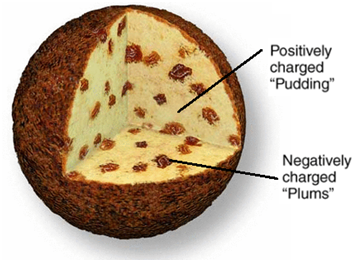
Plum pudding model
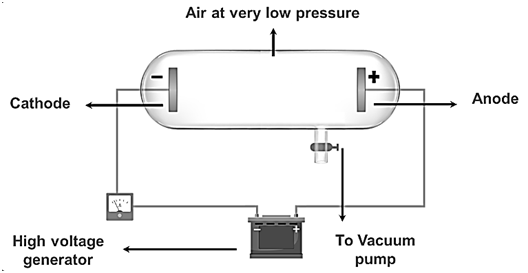
Limitations: Thomson’s atomic model does not clearly explain the stability of an atom and further discoveries of other subatomic particles. 2.3 Cathode and Anode rays Cathode rays: Theyare the beam of electrons travelling from the negatively-charged cathode to the positively charged anode at the other end of the vacuum tube. Properties 1. The characteristics of cathode rays or electrons do not depend on the material of electrodes or the nature of the gas present in the cathode ray tube. 2. These cathode rays travel in a straight-line path at high speed (slower than light) when a voltage difference is applied between the electrodes. Speed of cathode rays is. 3. When cathode rays strike a metal foil, the latter becomes hot indicating that the ray can produce heating effect. 4. They produce green fluorescence on the glass walls of the discharge tube as well as on certain other fluorescent substances. 5. They can easily pass through thin foils of metals (penetrating effect). 6. The negatively charged material particles constituting the cathode rays are basically electrons.
Cathode ray discharge tube
Anode rays: The renowned scientist Goldstein conducted a discharge tube experiment with a perforated cathode in 1886. The Anode rays are produced as a result of the bombardment of high-speed electrons from cathode rays on gaseous atoms, which knocks electrons out of them. Properties 1. Anode rays(also known as positive rays or canal rays) are radiations that are positively charged and made up of particles with charges that are equal in magnitude but reverse in sign to the electrons. 2. They can also be described as a beam of positive ions produced by certain types of gas discharge tubes. 3. As the anode rays are made of the positive ionised ions which are formed by the ionisation of the gas present in the tube, anode rays are dependent upon the nature of the gas which is present in the glass tube. 4. The mass of anode rays is almost identical to the atoms from which they are derived. 5. These rays originate as a result of the knockout of the electrons from the gaseous atoms by the bombardment of high-speed electrons of the cathode rays on them.
Properties Cathode rays Anode rays
Motion They travel in straight line They also travel in straight line.
Type of charge They are deflected towards positive plate as they carry negative charge. They are deflected towards the negative plate as they carry positive charge.
Particles Particles present in cathode rays are electrons. Particles present in anode rays are positively charged.
Charge & mass Electrons present in cathode rays have same charge and mass. The charge on the particle depends upon the number of electrons lost by atoms.
Origin They originate from cathode. They originate from anode.
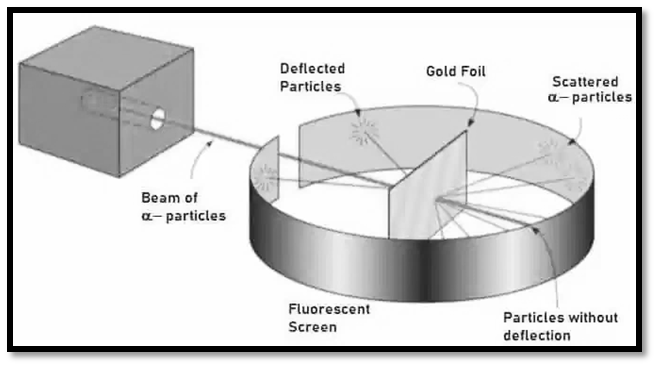
Cathode rays vs Anode rays 2.4 Rutherford’s Atomic model Rutherford conducted an experiment in 1911 by bombarding a thin sheet of gold with α-particles and then studied the trajectory of these particles after their interaction with the gold foil. Rutherford made certain observations that contradicted Thomson’s atomic model.
2.4.1 Observations of α-Scattering experiment  A major fraction of the α-particles passed through the sheet without any deflection.  Some of the α-particles were deflected by the gold sheet by very small angles.  Very few of the α-particles were deflected back, that is only a few α-particles had nearly 180 ° angle of deflection. 2.4.2 Conclusion of the experiment  The positive charge and most of the mass of an atom is concentrated in an extremely small volume.  This small volume region of the atom is called as a nucleus (discovery of nucleus).  The size of the nucleus of an atom is very small in comparison to the total size of an atom.  The negatively charged electrons surround the nucleus of an atom and revolve around it with very high speed in circular paths (orbits).  Electrons and nucleus are held together by a strong electrostatic force of attraction.  An atom has no net charge or they are electrically neutral. 2.4.3 Limitations of Rutherford’s Atomic model  When a body is moving in an orbit, it undergoes acceleration even if it is moving with a constant speed in an orbit because of changing direction.  According to electromagnetic theory, charged particles when accelerated should emit electromagnetic radiation.  So, electrons, revolving around the nucleus, should emit radiation the energy of which comes from electronic motion.  Eventually, they will lose all their energy and will fall into the nucleus leading to instability.  It says nothing about distribution of the electrons around the nucleus and the energies of these electrons.  If electrons continuously revolve around the ‘nucleus, the type of spectrum expected is a continuous spectrum but in reality, we get a line spectrum. 2.5 Discovery of Neutron In 1932, James Chadwick conducted an experiment in which he bombarded beryllium with α-particles. During the experiment, he discovered the emission of neutral radiation. James Chadwick’s discovery of a neutral particle, or neutron, led to the current understanding that the nucleus is made up of protons and neutrons. A neutron is a neutral subatomic particle with no electrical charge and has about the same mass as a proton. A proton (positive), electron (negative), and neutron are the three constituents of an atom (neutral).
Particle Symbol Charge (Coulomb) Relative charge Mass (kg) Relative mass Location
Electrons e 0 or e-1 or 0 β -1 -1.6 x 10 -19 -1 9.1 x 10 -31 1/1872 Outside nucleus (energy levels)
Protons p or 1 p 1 or 1 H 1 1.6 x 10 -19 +1 1.67 x 10 -27 1 Nucleus
Neutrons n or 1 n 0 0 1.67 x 10 -27 1 Nucleus
2.6 Atomic number and Mass number Atoms of each element contain a characteristic number of protons which determines what atom we are looking for. The number of protons in an atom or the number of electrons in an electrically neutral atom is called the atomic number (represented by Z ). In contrast, the number of neutrons for a given element can vary. The number of protons and neutrons combines to give us the mass number (represented by A ) of an atom. Protons and neutrons present in the nucleus are collectively known as nucleons. An element is expressed with atomic and mass number as A Z X, where X = element, Z = atomic number, A = Mass number. For example, cobalt with atomic number and mass number 27 and 59 respectively can be expressed as 59 27 Co. 2.6.1 Isotopes and Isobar Isotopes are atoms of the same element that have different numbers of neutrons but the same number of protons. The difference in the number of neutrons between the various isotopes of an element means that the various isotopes have different masses.Isobars are the atoms with same mass number but different atomic number.For example, 14 6 C and 14 7 N.
Figure 3 : Isotopes of Carbon
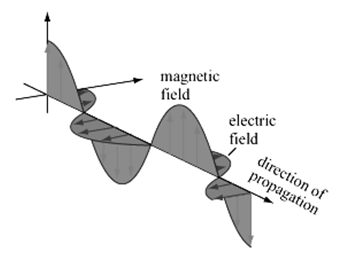
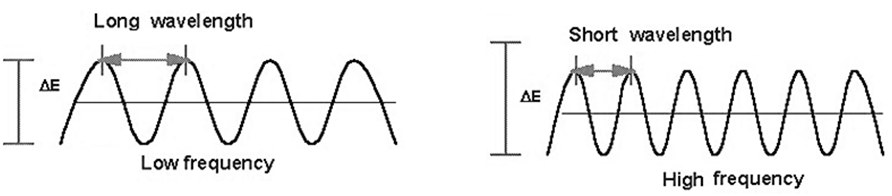
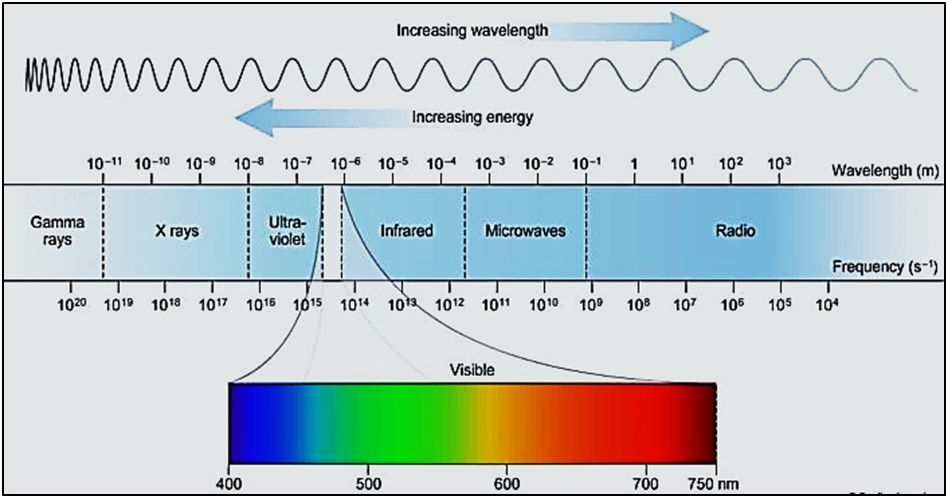
Chemical properties of atoms are controlled by the number of electrons, which are determined by the number of protons. Number of neutrons present in the nucleus has very little effect on the chemical properties of an element. Therefore, all the isotopes of a given element show same chemical behaviour. 2.7 Electromagnetic Wave Theory James Maxwell (1870) was the first to give a comprehensive explanation about the interaction between the charged bodies and the electrical and magnetic fields on macroscopic level. He suggested that when electrically charged particle moves under acceleration, alternating electrical and magnetic fields are produced and transmitted. These fields are transmitted in the forms of waves called electromagnetic waves or electromagnetic radiation (light wave is an example). These waves do not require medium and can move in vacuum. There are many types of electromagnetic radiations, which differ from one another in wavelength or frequency.
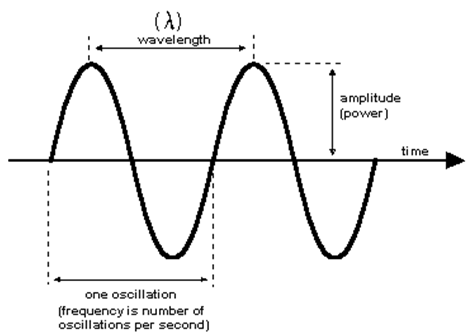
Frequency ( ν ) is defined as the number of waves that pass through a given point in one second. Mathematically it is equal to the reciprocal of the time period(T) of electromagnetic radiation. Wavelength ( λ ) can be defined as the distance between two successive crests or troughs of a wave. Wavenumber ( - ν ) is reciprocal of wavelength. ν = 1 / T λ = c / ν - ν =1/ λ
2.7.1 Electromagnetic spectrum The electromagnetic spectrum can be defined as the range of all types of electromagnetic radiation. All electromagnetic waves travel at the same speed as light in a vacuum. However, the wavelengths, frequencies of different types of electromagnetic waves will vary.
Figure 4 : Electromagnetic spectrum
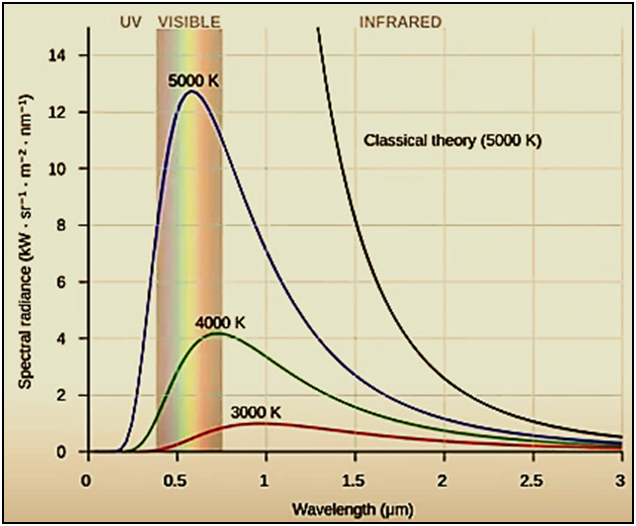
2.8 Particle nature of Electromagnetic radiation Some of the experimental phenomenon such as diffraction and interference can be explained by the wave nature of the electromagnetic radiation but not the following observations. (i) Black -body radiation: The nature of emission of radiation from hot bodies (ii) Photoelectric effect: Ejection of electrons from metal surface when radiation strikes it (iii) Variation of heat capacity of solids as a function of temperature 2.8.1 Black body radiation The ideal body which emit and absorbs all the frequencies is called Black body and the radiation emitted by such body is called Black body radiation. It neither reflects nor transmits any of the incident radiation and therefore appears black, whatever the colour of the incident radiation. When an ideal black body is heated, it becomes red-hot or emits red coloured light. As the temperature is further increased, the colour of the radiation emitted changes from red to yellow to white and finally blue as the temperature becomes very high. This implies that the wavelength of radiation emitted by the black body decreases with an increase in temperature. At a given temperature, intensity of radiation emitted increases with the increase of wavelength, reaches a maximum value at a given wavelength and then starts decreasing with further increase of wavelength. Also, as the temperature increases, the maxima of the curve shift to short wavelength.
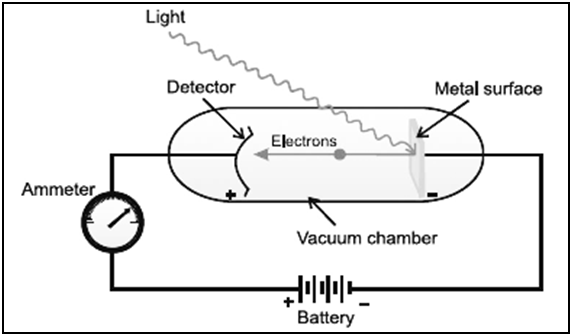
2.8.2 Planck’s Theory: Quantization of Energy Scientists were not able to explain these observations of black body radiation with the electromagnetic theory. Planck was able by the assumption that absorption and emission of radiation arises from oscillator i.e., atoms in the wall of black body. Their frequency of oscillation is changed by interaction with oscillators of electromagnetic radiation. This theory says: (a) The radiation energy emitted or observed in the form of small packets of energy (quantum or photon) in discrete quantities and not in a continuous manner. The restriction of any property to discrete values is called quantization. (b) Energy of each photon is directly proportional to frequency of radiation. E∝ ν or E = h ν where h = Planck’s constant = 6.626 x 10 -34 J.s 2.8.3 Photoelectric effect H. Hertz performed an experiment in which electrons (or electric current) were ejected when certain metals (for example K, Rb, Cs etc.) were exposed to a beam of light. The phenomenon of ejection of electrons from the surface of a metal when light of suitable frequency strikes on it is called photoelectric effect. These ejected electrons are called photoelectrons.
2.8.3.1 Observation of the experiment For each metal, a characteristic minimum frequency (threshold frequency ν Ο ) of light is needed to eject the electrons. If frequency of light is less than the threshold frequency there is no ejection of electrons no matter how long it falls on surface or how high is its intensity. The kinetic energy of the ejected electrons is directly proportional to the frequency of the incident ( ν ) radiation and it is independent of its intensity. The number of electrons ejected per second from the metal surface depends upon the intensity or brightness of incident radiation but independent of its frequency. Note: Frequency is defined as the number of wavelengths passing through a fixed point per unit time whereas; intensity of light is the number of photons falling on a certain area, within some interval of time. 2.8.3.2 Explanation of the observations All the experimental results could not be explained on the basis of laws of classical physics according to which the energy content of the beam of light depends upon the intensity of the light. So, explanations were given using Plank’s Quantum theory. Einstein could explain photoelectric effect using Plank’s Quantum theory. Photoelectrons are ejected only when incident light has threshold frequency ( ν Ο ). If frequency of incident light is more than threshold frequency then the excess energy is imparted to electrons in the form of kinetic energy. Greater the frequency of incident light ( ν ), greater the kinetic energy of e. Greater the intensity of light more is the number of electrons ejected. E=K max + W h ν = 1
2
mv 2 + h ν Ο
Where E = energy of photon, K max = maximum kinetic energy, W =work function, v = velocity 2.9 Dual behaviour of Electromagnetic radiation Electromagnetic radiation such as light exhibits both wave nature and particle nature. This is said to be dual nature of electromagnetic radiation. Interference and diffraction of light is due to wave nature of light whereas Photoelectric effect is due to particle nature of light.The only way to resolve this dilemma is to accept the dual nature of the Electromagnetic Radiation that is Electromagnetic radiation has both the wave nature and particle nature.Light behaves either as a wave or as a stream of particles depending on the experiment. These particles with wave nature are called photons.On most occasions, one set of properties is the most significant.The longer the wavelength of the electromagnetic radiation the more significant are the wave properties.Light of intermediate wavelength, is best considered to be equally significant in both. 2.10 Line, Band and Continuous spectra When white light is analyzed by passing through prism, it splits into seven colors called spectrum (VIBGYOR). These colors are so continuous that each of them merges into the next, hence, known as continuous spectrum.Continuous spectra (also called thermal or blackbody spectra) arise from hot, dense light sources (dense gases or solid objects). They emit radiation over a broad range of wavelengths, thus the spectra appear smooth and continuous.
Line Spectrum or Atomic Spectrum is made up of distinct lines. When an electron in an atom excites and de-excites, this spectrum occurs. Line spectra are characteristic of the elements that emit the radiation. They are also called atomic spectra because the lines represent wavelengths radiated from atoms when electrons change from one energy level to another. There are two types of line spectra; emission and absorption
Band spectrum or Molecular spectrum is produced by molecules, which consist of a series of closely spaced lines separated by dark spaces called bands.
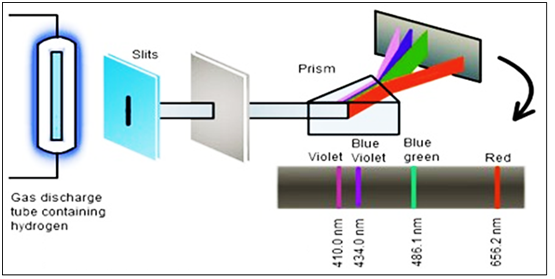
2.11 Emission & Absorption Spectrum Spectra may be classified according to the nature of their origin, i.e., emission or absorption. An emission spectrum consists of all the radiations emitted by atoms or molecules, whereas in an absorption spectrum, portions of a continuous spectrum (light containing all wavelengths) are missing because they have been absorbed by the medium through which the light has passed. Emission Spectrum: The spectrum of radiation emitted by a substance that has absorbed energy is called an emission spectrum. It is noticed when radiations emitted from source are passed through a prism &received on photographic plate. This kind of spectrum usually consists of bright lines on a dark background.
Absorption Spectrum: Absorption spectrum is the spectrum obtained when radiation is passed through a sample of material. The certain wavelengths which are absorbed are missing and come as dark lines. An absorption spectrum is like the photographic negative of an emission spectrum. Unlike the emission spectrum, it consists of dark lines on a bright background.
2.12 Line Spectrum of Hydrogen When H 2 gas present on discharge tube passed through high voltage & low pressure, the radiations emitted passed through spectroscope and spectrum is obtained on photographic plate. H 2 spectrum contains several lines known as series named after their discoverers.
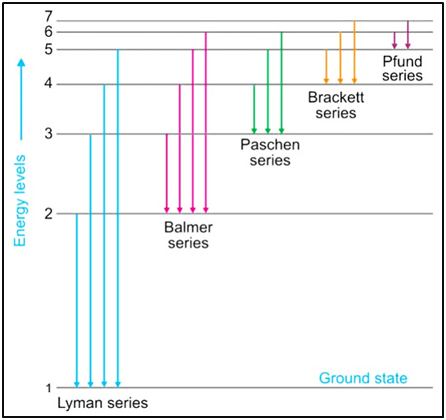
Johannes Rydberg, noted that all series of lines in the H spectrum could be described by the following equation in terms of wavenumber ( - ν ). - ν = 1/ λ R H (1/n1 2 -1/n2 2 ) cm-1 ; where R H = 109677 cm-1= Rydberg constant for H, n 1 =1,2........and n 2 = (n 1 + 1), (n 1 + 2)......
Series n1 n2 Region of spectrum
Lyman 1 2, 3, 4….. Ultraviolet
Balmer 2 3, 4, 5….. Visible
Paschen 3 4, 5, 6….. Infrared
Bracket 4 5, 6, 7….. Infrared
Pfund 5 6, 7, 8….. Infrared
Figure 5 : Transitions of the electron in the H atom (all series of transitions are shown)
H atom has the simplest line spectrum of all the elements. Line spectrum becomesmore and more complex for heavier atom. The features that are common to all line spectra, i.e., (i) line spectrum of an element is unique and (ii) there is regularity in the line spectrum of each element. 2.13 Bohr’s Model for H Atom The work of Planck and Einstein showed that the energy of electromagnetic radiation is quantised in units of hν. Extending Planck’s quantum hypothesis to the energies of atoms, Niels Bohr proposed a new atomic model for the H-atom.This model is based on the following assumptions The energies of electrons are quantised. The electron is revolving around the nucleus in a certain fixed circular path called stationary orbit. Electron can revolve only in those orbits in which the angular momentum (mvr) of the electron must be equal to an integral multiple of h/2π, i.e. mvr = nh/2π where n = 1,2,3,...etc. As long as an electron revolves in the fixed stationary orbit, it doesn’t lose its energy. However, when energy is supplied to electron, it absorbs the energy and jumps from lower energy state (E 1 ) to higher state (E 2 ) and when an electron jumps from higher energy state (E 2 ) to a lower energy state (E 1 ), the excess energy is emitted as radiation. The frequency of radiation absorbed or emitted when transition occurs between two stationary states that differ in energy by ΔE is, ν = ΔE/h = (E 2 – E 1 )/h 2.13.1 Some important information regarding Bohr’s theory for H like system containing only 1 electron (He + , Li 2+ , Be 3+ etc.) Applying Bohr’s postulates to an H like atom, the radius of the nth orbit and the energy of the electron revolving in the n th orbit were derived. The stationary states for electron are numbered n = 1,2,3.......... These integral numbers are known as Principal quantum numbers. The radii of the stationary states are expressed as: r n = 52.9 n
Z
pm
Where Z = atomic number of the element concerned. Thus the radius of the first stationary state of H atom, called the Bohr orbit, is 52.9 pm (n = 1, Z = 1). As n increases the value of r will increase that is the electron will be present away from the nucleus. The most important property associated with the electron, is the energy of its stationary state which is given by the expression. E n = -2.18 x 10 -18 ( Z 2
n 2
) J
A free electron at rest is infinitely away from the nucleus and is assigned a energy level 0. The difference in energy between initial and final state is given by ΔE = E f – E i =2.18 x 10 -18 x Z 2 ( 1
n 2 i
- 1
n 2 f
)
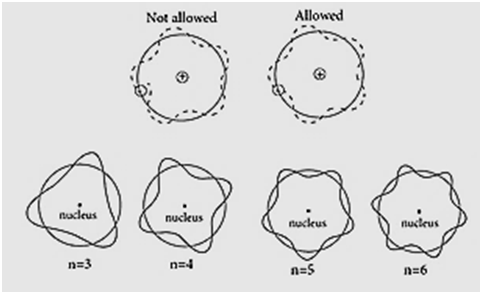
In case of absorption, n f >n i and ∆E is +ve and in case of emission, n i >n f and ∆E is –ve. The time taken for the electron having velocity v in a Bohr’s orbit is given as T = (distance/velocity) = (circumference/velocity) = (2πr n /v) As the frequency is the inverse of time taken. Hence, frequency can be given as = 1/T = (v/2πr n ) and velocity v = (2πr n /T) 2.13.2 Merits & Demerits of Bohr’s Theory Merits It can explain atomic spectrum of H atom. It can explain stability of atom (improvement over Rutherford’s nuclear model). Bohr’s theory helped in calculating energy of electron in H atom & H like atoms. Demerits The Bohr’s atom model is applicable only to species having one electron such as H, Li 2+ etc. and not applicable to multi electron atoms. It was unable to explain the splitting of spectral lines in the presence of magnetic field (Zeeman effect) or an electric field (Stark effect). Bohr’s theory was unable to explain why the electron is restricted to revolve around the nucleus in a fixed orbit in which the angular momentum of the electron is equal to nh/2π and a logical answer for this, was provided by Louis de Broglie. Bohr Theory failed to explain fine structure of spectral lines. This theory failed to explain ability of atoms to form molecule by chemical bonds. It was not in accordance with Heisenberg uncertainty principle. 2.14 Dual behaviour of matter: De-Broglie equation Albert Einstein proposed that light has dual nature. i.e. light photons behave both like a particle and as a wave. Louis de Broglie extended this concept and proposed that all forms of matter showed dual character. To quantify this relation, he derived an equation for the wavelength of a matter wave. He combined two equations of energy of which one represents wave character (h ν ) and the other represents the particle nature (mc 2 ).From Planck’s quantum hypothesis E = h ν and from Einsteins mass-energy relationship E = mc 2 . Combining both we get, h ν = mc 2 or hc/λ = mc 2 or λ = h/mc For a particle of matter with mass m and moving with a velocity v, we can write λ = h/mv. This is valid only when the particle travels at speeds much less than the speed of Light.The equation λ = h/mv implies that a moving particle can be considered as a wave and a wave can exhibit the properties (i.e. momentum) of a particle. For a particle with high linear momentum (mv), the wavelength will be so small and cannot be observed. For a microscopic particle such as an electron, the mass is of the order of 10 -31 kg, hence the wavelength is much larger than the size of atom and it becomes significant. 2.14.1 Quantisation of Angular momentum According to the de Broglie concept, the electron that revolves around the nucleus exhibits both particle and wave character. In order for the electron wave to exist in phase, the circumference of the orbit should be an integral multiple of the wavelength of the electron wave. Otherwise, the electron wave is out of phase.
Circumference of the orbit = nλ or 2πr = nλ = nh/mv Rearranging we get, mvr = nh/2π or angular momentum = nh/2π The equation mvr = nh/2π was already predicted by Bohr. Hence, De Broglie and Bohr’s concepts are in agreement with each other. 2.15 Heisenberg’s Uncertainty principle Uncertainty principle, stated by Werner Heisenberg in 1927, is the consequence of dual behaviour of matter and radiation. It states that it is impossible to determine simultaneously, the exact position and exact momentum (or velocity) of an electron. If the position of the electron is known with high degree of accuracy (Δx is small), then the velocity of the electron will be uncertain (Δv is large) and vice versa. So, if we carry out some physical measurements on the electron’s position or velocity, the outcome will always depict a fuzzy picture. The uncertainty principle has negligible effect for macroscopic objects and becomes significant only for microscopic particles. Δx. Δp≥ h/4π Δx. Δ(m.v) ≥ h/4π Δx. Δv≥ h/4πm Where Δx and Δp are uncertainties in determining the position and momentum, respectively. 2.15.1 How Heisenberg’s Uncertainty principle works? To determine the position of an electron, we must use a meter-stick calibrated in units of smaller than the dimensions of electron. Hence, to observe an electron, we can illuminate it with “light” of wavelength smaller than the dimensions of an electron. The high momentum (mv = h/λ) photons of such light would change the energy of electrons by collisions. By doing so, we will certainly be able to calculate the position of the electron, but we would know very little about the velocity of the electron. 2.15.2 Heisenberg Uncertainty Principle rules out existence of definite paths or trajectories of electrons or other similar particles The fixed path of an object is determined by its location and velocity at various moments. If we know where a body is at a particular instant along with its velocity and the forces acting on it at that instant, we can predict where the body would be after sometime. According to this principle, for microscopic particles such as an electron, it is not possible. Thus, fixed path of an electron is impossible. Failure of Bohr’s model & introduction of quantum mechanics The wave character is not considered in Bohr model and so it ignores dual behaviour of matter. According to Bohr model, an orbit is clearly defined path but this path can completely be defined only if both position & velocity of electron are known at the same time. However, this is not possible according to Heisenberg uncertainty principle. So, a new model is required to describe structure of the atom which could account for wave-particle duality of matter and be consistent with Heisenberg uncertainty principle. The ‘precision’ of the position and momentum of electrons have to be replaced by the term ‘probability’ and this came with the introduction of quantum mechanics. 2.16 Quantum mechanical model In classical mechanics, the physical state of the particle is defined by its position and momentum. Knowledge of both these properties, help us to predict the future state of the system. The motion of objects that we come across in our daily life can be well described using classical mechanics (based on the Newton’s laws of motion) which have essentially a particle-like behaviour. However, according to Heisenberg’s uncertainty principle both these properties cannot be measured simultaneously with absolute accuracy for a microscopic particle such as an electron. As the classical mechanics does not consider the dual nature of the matter which is significant for microscopic particles, it fails to explain the motion of microscopic particles. A new mechanics called quantum mechanics was developed based on the Heisenberg’s principle and the dual nature of the microscopic particles.When it is applied to macroscopic objects (wave like properties are insignificant) the results are the same as those from the classical mechanics. 2.16.1 Schrödinger equation Erwin Schrödinger expressed the wave nature of electron in terms of a differential equation. This equation determines the change of wave function in space depending on the field of force in which the electron moves. Quantum mechanics is based on this fundamental equation called Schrödinger equation. This equation including wave-particle duality of matter as proposed by de Broglie is quite complex. The Schrödinger equation for a system such as an atom or a molecule whose energy does not change with time (time independent) can be expressed as, H ̂Ψ = EΨ where Ĥ is a mathematical operator called Hamiltonian Ψ is the wave function and is a function of position co-ordinates of the particle. This equation can be solved only for certain values of E, the total energy. i.e. the energy of the system is quantized. The total energy of the system takes into account the kinetic energies of all the subatomic particles (electrons, nuclei), attractive potential between the electrons and nuclei and repulsive potential among the electrons and nuclei individually. Solution of this equation gives E and Ψ. The permitted total energy values are called Eigen values and the corresponding wave functions represent the atomic orbitals. 2.16.2 Features of the quantum mechanical model The energy of electrons in atoms is quantized i.e. it can have only certain specific energy values. The quantized energy of an electron is the allowed solution of the Schrödinger wave equation and it is the result of wave like properties of electron. The exact position and momentum of an electron cannot be determined with absolute accuracy. As a consequence, quantum mechanics introduced the concept of orbital which is a 3D space in which the probability of finding the electron is maximum. The solution of Schrödinger wave equation for the allowed energies of an atom gives the wave function ψ, which represents an atomic orbital. The wave nature of electron present in an orbital can be well defined by the wave function ψ. All the information about the electron in an atom is stored in ψ and quantum mechanics makes it possible to extract this information out of ψ.The wave function ψ itself has no physical meaning. However, the probability of finding the electron in a small volume dxdydz around a point (x,y,z) is proportional to |ψ(x,y,z)| 2 . |ψ(x,y,z)| 2 or ψ 2 (always +ve) is known as probability density. 2.16.3 Schrödinger equation for H atom When Schrödinger equation is solved for H atom, the solution gives the possible energy levels, the electron can occupy and the corresponding wave function(s) (ψ) of the electron associated with each energy level. These quantized energy states and corresponding wave functions which are characterized by a set of three quantum numbers (principal, azimuthal, and magnetic) arise as a natural consequence in the solution of the Schrödinger equation. The quantum mechanical results of the H atom successfully predict all aspects of the H atom spectrum including some phenomena that could not be explained by the Bohr model. The Schrödinger equation cannot be solved exactly for a multi-electron atom but it can be overcome by using approximate methods. For multi-electron system, the principal difference lies in the consequence of increased nuclear charge and because of this all the orbitals are somewhat contracted. 2.16.4 Quantum numbers A set of 4 quantum numbers which specify the energy, size, shape and orientation of an orbital about all the electrons present in an atom is called Quantum Numbers . To specify an orbital, only 3 quantum numbers are required while to specify an electron all 4 quantum numbers are required. The 4 th quantum number arises due to the spinning of the electron about its own axis. When Schrödinger equation is solved for a wave function Ψ, the solution contains the first 3 quantum numbers. The quantum numbers are described below. Principal quantum number (n): This quantum number represents the energy level in which electron revolves around the nucleus and is denoted by the symbol ’n’.The ’n’ can have the values 1, 2, 3,…etc. n=1 represents K shell; n=2 represents L shell and n = 3, 4, 5 represent the M, N, O shells, respectively.The maximum number of orbitals in a shell is given by n2 and the maximum number of electrons that can be accommodated in a given shell is 2n2.’n’ gives the energy of the electron, E n = (-1312.8) Z 2 /n 2 kJ/mole and the distance of the electron from the nucleus is given by r n =(0.529) n 2 /Z A ° .
n 1 2 3
No. of orbitals (n 2 ) 1 4 9
Max no. of electrons (2n 2 ) 2 8 18
Azimuthal/ subsidiary/ Orbital angular quantum number(l) Each shell consists of one or more sub-shells and number of subshells (l) in a particular shell is equal to n where n is principal shell. So, l values are 0 to (n-1). Sub-shells corresponding to different values of l are represented by the symbols: s, p, d, f, etc. It defines the 3D shape of the orbital. It is used to calculate the orbital angular momentum using the expression Angular momentum = √l(l+1) h/2π
Orbital l
s 0
p 1
d 2
f 3
n l Subshell notation
1 0 1s
2 0 2s
2 1 2p
3 0 3s
3 1 3p
3 2 3d
4 0 4s
4 1 4p
4 2 4d
4 3 4f        
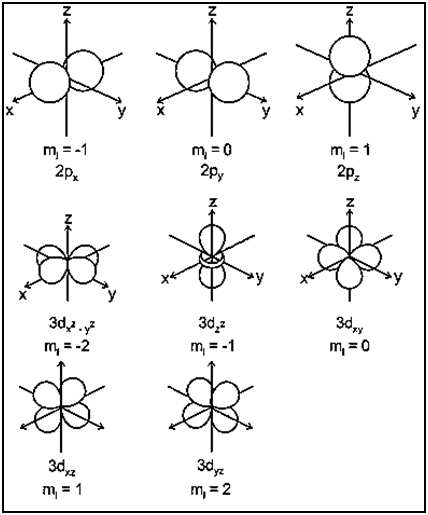
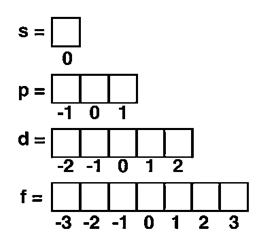
Magnetic Quantum number (m l ) It gives information about the no. of preferred orientations of electrons in sub-shell and each orientation corresponds to an orbital.For any sub-shell (defined by ‘l’ value), (2l+1) values of ml are possible and the maximum number of electrons that can be accommodated in a given subshell is 2(2l+1). It takes integral values ranging from -l to +l through 0. The Zeeman Effect (the splitting of spectral lines in a magnetic field) provides the experimental justification for this quantum number. The magnitude of the angular momentum is determined by l while its direction is given by m l .
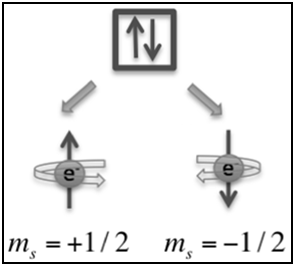
Spin quantum number (ms) The 3 quantum numbers mentioned work well for describing electron orbitals, but some experiments showed that they were not sufficient to explain all observed results. When H-line spectra are examined at extremely high resolution, some lines are actually not single peaks but, rather, pairs of closely spaced lines (fine structure of the spectrum). It means that there are additional small differences in energies of electrons even though they are located in the same orbital. These observations led to a 4th quantum number; spin quantum number. Each electron acts as a tiny magnet or a tiny rotating object with an angular momentum, even though this rotation cannot be observed in terms of the spatial coordinates. Corresponding to the clockwise and anti-clockwise spinning of the electron, maximum two values are possible for this quantum number; -½ or +½.
Q. N. Symbol Allowed values Physical meaning
Principal n 1, 2, 3, 4……….∞ shell, the general region for the value of energy for an electron on the orbital.
Azimuthal l 0, 1, 2, 3…………(n-1) subshell, the shape of the orbital
Magnetic m l +l………0……….-l orientation of the orbital
Spin m s ± ½ direction of the intrinsic quantum spinning of the electron
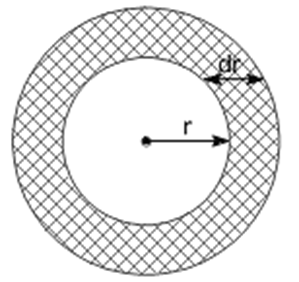
2.16.5 Probable distribution in an orbital Probability density |ψ| 2 is the probability per unit volume and the product of |ψ| 2 and a small volume (called a volume element) yields the probability of finding the electron in that volume. The reason for specifying a small volume element is that |ψ| 2 varies from one region to another in space but its value can be assumed to be constant within a small volume element). The total probability of finding the electron in a given volume can then be calculated by the sum of all the products of |ψ| 2 and the corresponding volume elements. In this way, it is possible to get the probable distribution of an electron in an orbital. The solution (Ψ) of the Schrӧdinger wave equation for one electron system like H can be represented in the following form in spherical polar coordinates r, θ, φ as, Ψ(r,θ,ϕ) = R(r)Y(θ,ϕ) Where R(r) is the radial component which depends only on the distance from the nucleus and Y(θ,ϕ) is the angular component. The radial part is dependent on n and l, while the angular part is dependent on l and m l . Radial distribution function It is important to know how |Ψ| 2 varies with the distance from nucleus (radial distribution of the probability) and the direction from the nucleus (angular distribution of the probability). Radial probability density = R 2 (r) = It is the square of the radial wave function. Radial probability: It is the probability of finding the electron within the spherical shell enclosed between a sphere of radius ’r + dr’ and a sphere of radius "r’ from the nucleus. Radial Probability = (Volume of spherical shell x Radial probability density) = [4πr 2 dr x R 2 (r)] 4πr 2 R 2 (r) is also known as Radial distribution function. It gives idea about the distribution of electron density at a radial distance around the nucleus without considering the direction or angle.
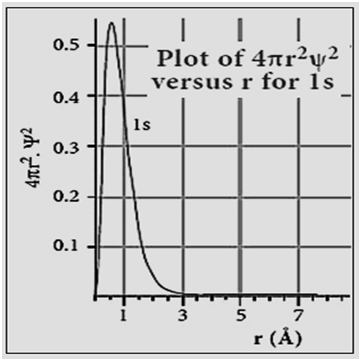
Radial distribution function Consider a single electron of H atom in the GS for which the quantum numbers are n=1 and l=0. i.e. it occupies 1s orbital. Plot of 4πr 2 Ψ 2 versus r for 1s is The plot shows that the maximum probability occurs at distance of 0.52 Å (Bohr radius) from the nucleus. It indicates that the maximum probability of finding the electron around the nucleus is at this distance.
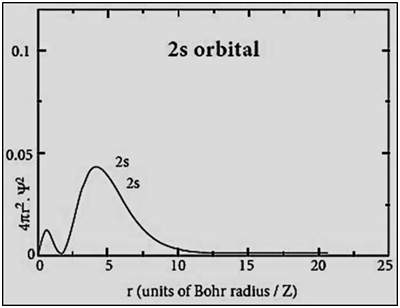
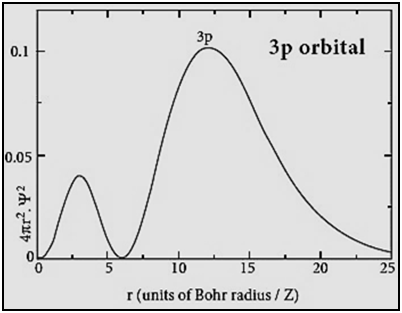
Plot of 4πr 2 Ψ 2 versus r for 2s Plot of 4πr 2 Ψ 2 versus r for 3p
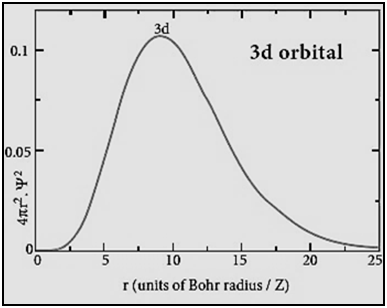
The plot of 4πr 2 Ψ 2 versus r for 3d
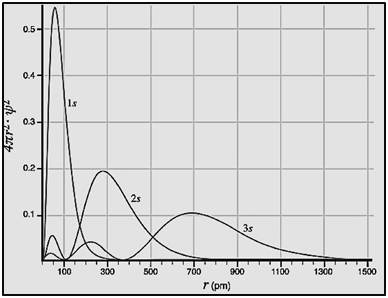
Plot of 4πr 2 Ψ 2 versus r for 1s, 2s, 3s
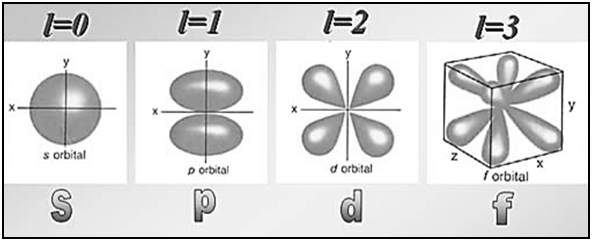
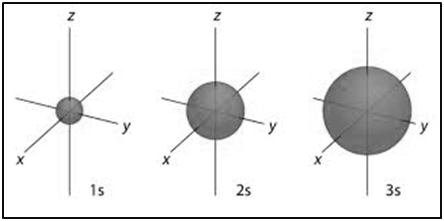
2.16.6Shapes of Orbitals Boundary Surface Diagrams: The angular component of Ψ describes the basic shape of the orbital. It is the surface in the space where probability density is constant for a given orbital. These shapes enclose the volume or region where probability of finding electron is high. Shape of s-orbital: All s -orbitals have spherical shape. The probability of finding the electron at a given distance is equal in all the directions. The size of the s orbital increases with increase in n, that is, 4s > 3s > 2s > 1s and the electron is located further away from the nucleus as n value increases.
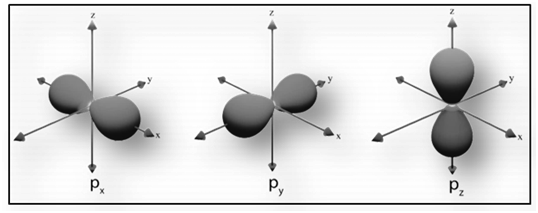
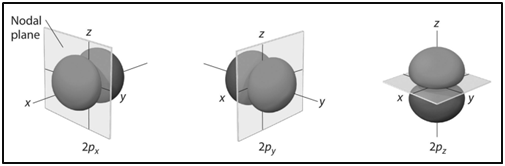
Shape of p-orbital: It has 3 possible orientations: p x , p y , p z . Each p orbital consists of two sections called lobes that are on either side of the plane that passes through the nucleus. The probability density function is zero on the plane where the two lobes touch each other. The size, shape and energy of the 3 orbitals are same, only the orientation is different.There is no simple relation between ml values (–1, 0, +1) & the x, y and z directions.
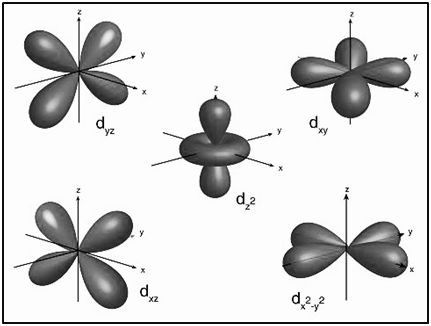
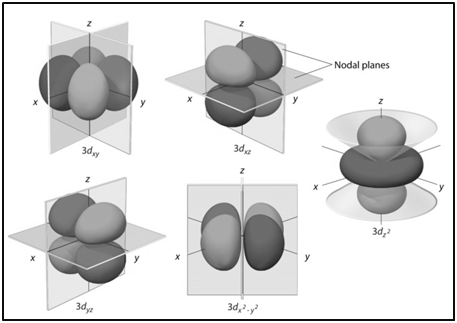
Shape of d-orbital: It has five orientations: d xy , d yz , d zx , d x2-y2 , d z2 The shapes of the first four d orbitals are similar to each other, where as that of the 5th one is different from others, but all five 3d orbitals are equivalent in energy.
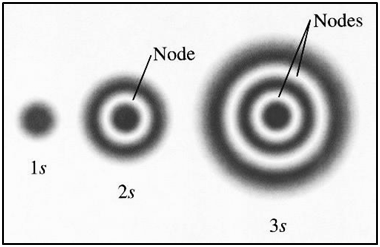
2.16.7Radial and Angular nodes: The region where this probability density function Ψ 2 or the probability of finding an electron reduces to zero is called nodal surfaces or simply nodes.There are two types of nodes: Radial nodes or Nodal region and Angular nodes or Nodal planes.The spherical surfaces around the nucleus where the probability of finding an electron is zero are called Radial nodes. Number of radial nodes = (n – l – 1) The planes or planar areas around the nucleus where the probability of finding an electron is zero are called Angular nodes. Number of angular nodes = l Total number of nodes = No. of radial nodes + No. of angular nodes = (n – 1)
1s: (n – l – 1) = 1-0-1 = 0 2s: (n – l – 1) = 2-0-1 = 1 3s: (n – l – 1) = 3-0-1 = 2 Angular nodes in p & d orbitals
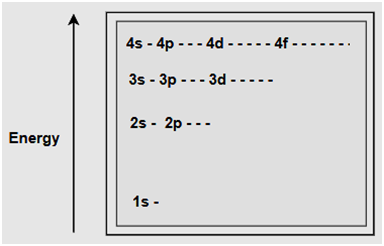
Angular nodes for p = l = 1Angular node for d = l = 2 2.16.8Energy of orbitals in H atom The energy required to remove an electron present in an orbital to infinity or the release of energy when an electron from infinity is brought to that orbital, is referred to as the energy of orbitals. The energy of an electron in a H atom is determined solely by the principal quantum (n). Thus the energy of the orbitals in hydrogen atom increases as follows 1s < 2s = 2p < 3s = 3p = 3d <4s = 4p = 4d = 4f <…..
Although the shapes of 2s and 2p orbitals are different, an electron has the same energy when it is in the 2s orbital as when it is present in 2p orbital. The orbitals having the same energy are called degenerate orbitals. 2.16.9 Energy of orbital in multi-electron atoms
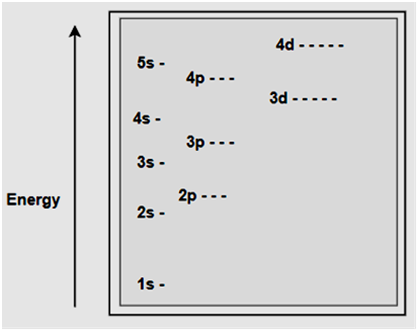
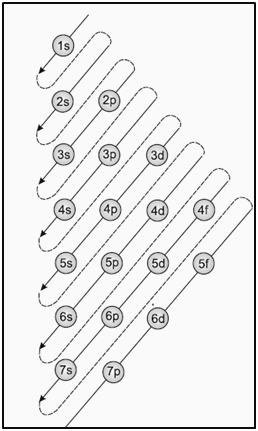
In a multi-electron atom, in addition to the electrostatic attractive force between the electron and nucleus, there exists a repulsive force among the electrons. The energy of the orbital in multi-electron atoms depends on angular momentum quantum number as well as principle quantum number. For a given principal quantum number, s, p, d, f... all have different energies. Within a given principal quantum number, the energy of orbitals increases in the order of s<p<d<f. The energy of the orbital is determined by sum of the principle quantum number and azimuthal quantum number; (n + l). The energies of same orbitals decrease with an increase in the atomic number. For example, E 2s (H) > E 2s (Li) > E 2s (Na) > E 2s (K). The lower the value of (n + l) for an orbital, the lower is its energy. If two orbitals have the same value of (n + l), the orbital with lower value of n will have the lower energy. 2.16.10 Effective nuclear charge The attractive interactions of an electron increases with increase of positive charge on the nucleus. Due to the presence of electrons in the inner shells, the electron in the outer shell will not experience the full positive charge of the nucleus. This results in the decrease in the nuclear force of attraction on electron due to the partial screening of positive charge on the nucleus by the inner shell electrons. This is known as the shielding of the outer shell electrons from the nucleus by the inner shell electrons, The net charge experienced by the electron is called effective nuclear charge. The effective nuclear charge depends on the shape of the orbitals and it decreases with increase in azimuthal quantum number l. The order of the effective nuclear charge felt by an electron in an orbital within the given shell is s > p > d > f. Greater the effective nuclear charge, greater is the stability of the orbital. Hence, within a given energy level, the energy of the orbitals is in the following order. s < p < d < f. 2.16.11 Filling of orbitals In an atom, the electrons are filled in various orbitals according to Aufbau principle, Pauli exclusion principle and Hund’s rule. Aufbau principle In the ground state of the atoms, the orbitals are filled in the order of their increasing energies. It means, the electrons first occupy the lowest energy orbital available to them. Once the lower energy orbitals are completely filled, then the electrons enter the next higher energy orbitals in accordance with (n+l) rule.The order should be assumed to be a rough guide to the filling of energy levels. In many cases, the orbitals are similar in energy and small changes in atomic structure may bring about a change in the order.
Orbital n l n+l
1s 1 0 1
2s 2 0 2
2p 2 1 3
3s 3 0 3
3p 3 1 4
3d 3 2 5
4s 4 0 4
4p 4 1 5
4d 4 2 6
4f 4 3 7
5s 5 0 5
5p 5 1 6
5d 5 2 7
5f 5 3 8
(n+l) values of different orbitals Pauli Exclusion Principle The principle states that "No two electrons in an atom can have the same set of values of all four quantum numbers." For the lone electron present in H atom, the four quantum numbers are: n = 1; l = 0; m = 0 and s = +½. For the two electrons present in He, one electron has the quantum numbers same as the electron of H atom, n = 1, l = 0, m = 0 and s = +½. For other electron, the 4th quantum number is different i.e., n = 1, l = 0, m = 0 and s = –½. As we know that the spin quantum number can have only two values +½ and –½, only 2 electrons can be accommodated in a given orbital in accordance with Pauli exclusion principle. Here, the four quantum numbers are shown for the eight electrons present in 2s and 2p orbitals of Ne (atomic number = 10).
Electron n l m s
1st 2 0 0 +1/2
2nd 2 0 0 -1/2
3rd 2 1 -1 +1/2
4th 2 1 -1 -1/2
5th 2 1 0 +1/2
6th 2 1 0 -1/2
7th 2 1 +1 +1/2
8th 2 1 +1 -1/2
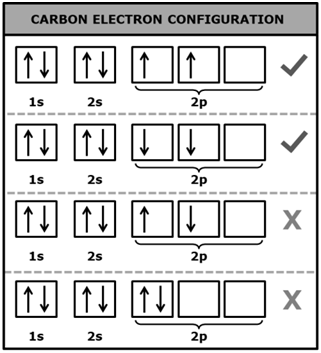
Hund’s rule of maximum multiplicity The rule states that “Each orbital in a sublevel or subshell (p, d or f) is singly occupied before any orbital is doubly occupied” and “The electrons present in singly occupied orbitals possess identical spin”. 1st rule: There are 3 p orbitals, 5 d orbitals and 7 f orbitals and according to this rule, pairing of electrons in these orbitals starts only when the 4th, 6th and 8th electron enters the p, d and f orbitals respectively. 2nd rule: The 1st electron in a sublevel could be either spin-up or spin-down. Once the spin of the 1st electron in a sublevel is chosen, the spins of all of the other electrons in that sublevel are fixed. In general, the 1st electron, and any other unpaired electron is drawn as spin-up.
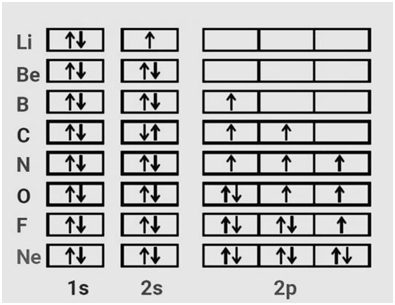
2.16.12 Electron configuration The distribution of electrons into various orbitals of an atom is called its electronic configuration. It can be written based on the Aufbau principle, Pauli exclusion principle and Hund’s rule. The electrons in the completely filled shell are called core electrons. The electrons that are added to the electronic shell with the highest n value is called valence electrons.The electronic configuration is written as nlx, where n represents the principle Q.N. and ’l’ represents the letter designation of the orbital (s, p, d, f etc.) and ’x’ represents the number of electron present in that orbital.
Element Atomic number (z) Electron configuration
C 6 1s 2 2s 2 2p 2 [He] 2s 2 2p 2
N 7 1s 2 2s 2 2p 3 [He] 2s 2 2p 3
O 8 1s 2 2s 2 2p 4 [He] 2s 2 2p 4
F 9 1s 2 2s 2 2p 5 [He] 2s 2 2p 5
Ne 10 1s 2 2s 2 2p 6 [He] 2s 2 2p 6
Na 11 1s 2 2s 2 2p 3 3s 1 [Ne]3s 1
Mg 12 1s 2 2s 2 2p 6 3s 2 [Ne]3s 2
Al 13 1s 2 2s 2 2p 3 3s 2 3p 1 [Ne]3s 2 3p 1
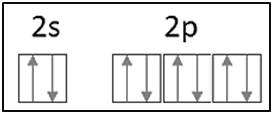
Electronic configurations of some elements Electron configuration with orbital diagram Instead of using letter symbols for the subshells, another notation can also be used for electron configuration is by using orbital diagram. Each orbital of the subshell is represented by a box and the electron is represented by an arrow (↑) a +ve spin or an arrow (↓) a –vespin. This notation has an advantage over the first as from this diagram the four quantum numbers can be understood.
Importance of Electronic configuration When atoms come into contact with one another, it is only the outermost electrons of these atoms, or valence shell that will interact first. It helps to classify elements into different blocks (s-block, p-block, d-block etc.) making it easier to collectively study the properties of the elements. Electron configurations can also predict stability depending on whether the valence shell is complete or not. An atom is least stable (or most reactive) when its valence shell is incomplete. Elements that have the same number of valence electrons often have similar chemical properties. The most stable configurations are the ones that have full energy levels (noble gases). The noble gases are very stable elements that do not react easily with any other elements. Electron configurations can assist in making predictions about the ways in which certain elements will react, and the chemical compounds that different elements will form. 2.16.13 Stability of completely & half-filled subshells Though the ground state electronic configuration of the atom of an element always corresponds to the state of the lowest total electronic energy, in some cases, the actual electronic configuration of some elements (such as Cr and Cu) slightly differ from the expected electronic configuration in accordance with the Aufbau principle. In these cases, the exactly half filled and completely filled orbitals have greater stability than other partially filled configurations in degenerate orbitals.This can be explained on the basis of Symmetry and Exchange energy.
Element Expected configuration Actual configuration
Cr (atomic no. 24) 1s 2 2s 2 2p 6 3s 2 3p 3 3d 4 4s 2 1s 2 2s 2 2p 6 3s 2 3p 6 3d 5 4s 1
Cu (atomic no. 29) 1s 2 2s 2 2p 3 3s 2 3p 6 3d 9 4s 2 1s 2 2s 2 2p 6 3s 2 3p 6 3d 10 4s 1
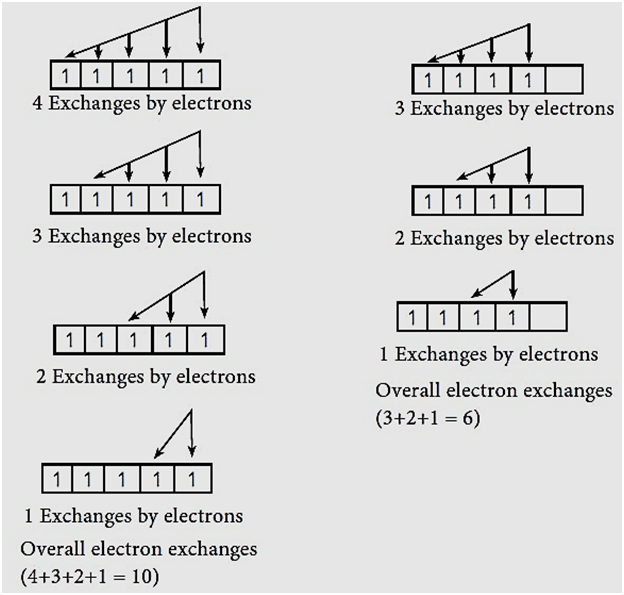
Symmetry: The degenerate orbitals such as p x , p y and p z have equal energies but their orientation in space are different. Due to this symmetrical distribution, the shielding of one electron on the other is relatively small and hence the electrons are attracted more strongly by the nucleus and it increases the stability. Exchange energy: The two or more electrons with the same spin present in the degenerate orbitals of a sub-shell can exchange their position and the energy released due to this exchange is called exchange energy. The numbers of exchanges aremaximum when the subshell is either half-filled or completely filled resulting maximum exchange energy or stability. It is the basis for Hund’s rule, which allows maximum multiplicity.