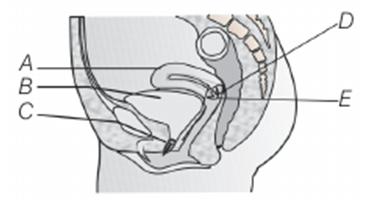
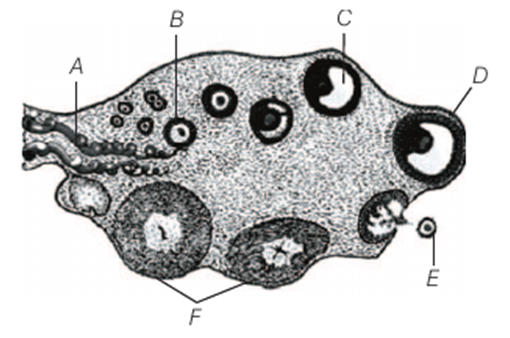
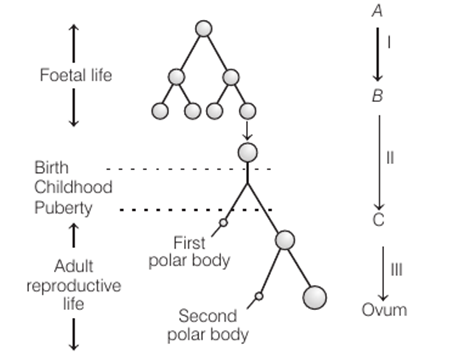
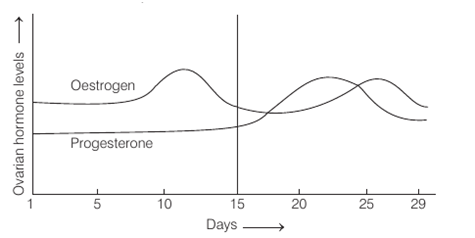
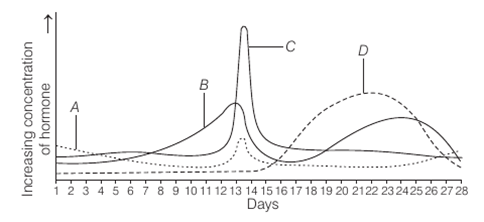
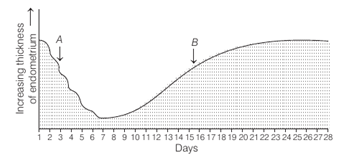
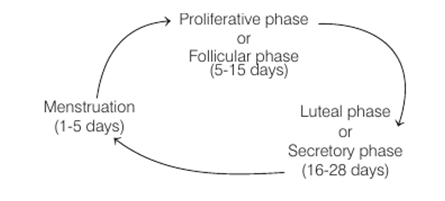
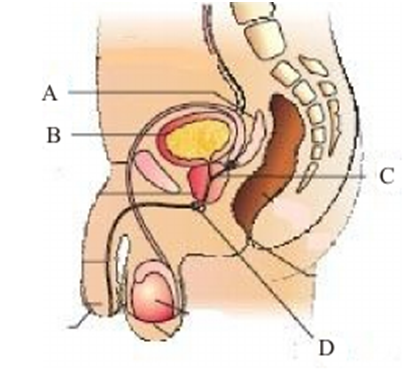
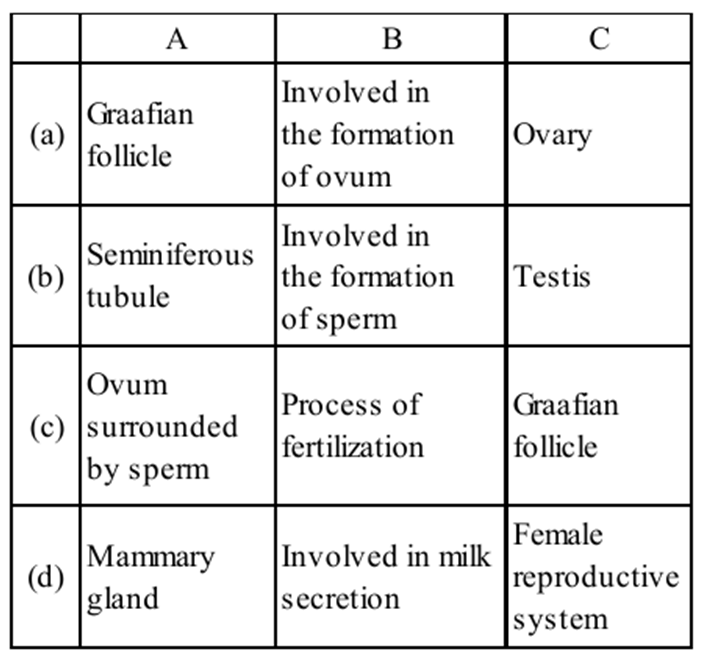
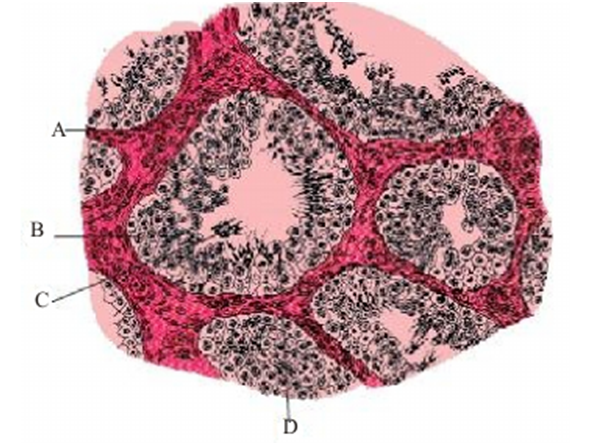
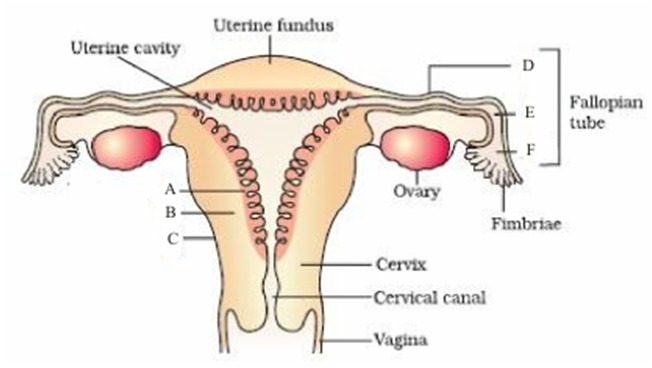
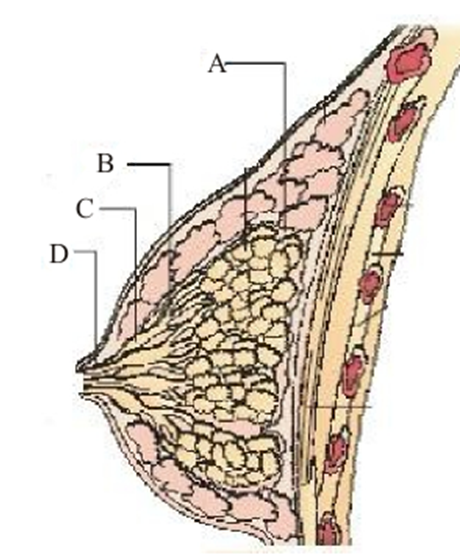
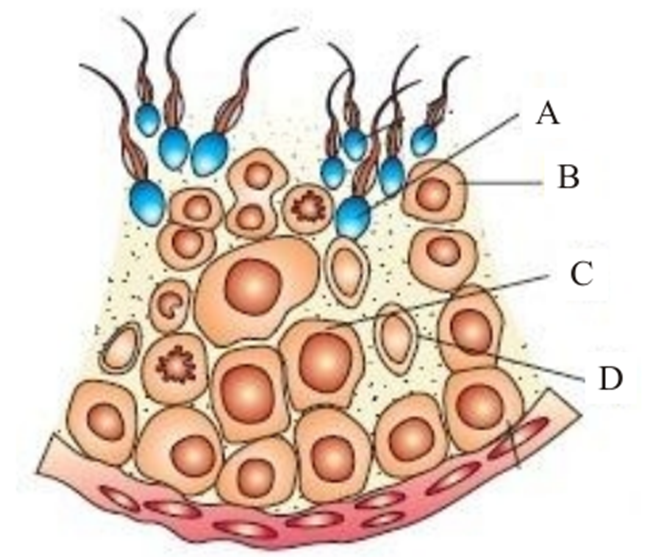
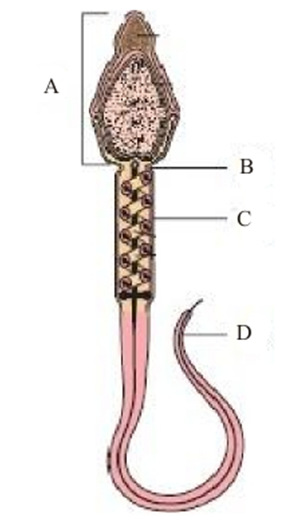
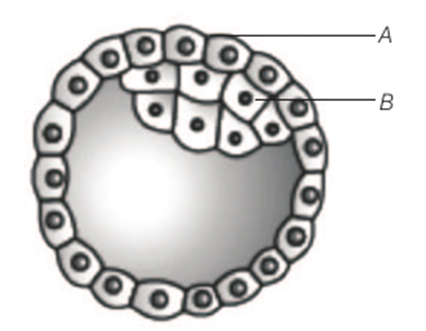
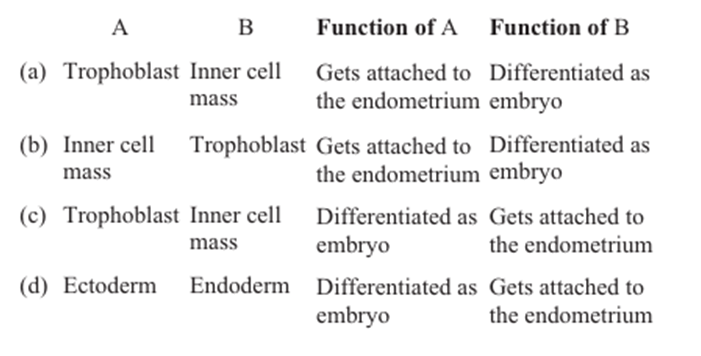
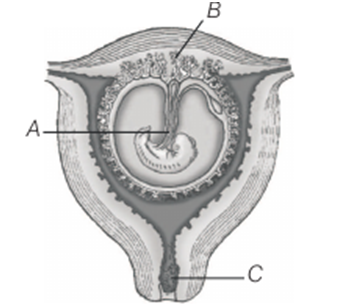
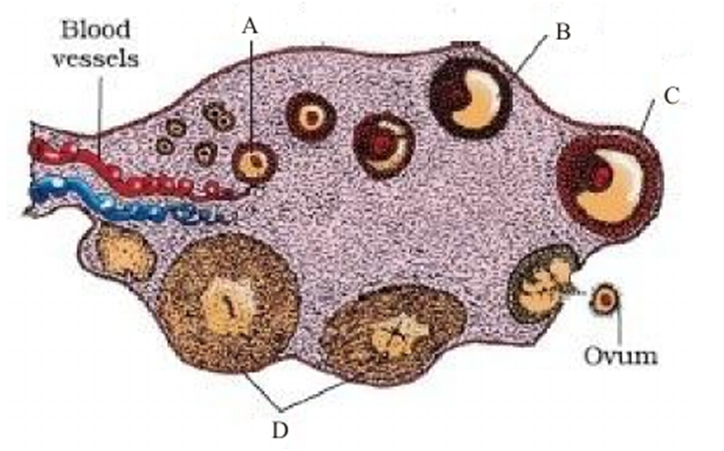
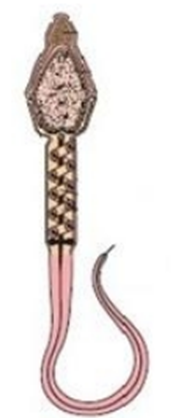
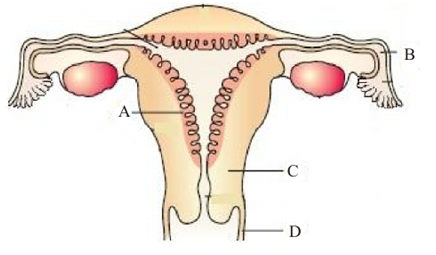
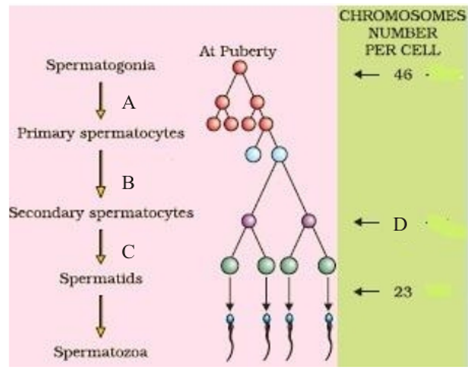
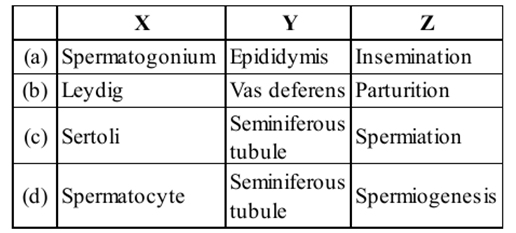
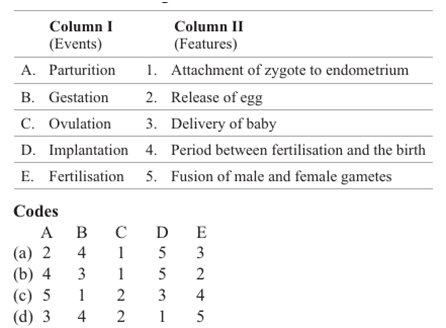
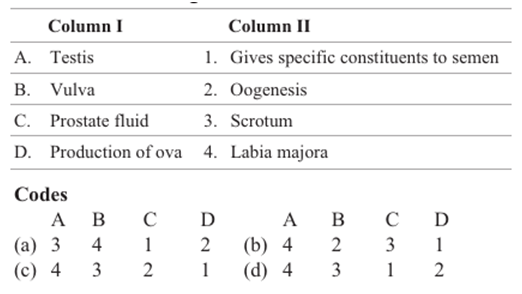
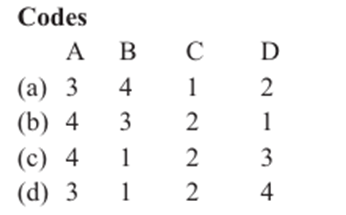
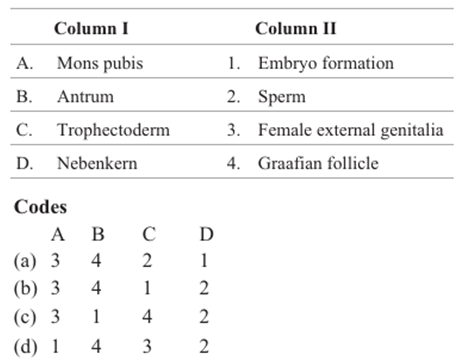
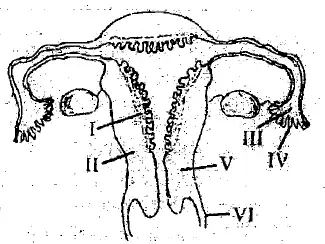
a1. Testes are suspended outside the abdominal cavity, in a Pouch which is(a) tunica albuginea(b) inguinal canal(c) epididymis(d) scrotum2. Scrotum is to maintain the…………….(a) temperature of testes(b) body temperature(c) level of growth hormone(d) level of male hormone3. Length and width of testis areapproximately(a) 4-5 cm and 2-3 cm(b) 5-6 cm and 3-4 cm(c) 6-7 cm and 4-5 cm(d) 7-8 cm and 8-9 cm4. Each human testis consists of ………number of compartments?(a) 250(b) 300(c) 350(d) 4005. Mammalian testes compartments are called as(a) testicular lobules(b) seminiferous tubules(c) Sertoli cells(d) interstitial cells6. Testicular lobules contain(a) 3-5 seminiferous tubules(b) 2-6 seminiferous tubules(c) 5-7 seminiferous tubules(d) 1-3 seminiferous tubules7. The inner lining of seminiferous tubules of the testis is …….(a) Spermatocytes(b) spermatogonia(c) cells of Sertoli(d) Both (b) and (c)8. Select the one which provide nutrition to the male germ cells.(a) Interstitial cells(b) Leydig cells(c) Sertoli cells(d) Both (a) and (b)9. ……………… cells present in the mammalian testes forms the sperms?(a) Leydig cells(b) Spermatogonia(c) Interstitial cells(d) Sertoli cells10. Outside region of the seminiferous tubules is called(a) interdigital space(b) interferous space(c) interstitial space(d) blind space11. The seminiferous tubules of the testis open into the vasa efferentia by(a) vasa deferentia(b) rete testis(c) epididymis(d) seminiferous tubules12. The transport of sperm cells in male reproductive system starts from……. And ends in………..(a) Seminiferous tubules→ Rete testis → Vasa efferentia →Epididymis → Vas deferens →Ejaculatory duct → Urethra →Urethral meatus(b) Seminiferous tubules→ Vasaefferentia → Epididymis →Inguinal canal → Urethra(c) Testis → Epididymis → Vasaefferentia → Vas deferens →Ejaculatory duct → Inguinal canal→ Urethra → Urethral meatus(d) Testis → Epididymis → Vasaefferentia → Rete testis → Inguinalcanal → Urethra13. From the following pairs, Choose the incorrect one(a) Leydig cells — Secrete testicular hormone(b) Vasa efferentia and epididymis — Accessory ducts(c) Vas deferens — Loops over the urinary bladder(d) Ejaculatory duct — Vasa efferentia and seminal vesicle14. Select the correct option from the following.
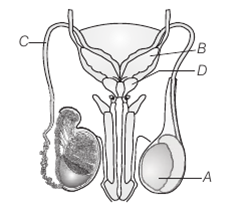
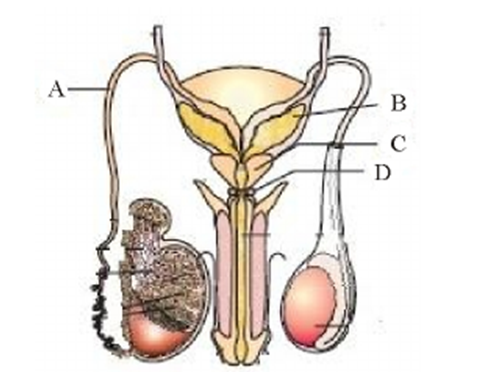
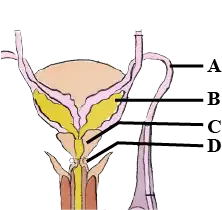
(a) A– Testis–possesses 3-4 testicular lobule(b) B– Seminal vesicle–storage of sperm(c) C– Vas deferens–helps in sperm transfer(d) D– Prostate gland–secretes seminal fluid15. The shared terminal duct of the reproductive and urinary system in the human male is(a) urethra(b) ureter(c) vas deferens(d) vasa efferentia16. The ____ lead to vas deferens that ascends to the __ and loops over the____.(a) Prostate, stomach, urinarybladder.(b) Epididymis, abdomen, urinary bladder.(c) Vas efferentia, abdomen, ureter.(d) Urinary bladder, ejaculatory duct, abdomen.17. The enlarged end of penis is covered by a loose fold of skin is called.(a) Glans penis(b) foreskin(c) hymen(d) urethral meatus18. Which of the following is a transporting tube leading from the bladder to which brings urine outside the body via penis?(a) Ureter(b) Epididymis(c) Ejaculatory duct(d) Urethra meatus19. Vasa efferentia are the ductules leading from(a) epididymis to urethra.(b) Vas deferens to epididymis.(c) Rete testis to vas deferens.(d) Testicular lobules to rete testis.20. A sac shaped like an upside down pear with a thick lining and muscles in the pelvic area where a fertilizedegg or zygote comes to grow into a baby is called ___.(a) Oviduct(b) uterus(c) vagina(d) vulva21. Which of the following is a finger likestructure and lies at the upper junction of the two labia minora above the urethralopening? (a) Clitoris (b) Oviduct (c) Ampulla (d) Chorionic villi22. Which of the following produces sperms in spermatogenesis?(a) Sertoli cells.(b) Interstitial cells.(c) Primary spermatocytes.(d) Immature male germ cells.23. In the process of spermatogenesis, first maturation division is called__.(a) Mitotic division(b) reduction division(c) amitotic division(d) None of the these24. Spermatids are transformed into sperm by a process called___.(a) Spermiation(b) implantation(c) insemination(d) spermiogenesis25. In humans, male germs cells differentiate into ___ at the end of first meiotic division.(a) Spermatid(b) spermatogonium(c) secondary spermatocyte(d) primary spermatocyte26. Increased secretion of which hormone start the process of sperm formation at the time of puberty?(a) GH(b) TSH(c) PRL(d) GnRH27. After birth, colostrum is released from mammary glands which is rich in(a) fat and low in proteins(b) proteins and low in fat(c) proteins, antibodies and low in fat(d) proteins, fat and low in antibodies28. Which of the following hormone maintains the function of male sex accessory gland and ducts?(a) Estrogen(b) Androgen(c) Progesterone(d) Luteinizing hormone29. Semen is a constituent of seminal plasma with ___.(a) ovum(b) sperm(c) zygote(d) follicle30. Ejaculation of human male contains about 200 – 300 million sperms, of which for normal fertility __ % sperms must have normal shape and size and at least __% must show energetic motility.(a) 40, 60 (b) 50, 50(c) 60, 40 (d) 30, 7031. Identify A, B, C and D in the given diagram.
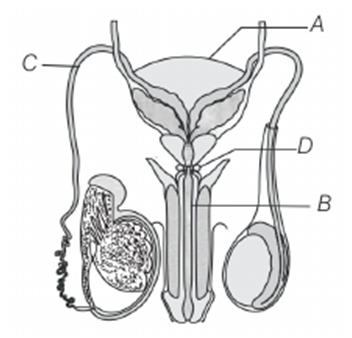
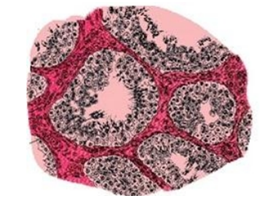
(a) A–Urinary bladder, B–Bulbourethral gland, C–Prostate gland, D–Seminal vesicles(b) A–Urinary bladder, B–Urethra, C–Vas deferens, D–Bulbourethral gland(c) A–Prostate gland, B–Seminal vesicles, C–Urinary bladder, D–Bulbourethral gland(d) A–Bulbourethral gland, B–Urinary bladder, C–Seminal vesicles, D–Prostate gland32. Identify the accessory glands found in males.(a) Seminal vesicles(b) Prostate gland(c) Bulbourethral gland(d) All of these33. The given diagram refers to TS of testis showing sectional view of a few seminiferous tubules. Identifythe parts labelled A-D and select the correct option.
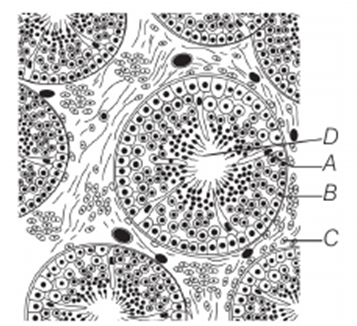
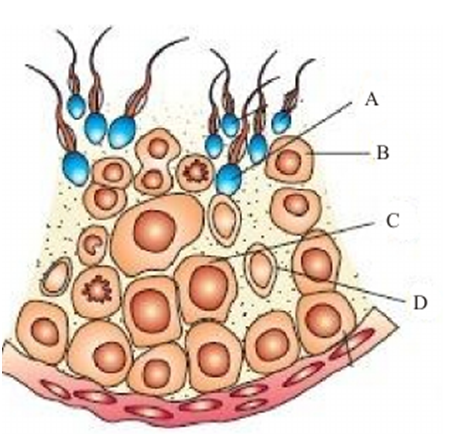
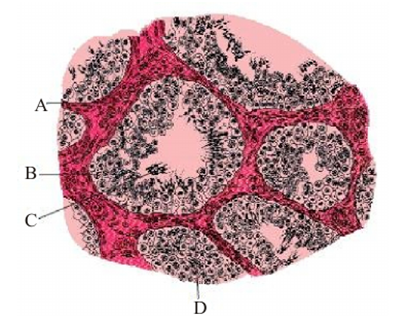
(a) A–Sertoli cells, B–Spermatozoa, C–Interstitial cells, D–Sperms(b) A–Sertoli cells, B–Secondary spermatocyte, C–Interstitial cells, D–Spermatozoa(c) A–Interstitial cells, B– Spermatogonia, C–Sertoli cells, D– Sperms(d) A–Sertoli cells, B– Spermatogonia, C–Interstitial cells, D–Spermatozoa34. The given diagram shows LS of testis showing various parts. Identify the parts labelled (A-G) from the listgiven below.
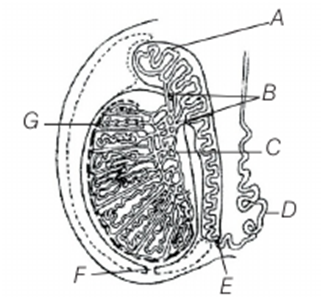
I. Caput epididymisII. Cauda epididymisIII. Vas deferensIV. Vasa efferentiaV. Corpus epididymisVI. Seminiferous tubulesVII. Tunica vaginalisVIII. Tunica albugineaIX. Tunica vasculosaX. Rete testisCodes A B C D E F G(a) II III IV X VI I IX(b) V IV III VI I X VII(c) I IV X III II VI VIII(d) I VI IV III V X IX35. The ovaries are located one on each side of the…A…. Each ovary is about 2-4 cm in length connected to the …B… wall by …C… . Each ovary is covered by a thin epithelium which encloses the ovarian stroma. Stroma is divided into two zones …D… and …E… . Fill the suitable choices for A-E.(a) A–inner medulla, B–peripheral cortex, C–ligaments, D–pelvic wall, E-lower abdomen(b) A–lower abdomen B–pelvic, C–ligaments, D–peripheral cortex, E– inner medulla(c) A–pelvic wall, B–lower abdomen, C–ligaments, D–inner medulla, E–peripheral cortex(d) A–inner medulla, B–peripheral cortex, C–lower abdomen, D–pelvic wall, E–ligaments36. The following diagram refers to female reproductive system of human. Identify A to E.
(a) A–Urethra, B–Urinary bladder,C–Uterus, D–Cervix, E–Vagina(b) A–Urethra, B–Urinary bladder, C–Uterus, D–Vagina, E–Cervix(c) A–Urethra, B–Urinary bladder, C–Uterus, D–Cervix, E–Vagina(d) A–Uterus, B–Urinary bladder, C–Urethra, D–Cervix, E–Vagina37. Oviducts are also called(a) Fallopian tubes(b) uterus(c) vagina(d) ovary38. Human Fallopian tube is about(a) 8-9 cm long(b) 9-10 cm long(c) 10-12 cm long(d) 12-17 cm long39. Funnel-shaped part of oviduct closer to the ovary is called(a) fimbriae(b) infundibulum(c) ampulla(d) isthmus40. Fimbriae are associated with which organ?(a) Fallopian tube(b) Uterus(c) Vagina(d) Ovary41. The main function of fimbriae of Fallopian tube is(a) help in development of ovary(b) help in collection of the ovum after ovulation(c) help in development of ova(d) help in fertilisation42. Choose the incorrect pair.(a) Finger-like projections – Fimbriae(b) Narrow part of oviduct – Ampulla(c) Part of oviduct joining the uterus – Isthmus(d) None of the above43. The following diagram refers to the female reproductive system of humans. Identify A-F.(a) A–Ampulla, B–Isthmus, C–Infundibulum, D–Fallopian tube E–Ovary, F–Uterine fundus(b) A–Isthmus, B–Infundibulum, C–Ampulla, D–Fallopian tube, E–Ovary, F–Uterine fundus(c) A–Isthmus, B–Ampulla, C–Infundibulum, D–Fallopian tube, E– Ovary, F–Uterine fundus(d) A–Ampulla, B–Infundibulum, C–Isthmus, D–Fallopian tube, E– Ovary, F–Uterine fundus44. Choose the incorrect pair.(a) Cushion of fatty tissue covered by pubic hair –Mons pubis(b) Membrane covering opening of vagina–Hymen(c) Finger-like structure above the urethral opening –Clitoris(d) Uterine layer exhibiting strong contraction during delivery–Endometrium45. The main tissue present in breast is……… tissue.(a) Glandular(b) squamous(c) ciliated(d) epithelium46. Which of the following stage of oogenesis forms a membrane called zona pellucida surrounding it?(a) Oogonia(b) Polar body(c) Corpus luteum(d) Secondary oocytes47. By which process sperms released from the seminiferous tubules?(a) Spermiation(b) Insemination(c) Spermatogenesis(d) Spermiogenesis48. Which of the following contains a fluid filled cavity called antrum(a) Primary spermatocyte.(b) Primary follicle of ovary.(c) Tertiary follicle of ovary.(d) Secondary spermatocyte.49. Menstruation is triggered by a sudden decline in the amount of hormone secreted by corpus luteum. Identifythe hormone.(a) Luteinizing hormone(b) Follicle stimulating hormone(c) Progesterone(d) Estrogen50. Level of which hormones are at their highest during the luteal phase (second half of the cycle) of the menstrual cycle?(a) Estrogen(b) Progesterone(c) Luteinizing hormone(d) Follicular stimulating hormone51. Which phase of menstrual cycle is also called proliferative phase(a) Luteal(b) Ovulatory(c) Follicular(d) Menstruation52. Which phase of menstrual cycle is also called secretory phase?(a) Luteal(b) Ovulatory(c) Follicular(d) Menstruation53. Which of the following indicates pregnancy?(a) Lack of menstruation.(b) Occurrence of menstrual flow.(c) When released ovum is not fertilized.(d) When Graafian follicle matures and endometrium regenerates through proliferation.54. When semen is released by the penis into the vagina during copulation, then it is called___.(a) Ovulation(b) insemination(c) menstruation(d) gametogenesis55. At the time of implantation, the human embryo is called ___.(a) zygote(b) blastocysts(c) embryo(d) foetus56. Fusion of haploid nucleus of sperm and that of ovum lead to the formation of ___.(a) zygote(b) blastocysts(c) embryo(d) foetus57. Which of the following differentiate into embryo?(a) Morula(b) Zygote(c) Trophoblast(d) Inner cell mass58. Trophoblast and inner cell mass are the arrangements of blastomeres as outer and inner layers respectively in ___.(a) Zygote(b) morula(c) placenta(d) blastocysts59. The embryo with 8 to 16 blastomeres is called ____.(a) Zygote(b) morula(c) placenta(d) blastocysts60. Presence of XX or XY chromosomes in zygote depends on(a) The sperm carrying X chromosome fertilized the ovum.(b) The sperm carrying Y chromosome fertilized the ovum.(c) The sperm without any chromosome fertilized the ovum.(d) The sperm carrying X or Y chromosomes fertilized the ovum.61. Given the diagrammatic sectional view of mammary gland. Identify A, B, C and D.
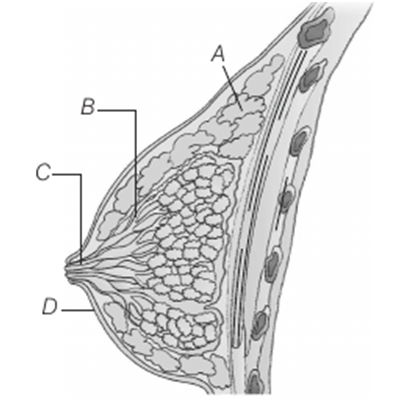
(a) A–Alveolus, B–Mammary duct, C–Lactiferous duct, D–Areola(b) A–Alveolus, B–Lactiferous duct, C–Mammary duct, D–Areola(c) A–Alveolus, B–Mammary duct, C–Lactiferous duct, D–Lactogenic spot(d) A–Fat, B–Mammary duct, C– Lactiferous duct, D–Areola62. Several mammary ducts join to form a wider mammary ampulla, which is connected to(a) lactiferous duct(b) seminiferous duct(c) seminiferous tubules(d) nipple63. Pick the odd one out from each series given below and select the correct option.I. Scrotum, rete testis, fallopian tube, vas deferens.II. Ovary, uterus, vagina, ejaculatory duct.III. Acrosome, Graafian follicle, corpus luteum, cervix.IV. Prostate, testis, seminal vesicles, Cowper’s gland.I II III IV(a) Vas deferens Vagina Cervix Cowper’s gland(b) Rete testis Ovary GraafianProstate follicle(c) Scrotum Uterus Corpus Seminal luteum vesicles(d) Fallopian Ejaculatory Acrosome Testis tube duct64. A sectional view of mammary gland showsI. nipple and areola.II. Mammary lobes (alveolus) and duct.III. Ribs.IV. Ampulla and lactiferous duct.Choose the correct option from the above.(a) I, II, III and IV(b) I, II and III(c) III, IV and II(d) I, IV and III65. Number of chromosomes present in spermatogonium is(a) 46(b) 23(c) 48(d) 4366. Which cells come earliest in the sequence of sperm production?(a) Spermatozoa(b) Spermatocyte(c) Spermatid(d) Spermatogonia67. Which of the following undergoes meiosis-I division during spermatogenesis?(a) Primary spermatocytes(b) Secondary spermatocytes(c) Sertoli cell(d) Leydig cell68. Number of chromosomes present in secondary spermatocyte is(a) 22(b) 23(c) 24(d) 2569. Which one of the following cells has haploid number of chromosome?(a) Primary spermatocytes(b) Secondary spermatocytes(c) Spermatid(d) Both (b) and (c)70. During spermatogenesis, which cells are the first to contain haploid number of chromosomes?(a) Spermatogonium(b) Primary spermatocyte(c) Secondary spermatocyte(d) Spermatid71. Find out spermatid and Sertoli cell in given below diagram.
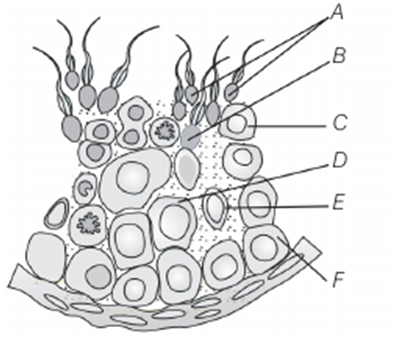
(a) D and E(b) E and F(c) A and C(d) B and E72. Spermiogenesis is(a) spermatids transformed into spermatozoa(b) spermatozoa transformed into spermatids(c) spermatozoa transformed to spermatocytes(d) spermatid to secondary spermatocytes73. What is the correct sequence of sperm formation?(a) Spermatid, Spermatocyte, Spermatogonia, Spermatozoa(b) Spermatogonia, Spermatocyte, Spermatozoa, Spermatid(c) Spermatogonia, Spermatozoa, Spermatocyte, Spermatid(d) Spermatogonia, Spermatocyte, Spermatid, Spermatozoa74. The difference between spermiogenesis and spermiation is(a) in spermiogenesis, spermatozoa from Sertoli cells are released into the cavity of seminiferous tubules, while in spermiation, spermatozoa are formed(b) in spermiogenesis, spermatozoa are formed, while in spermiation, spermatids are formed(c) in spermiogenesis, spermatids are formed, while in spermiation, spermatozoa are formed(d) in spermiogenesis, spermatozoa are formed, while in spermiation, spermatozoa are released through seminiferous tubules75. Spermatogenesis starts at puberty due to significant increase in the secretion of(a) GnRH(b) prolactin(c) testosterone(d) oestrogen76. Which layer of blastocysts gets attached to the endometrium(a) Trophoblast(b) Inner cell mass(c) Umbilical cord(d) Both (a) and (c)77. Finger like projection, called chorionic villi, appear on the ___ after the implantation.(a) ampulla(b) trophoblast(c) infundibulum(d) inner cell mass78. Which of the following hormones is produced in women only during pregnancy?(a) Relaxin(b) Estrogen(c) Oxytocin(d) Progesterone79. The placenta is formed from the ___ of the embryo and the ___ of the mother.(a) uterus, trophoblast(b) chorion, endometrium(c) endometrium, chorion(d) inner cell mass, endometrium80. Placenta acts as an(a) Embryo(b) Corpus luteum(c) Exocrine gland(d) Endocrine tissue81. Primary germ layers are(a) ectoderm and inner cell mass only.(b) Trophoblast, ectoderm and mesoderm.(c) Endoderm and mesoderm only.(d) Ectoderm, endoderm and mesoderm82. Which of the following hormone acts on uterine muscle and causes its stronger contraction?(a) Relaxin(b) Estrogen(c) Oxytocin(d) Progesterone83. Colostrum(a) is a hormone essential for milk secretion.(b) Can be synthesized by the new born infant but not by a foetus.(c) Stimulates further secretion of oxytocin for uterine contraction.(d) Is a source of antibodies essential to develop resistance against diseases in new born babies.84. Secretion of milk from the mammary gland towards the end of the pregnancy is called___(a) lactation(b) parturition(c) fertilization(d) implantation85. Two types of cells present in the lining of seminiferous tubules are ___ and ___.(a) Leydig cells, sertoli cells.(b) Male germ cells, sertoli cells.(c) Spermatogonium, spermatids.(d) Primary oocyte, leydig cells.86. The womb opens into vagina through ___.(a) Cervix(b) hymen(c) clitoris(d) ampulla87. First polar body is formed during the formation of ___ and completion of _ meiotic division.(a) Primary oocytes, II(b) Secondary oocytes, I(c) Secondary spermatocytes, II(d) Primary spermatocytes, I88. Second meiotic division in secondary oocyte results in the formation of(a) first polar body and a diploid ovum.(b) First polar body and a haploid ovum.(c) Second polar body and a diploid ovum.(d) Second polar body and a haploid ovum89. In human female, menopause is a stage in which(a) oogenesis starts at puberty.(b) Menstruation starts at puberty.(c) Corpus luteum starts secreting progesterone for maintaining pregnancy.(d) Menstruation stops at the age of50 years and reproductive capacity is arrested.90. Which of the following process induces the completion of the meiotic division of secondary oocyte?(a) Parturition(b) Implantation(c) Fertilization(d) Gametogenesis91. GnRH, a hypothalamic hormone, needed in reproduction, acts on(a) anterior pituitary gland and stimulates secretion of LH and oxytocin(b) anterior pituitary gland and stimulates secretion of LH and FSH(c) posterior pituitary gland and stimulates secretion of oxytocin and FSH(d) posterior pituitary gland and stimulates secretion of LH and relaxin92. Give the name of two hormones A and B in the figure given below.(a) FSH and GH(b) LH and androgens(c) GH and LH(d) GH and lactin93. Sperms of mammals depend for movement on(a) only tail(b) tail and middle piece(c) middle piece(d) Only head94. Which one of the labelled part utilises fructose as a source of energy?
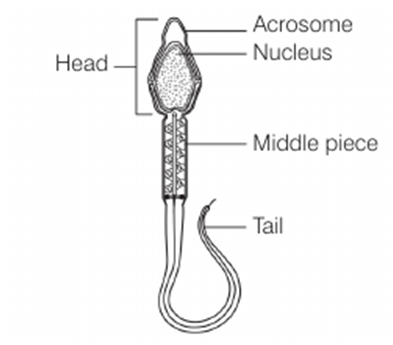
(a) Head(b) Tail(c) Acrosome(d) Middle piece95. Choose the incorrect pair.(a) Acrosome – Enzyme filled cap structure on sperm head(b) Middle piece – Possesses numerous mitochondria(c) Sperm tail – Facilitates sperm motility essential for fertilisation(d) Semen – Contains only sperms96. Choose the incorrect pair.(a) Antrum – Fluid-filled cavity in primary follicle(b) Tertiary follicle – Primary oocyte completes its Ist meiotic division inside it(c) Secondary oocyte – Haploid cell formed after Ist meiotic division(d) Graafian follicle – Mature tertiary follicle which ruptures during ovulation97. The new membrane formed by follicular cells in secondary oocyte is called(a) zona granulosa(b) zona pellucida(c) plasma membrane(d) tertiary membrane98 Which of the following layers in an antral follicle is acellular?(a) Granulosa(b) Theca interna(c) Stroma(d) Zona pellucida99. At which stage of the development, ovum is released from the ovary of the human female?(a) Primary oocyte(b) Oogonium(c) Secondary oocyte(d) Ootid100. Consider the figure given below. Select the option which correctly identifies the parts labelled as C, D and F
(a) Primary follicle, Secondary follicle ,Corpus luteum(b) Secondary follicle ,Graafian follicle, Corpus luteum(c) Tertiary follicle, Primary follicle, Secondary follicle(d) Tertiary follicle, Graafian follicle, Corpus luteum101 Identify A, B and C in the figure given below.
(a) A–Secondary oocyte, B–Oogonia, C–Primary oocyte(b) A–Oogonia, B–Primary oocyte, C–Secondary oocyte(c) A–Secondary oocyte, B–Primary oocyte, C–Oogonia(d) A–Oogonia, B–Secondary oocyte, C–Primary oocyte102 Mark the wrong item in each series and select the correct option.I. Spermatocyte, polar body, spermatid, spermatogoniumII. Endometrium, corpus luteum, acrosome, Graafian follicleIII. Vas deferens, fallopian tube, epididymis, Cowper’s glandIV. Testes, prostate, seminal vesicles, Cowper’s glandI II III IV(a) Spermatid Endometrium Epididymis Prostate(b) Polar body Acrosome Fallopian tube Testes(c) Spermatocyte Corpus luteum Vas deferens Cowper’s gland(d) Spermatogonium Graafian follicle Cowper’s gland Seminal vesicle103. The reproductive cycle in the female primates such as monkeys, apes and human beings is called(a) menstrual cycle(b) oestrus cycle(c) circadian cycle(d) ovulatory cycle104. The first menstruation that begins at puberty is called(a) menopause(b) ovulation(c) gametogenesis(d) menarche105. Menstrual flow occurs due to the lack of(a) progesterone(b) FSH(c) oxytocin(d) vasopressin106. ___ is a sticky white or yellow fluid secreted by the breasts during the second half of pregnancy and for a few days after birth, before breast milk comes in.(a) Placenta(b) Colostrum(c) Egg yolk(d) Blood cells107. Which gland releases a small amount of fluid just prior to ejaculation to decrease acidity in the urethra caused by urine?(a) Prostate(b) Glans penis(c) Seminal vesicle(d) Bulbourethral gland108. By the end of how many weeks, major organ systems are formed during the embryonic development?(a) 4 weeks(b) 8 weeks(c) 12 weeks(d) 24 weeks109. Which of the following induces foetal ejection reflex?(a) Initiation of lactation(b) Fully developed foetus and placenta(c) Expulsion of the baby out of the uterus(d) Transport of embryo in the fallopian tube.100. Identify the structure on the basis of the given statement which surrounds the primary sex organ of male reproductive system. "It is responsible for maintaining the low temperature by about 2 - 2.5º C from normal body temperature to mature sperm."(a) Penis(b) Scrotum(c) Ureter(d) Urethra111. Which of the following is not a paired structure in male?(a) Urethra(b) Vas deferens(c) Epididymis(d) Ejaculatory duct112. Blastomeres are daughter cells formed in the process of(a) cleavage, when zygote undergoes mitotic division.(b) Fertilization, when sperm enters in the cytoplasm of ovum.(c) Implantation, when blastocysts attached to the uterine endometrium.(d) Gametogenesis, when male and female gametes are produced by testis and ovary respectively113. Which of the following statements regarding sertoli cell is correct?(a) It is found in seminiferous tubule and secrete testosterone hormone.(b) It is a place where spermatozoa is concentrated and stored until ejaculation.(c) It secretes spermatozoa activating substances like fructose, citrate, inositol, prostaglandin and protein.(d) It is found in seminiferous tubule and function as nurse cells for differentiating spermatozoa.114. The sperm and the egg make different contributions to zygote.Which of the following statements about their contributions are true(i) Sperm contributes most of the mitochondria.(ii) Egg contributes most of the cytoplasm.(iii) Both sperm and egg contribute haploid nucleus.(iv) Both sperm and egg contribute centrioles.(a) (i) and (ii)(b) (ii) and (iii)(c) (iii) and (iv)(d) All of these115. Read the following statements (i to iv) and answer the following question.(i) Each testis has highly coiled 250 compartments called seminiferous tubules.(ii) Erection of the penis due to presence of special tissues facilitates insemination.(iii) Immunologically competent cells are also present in the interstitial spaces of seminiferous tubules.(iv) Testes lie outside the abdominal cavity in a thin pouch like skin called scrotum.(v) Bulbourethral gland is a single accessory gland.How many of the above statements are incorrect?(a) (i), (ii) and (iii)(b) (iii) and (v)(c) (i) and (v )(d) (ii), (iv) and (v)116. Which of the following is true regarding the male reproductive system?(a) Sperms are diploid.(b) It includes testes, accessory ducts and glands, and oviducts.(c) The scrotum keeps the testes warmer, thus helping it to promote the sperm formation.(d) Sertoli cells are found in seminiferous tubules and provide nutrition to germ cells.117. Read the following statements (i to v) and answer the following question.(i) This structure is also called womb.(ii) Its shape is like an inverted pear.(iii) The process of fertilization takes place in this structure.(iv) The wall of this structure has three layers of tissue.(v) It secretes several steroid hormones.Identify the correct characteristics feature regarding uterus from the above statements.(a) (i) and (iv)(b) (iii) and (v)(c) (i), (ii) and (iv)(d) All the five statements.118. Which of the following statements regarding mammary gland is incorrect?(a) They are paired glandular structure that lies over the pectoral muscles.(b) Each gland has 100 – 500 lobulated milk glands each having a number of lobules containing number of alveoli.(c) The cells of alveoli secrete milk which is stored in the cavity of the alveoli.(d) Each milk gland or lobules has lactiferous ducts that drain into openings in the nipple.119. Select the correct statements regarding oogenesis.(i) It is initiated during the embryonic development stage when millions of oogonia are formed within each ovary.(ii) Graafian follicle releases primary oocyte from the ovary by ovulation.(iii) At puberty only 60,000 – 80,000 primary follicles are left in each ovary.(iv) Secondary oocyte within tertiary follicles grows in size and completes its second meiotic division.(a) (i), (ii) and (iii)(b) (i) and (iii)(c) (ii) and (iv)(d) all the four statements.120. Which of the following statement is correct regarding menstruation?(a) The menstrual fluid can easily clot.(b) The end of the cycle of menstruation is called menarche.(c) At menopause in the female, there is especially abrupt decrease in gonadotropic hormones.(d) In human female, menstruation can be deferred by the administration of combination of estrogen and progesterone.121. In an ideal menstrual cycle, the menstrual phase last for(a) 3-5 days(b) 5-6 days(c) 1-3 days(d) 2-3 day122. A regular cycling woman is not menstruating, which one of the following is the most likely to be the root Cause(a) Maintenance of the hypertrophic endometrial lining(b) Maintenance of high concentration of sex-hormones in the bloodstream(c) Regression of well-developed corpus luteum(d) Fertilisation of the ovum123. What happens during the follicular phase of menstrual cycle?(a) Proliferation of endometrium(b) Reduction in blood supply to endometrium(c) Regression of endometrium(d) No effect on endometrium124. Level of LH is maximum(a) just before ovulation(b) just after ovulation(c) at the time of ovulation(d) during menstrual bleeding phase125. When does ovulation occur in a healthy menstruating female?(a) 9-14 days(b) 14-16 days(c) 16-28 days(d) 20-26 days126. Rapid secretion of LH in ovulatory phase causes(a) rupturing of Graafian follicle(b) release of ova(c) ovulation(d) All of the above127. Which of the following events is not associated with ovulation in human female?(a) Decrease in oestradiol(b) Full development of Graafian follicle(c) Release of secondary oocyte(d) LH surge128. No new follicles develop in the luteal phase of the menstrual cycle because(a) follicles do not remain in the ovary after ovulation(b) FSH levels are high in the luteal phase(c) LH levels are high in the luteal phase(d) Both (b) and (c)129. Formation of corpus luteum is induced by(a) LH(b) oestrogen(c) FSH(d) progesterone130. A temporary endocrine gland in the human body is(a) pineal gland(b) corpus cardiacum(c) corpus luteum(d) corpus allatum131. The main function of mammalian corpus luteum is to produce(a) oestrogen only(b) progesterone only(c) human chorionic gonadotropin(d) relaxin only132. Endometrium, epithelial glands and connective tissue of uterus are broken due to the(a) lack of oestrogen(b) lack of progesterone(c) lack of FSH(d) excess of FSH133. If the mammalian ovum fails to get fertilised, which one of the following is likely to happen?(a) Corpus luteum will degenerate(b) Oestrogen secretion further decreases(c) Primary follicle starts developing(d) Progesterone secretion rapidly increases134. Which of them is not a correct match?(a) Proliferative phase–Rapid regeneration of myometrium and maturation of Graafian follicle(b) Secretory phase–Development of corpus luteum and increased secretion of progesterone(c) Menstruation–Breakdown of endometrium(d) Ovulation–LH and FSH attain peak level and cause rupture of Graafian follicle135. Correct sequence of secretion of hormone from beginning of menstrual cycle to the end is(a) FSH, progesterone, LH(b) oestrogen, FSH and progesterone(c) FSH, oestrogen, progesterone(d) oestrogen, progesterone, FSH136. Which of the following is required for the increased production of estrogen, progestogens, cortisol,prolactin and thyroxine etc. in the maternal blood?(i) Metabolic changes in the mother.(ii) Maintenance of pregnancy.(iii) Supporting the foetal growth(iv) Destruction of Graafian follicle(a) (iii) and (iv)(b) (i), (iv) and (v)(c) (i), (ii) and (iii)(d) All the four statements.137. Which of the following statement regarding female reproductive system is (are) correct?(i) Myometrium undergoes strong contraction at the time of delivery of baby.(ii) Ovary is secondary female sex organ which produces female gamete and steroid hormones.(iii) Ovarian stroma is divided into two zones: inner cortex and outer medulla.(iv) Infundibulum possess finger like projections which help in collection of ovum after the release of secondary oocyte.(v) A functional mammary gland is the characteristics of all the mammals (including male and female).(a) (i) and (iv)(b) (i), (ii), (iii) and (v)(c) (iii), (iv) and (v)(d) All the five statements138. Read the following statements (i to v) and answer the question.(i) It produces several hormones like hCG, hPL, estrogen,progestogens etc.(ii) It differentiates into three embryonic membranes – ectoderm, endoderm and mesoderm.(iii) It undergoes mitotic division.(iv) It is the organ, formed in the lining of the uterus by the union of the uterine mucous membrane with the membranes of the foetus.(v) It develops at a point of implantation and providing oxygen and nutrients for the foetus and transfer of waste products from the foetal to the maternal blood circulation.Identify the correct characteristics feature regarding placenta from the above statements.(a) (iii) and (v)(b) (i), (iv) and (v)(c) (i), (ii) and (iv)(d) all the four statements.139. Which of the following statements regarding parturition is incorrect(a) Prolactin induces uterine contraction.(b) It is induced by neuroendocrine mechanism.(c) Uterine contraction leads to expulsion of baby through the birth canal.(d) Oxytocin plays an important role in the contraction of fallopian tube.In the following questions, a statement of Assertion is followed by a statement of Reason.(a) If both Assertion and Reason are true and the Reason is the correct explanation of the Assertion.(b) If both Assertion and Reason are true but the Reason is not the correct explanation of the Assertion.(c) If Assertion is true but Reason is false(d) If both Assertion and Reason are false.140. Assertion: During fertilization only head of spermatozoa enters egg.Reason: If several spermatozoa hit the egg at same time, all can enter the egg.141. Assertion: In morula stage, cells divide without increase in size.Reason: Zona pellucida remains undivided till cleavage is complete.142. Assertion: Death is one of the important regulatory processes on earth.Reason: It avoids over-crowding caused by continuous reproduction.143. Assertion: Corpus luteum degenerates in the absence of fertilization.Reason: Progesterone level decreases.144. Assertion: Clitoris is not remnant of penis in females.Reason: It also has high blood supply and erectile tissue.145. Assertion: Mammalian ova produce hyaluronidase.Reason: The eggs of mammal are microlecithal and telolecithal.146. Assertion: Interstitial cell is present in the region outside the seminiferous tubule called interstitial spaces.Reason: Interstitial cells provide nutrition to the Sertoli cells.147. Assertion: Testicular lobules are the compartments present in testis.Reason: These lobules are involved in the process of fertilization.148. Assertion: Head of sperm consists of acrosome and mitochondria.Reason: Acrosome contains spiral row of mitochondria.149. In the given columns, column I contain structures of male reproductive system and column IIcontains its feature. Select the correct match from the options given below.
Column I
Column II
A.
Seminiferous tubule
I.
Network of seminiferous tubule
B
Rete testis
II
Secondary sexual characters
C
Leydig cells
III
Meiosis and sperm formation occurs
D
Prepuce
IV
Place of implantation
V
Terminal skin of penis
(a) A – I; B – II; C – III; D – V(b) A – III; B – I; C – II; D – V(c) A – III; B – I; C – IV; D – II(d) A – II; B – IV; C – III; D – V150. Which of the following pair is incorrectly matched?(a) Leydig cells – Testosterone(b) Spermatogenesis – Seminiferous tubules(c) Male reproductive system –Pelvis region(d) Spermatogonia – Mitotic division151. Read the graph and correlate the uterine events that take place according to the hormonal levels on
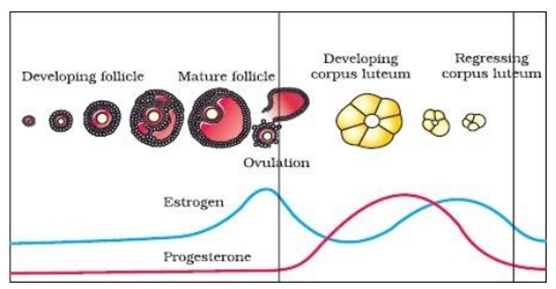
(a) A–Degeneration of endometrium, B–Myometrium thickness, becomes vascularised ready to receive and implant embryo, C–Regeneration of endometrium(b) A–Degeneration of endometrium, B–Endometrium thickness increases, become vascularised, ready to receive andimplant ovum, C–Regeneration of endometrium(c) A–Regeneration of endometrium, B–Endometrium becomes thick and vascularised ready to receive and implant bryo, C–Degeneration of endometrium(d) A–Regeneration of myometrium, B–Endometrium becomes thick and vascularised, ready to receive and implantembryo, C–Degeneration of endometrium152. The following graph of relative concentrations of the four hormones present in the blood plasma of a woman during her menstrual cycle.Identify the hormones A, B, C and D.
(a) A–FSH, B–Progesterone, C–LH, D–Oestrogen(b) A–LH, B–Progesterone, C–FSH, D–Oestrogen(c) A–FSH, B–Oestrogen, C–LH, D–Progesterone(d) A–LH, B–Oestrogen, C–FSH, D–Progesterone153. The diagram shows the changes that take place in the endometrium during a normal menstruation.Identify A and B.
(a) A–Ovulation, B–Menopause(b) A–Ovulation, B–Menstruation(c) A–Menstruation, B–Ovulation(d) A–Menopause, B–Ovulation154. The events of the menstrual cycle are represented below. In which of the following options the level of FSH, LH and progesterone is mentioned correctly?
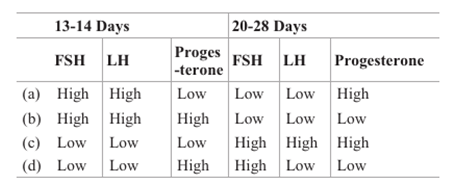
155. The diagram shows some of the changes in blood hormone concentration which occurs during the menstrual cycle. Match A, B, C, D, E, F, G and H of graph with the hormones and events given below.
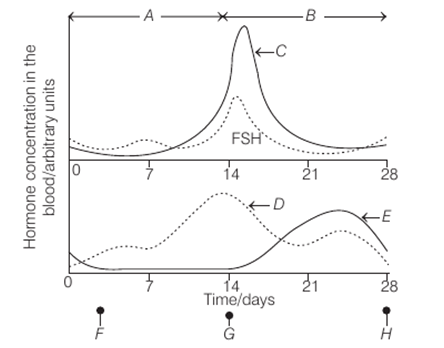
Hormones and EventsI. OestrogenII. OvulationIII. Repair of endometriumIV. Luteinizing hormoneV. MenstruationVI. Luteal phaseVII. ProgesteroneVIII. Ovarian phase A B C D E F G H(a) IV IV IV III V III VII II(b) VIII III IV II I VI VII V(c) VIII VI IV I VII III II V(d) I III V VII VIII VI IV II156. Some important events in the human female reproductive cycle are given below. Arrange the events in propersequence.I. Secretion of FSH.II. Growth of corpus luteum.III. Growth of the follicle and oogenesis.IV. Ovulation.V. Sudden increase in the levels of LH.Choose the correct option.(a) III I IV II V(b) I III V IV II(c) I IV III V II(d) II I III IV V157. Cessation of menstrual cycle at the age of 50 is called(a) ovulation(b) gametogenesis(c) menses(d) menopause158 Capacitation occurs in(a) rete testis(b) epididymis(c) vas deferens(d) female reproductive tract159. Fertilisation in humans is practically feasible only if(a) the ovum and sperms are transported simultaneously to ampullary-isthmic junction of the Fallopian tube(b) the ovum and sperms are transported simultaneously to ampullary-isthmic junction of the cervix(c) the sperms are transported into cervix within 48 hrs. of release of ovum in uterus(d) the sperms are transported into vagina just after the release of ovum in Fallopian tube160. Every time copulation does not lead to fertilisation and pregnancy because of failure of sperm to reach the(a) ampulla(b) cervix(c) endometrium(d) myometrium161. During fertilisation, a sperm comes in contact with the zona pellucida layer of the ovum and induces changes in the membrane that block the entry of …A… . The secretions of the …B… help the sperm enter into the cytoplasm of the ovum.A B(a) eggs zona pellucida(b) eggs acrosome(c) additional sperms acrosome(d) additional sperms zona pellucida162. What is acrosomal reaction?(a) Contact of sperms with eggs(b) Digestion of zona pellucida(c) Disintegration of acrosome(d) Contact of acrosome and nucleus of egg163. Extrusion of second polar body from egg nucleus occurs(a) after fertilisation(b) before the entry of sperm into ovum(c) simultaneously with first cleavage(d) after the entry of sperm but before fertilisation164. In human females, meiosis-II is not complete until(a) puberty(b) fertilisation(c) uterine implantion(d) birth165. The sex of the foetus will be decided at(a) fertilisation by male gamete(b) implantation(c) fertilisation by female gamete(d) the start of cleavage166. In the given columns, column-I contain structures of female reproductive system and column-II contain its feature.Select the correct match from the option given below.
Column I
Column II
A.
Ampulla
I.
It undergoes cyclical changes during menstrual cycle.
B
Labia majora
II
It helps in collection of ovum after ovulation.
C
Oviduct
III
Wider part of fallopian tube where fusion of male and female gametes takes place.
D
Fimbriae
IV
Larger hairy folds which extend down from the mons pubis and surrounds the vaginal opening.
E
Endometrium
V
Also called fallopian tubes, which extend from the periphery of each ovary to the womb.
(a) A – I; B – II; C – III; D – V; E –IV(b) A – III; B – I; C – II; D – V; E –IV(c) A – III; B – IV; C – V; D – II; E– I(d) A – II; B – IV; C – III; D – V; E– I167. Match the column-I with column-II and select the correct option. Match from the options given below
Column I
Column II
A.
Primary oocyte
I.
It is formed when oogonia starts division and temporarily arrested at prophase of meiosis I
B
Secondary oocyte
II
A large haploid cell which retains bulk of nutrient rich cytoplasm of the primary oocyte.
C
Primary follicle
III
A large number of these degenerate during the phase from puberty to birth.
D
Oogonia
IV
Gamete mother cell.
E
Secondary follicle
V
Surrounded by more layers of granulosa cells and a new theca.
F
Graafian follicle
VI
Rupture to release ovum from the ovary.
(a) A – I; B – II; C – III; D – IV; E –V; F – VI(b) A – III; B – I; C – IV; D – II; E– V; F – VI(c) A – VI; B – IV; C – V; D – II; E – I; F – III(d) A – II; B – IV; C – III; D – V; E – I; F – VI168. In the given columns, column-I contain various phases of menstrual cycle and column -II contain its features. Select the correct match from the options given below.
Column I
Column II
A.
Menstrual phase
I.
Breakdown of endometrial lining of uterus along with its blood vessels which form liquid that comes out of vagina.
B
Luteal phase
II
A temporary endocrine gland is formed and secretes a hormone which maintains endometrium and implantation of fertilized ovum and other events of pregnancy.
C
Follicular phase
III
Secretion of luteinizing hormone at its maximum level and induces breakdown of mature follicle torelease the female gamete
D
Ovulatory phase
IV
Formation of mature Graafian follicle and regeneration of endometrium of uterus.
(a) A – IV; B – II; C – III; D – I(b) A – III; B – I; C – II; D – IV(c) A – III; B – I; C – IV; D – II(d) A – I; B – II; C – IV; D – III169. In the given columns, column-I contain features of developing child and column-II contain the time of their occurrence. Select the correct match.
Column I
Column II
A.
Heart sound I
I.
By the end of the second month of pregnancy
B
Foetus develops
II
During the fifth month limbs and digit
C
Formation of
III
First sign of growing major organ system foetus
D
First movement
IV
By the end of 12 weeks of foetus and appear hair on head
E
Body covered with
V
By the end of 24 weeks hair, eyelid separate eyelashes are formed
(a) A – I; B – II; C – III; D – IV; E –V(b) A – III; B – I; C – IV; D – II; E– V(c) A – II; B – I; C – III; D – V; E –IV(d) A – III; B – IV; C – II; D – V; E– I170. Match the hormones given in column-I with their functions given in column-II and select the correct option.
Column I
Column II
A.
Luteinizing
I.
Develop corpus luteum hormone
B
Progesterone
II
Essential for maintenance of uterine layer (called endometrium)
C
Estrogen
III
Develops female secondary sexual characters
D
Follicle stimulating
IV
Maturation of Graafian hormone follicle
E
Oxytocin
V
Causes uterine contraction.
(a) A – I; B – V; C – III; D – II; E –IV(b) A – III; B – I; C – II; D – IV; E– V(c) A – I; B – II; C – III; D – IV; E –V(d) A – I; B – II; C – III; D – V; E –IV171. Match the column-I with column-II and select the correct option. Column I Column IIA Fertilization I. Mitotic divisionB Implantation II. Embryo with 8 to 16 blastomeresC Cleavage III. Ampullary-isthmic junctionD Morula IV. Structure formed by the continuous division of 8 to 1 blastomeresE Blastocysts V. Embedding of blastocysts in the endometrium(a) A – I; B – II; C – IV; D – V; E –III(b) A – III; B – I; C – IV; D – II; E– V(c) A – III; B – V; C – I; D – IV; E– II(d) A – III; B – V; C – I; D – II; E –IV172. Select the correct match of terms given in column-I with their definition given in column -II.Column-I Column-IIA. Parturition I. Duration between pregnancy (of about 9 month) and birthB. Ovulation II. Attachment of zygote to the endometriumC. Gestation III. ChildbirthD. Implantation IV. Stoppage of menstruationE. Conception V. Release of egg from Graafian follicle VI. Process of milk secretion VII.Formation of zygote by fusion of the egg andsperm(a) A – I; B – II; C – VII; D – V; E– III(b) A – III; B – I; C – IV; D – II; E– V(c) A – III; B – V; C – I; D – II; E –VI(d) A – III; B – V; C – I; D – IV, E– II173. The given figure shows the male reproductive system. Some structures are marked as A, B, C, and D.Identify the structure whose removal will cause the sperm to be reacted with acidic urine in the urethra.
(a) A(b) B(c) C(d) D174. Given below is a diagrammatic sketch of a portion of human male reproductive system. Select the correct set of the names of the parts marked as A, B, C, and D respectively.
(a) Ureter Seminal Prostate Bulbourethral vesicle gland(b) Ureter Prostate Seminal Bulbourethral vesicle gland(c) Vas Seminal Prostate Bulbourethral deferens vesicle gland(d) Vas Seminal Bulbourethral Prostate deferens vesicle gland175. Identify the figure (A) whose sectional view is given below and match with its characteristics (B) and its location (C). man Reproduction
176. Given below is the diagrammatic sectional view of seminiferous tubule with their parts marked as A, B, C, and D. Select the option which shows the correct identification of the structure with its characteristics.
(a) A: Spermatozoa, secretes testicular hormones that control spermatogenesis.(b) B: Spermatogonium, it is also called male germ cells which undergo meiotic division to from spermatozoa.(c) C: Interstitial cells, present in the interstitial spaces and store and transport the sperms from the testis to the outside through the urethra.(d) D: Sertoli cells, it maintains low temperature of the testis.177. The given figure shows the diagrammatic sectional view of female reproductive system with few structures marked as A, B, C, D, E and F. Which of the following options shows the correct labelling of A–F?
(a) A-->Myometrium, B-->Isthmus, C-->Endometrium, D--> Perimetrium, E-->Ampulla, F--> Infundibulum(b) A-->Infundibulum, B-->Perimetrium, C-->Endometrium,D-->Myometrium, E-->Ampulla, F-->Isthmus(c) A-->Endometrium, B-->Myometrium C-->Perimetrium, D-->Isthmus, E-->Ampulla, F-->Infundibulum(d) A-->Perimetrium, B-->Endometrium, C-->Isthmus, D-->Infundibulum, E-->Ampulla, F-->Myometrium178. Refer the figure of mammary gland with few structures marked as A, B, C and D. Which structure contains clusters of milk secreting cells?
(a) A(b) B.(c) C(d) D179. The figure given below shows the sectional view of seminiferous tubule.Which marked structure (A to D) undergoes second meiotic division to produce four equal haploid cells (called spermatids)?
(a) A(b) B(c) C(4) D180. The figure given below shows the structure of sperm. Identify the correct feature corresponding to the marked structure A, B, C and D.
(a) A – Head: Its anterior portion is covered by a structure filled with enzymes that help in the fusion of male and female gametes.(b) B – Middle piece: It contains a haploid nucleus.(c) C – Neck: It possesses few ribosomes which produces energy for the process of fertilization.(d) D – Tail: It releases energy source for swimming of sperm.181. Cleavage is the rapid mitotic division occurring on the way through isthmus to oviduct. It occurs in(a) gametes(b) zygote(c) sperm(d) ova182. Cleavage forms 2-4-8-16 cells. These cells are called(a) blastocysts(b) blastomeres(c) morula(d) trophoblast183. Embryo at 8-16 cells stage is called(a) blastula(b) morula(c) trophoblast(d) All of these184. Study the chart given below. Select the option containing the correct identify of A and B.
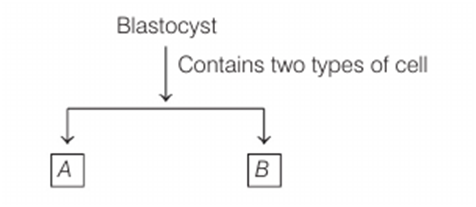
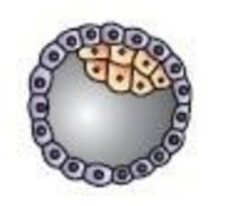
(a) A–Trophoblast, B–Inner cell mass(b) A–Placenta, B–Embryo blast(c) A–Placenta, B–Trophoblast(d) None of the above185. Trophoblast of blastocyst attaches to the(a) endometrium(b) myometrium(c) perimetrium(d) mesoderm186. Inner cell mass or embryo blast gives rise to(a) foetal part(b) embryo(c) notochord(d) nourishment cell187. The given diagram refers to ovum surrounded by few sperms. IdentifyA, B and C in the diagram.
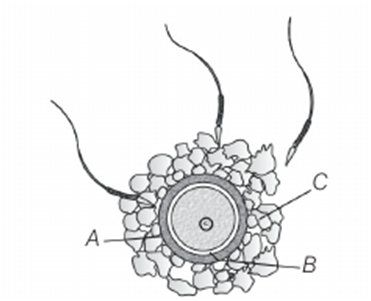
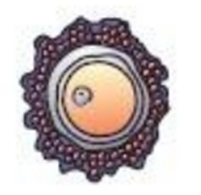
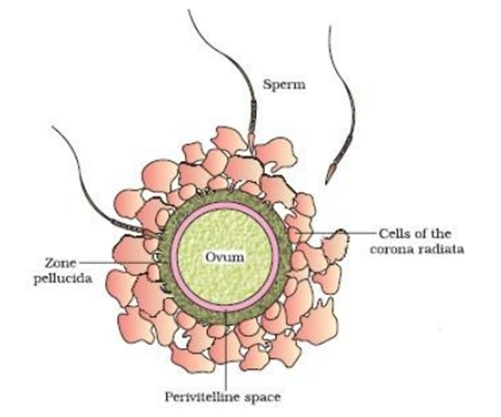
(a) A–Zona pellucida, B–Perivitelline space, C–Corona reticulate(b) A–Zona pellucida, B–Vitelline membrane, C–Corona radiata(c) A–Zona pellucida, B– Perivitelline space, C–Corona radiata(d) A–Oolemma, B–Perivitelline space, C–Corona radiata188. Consider the figure given below which depicts the sequence of embryonic development in humans.Identify E and G. E G
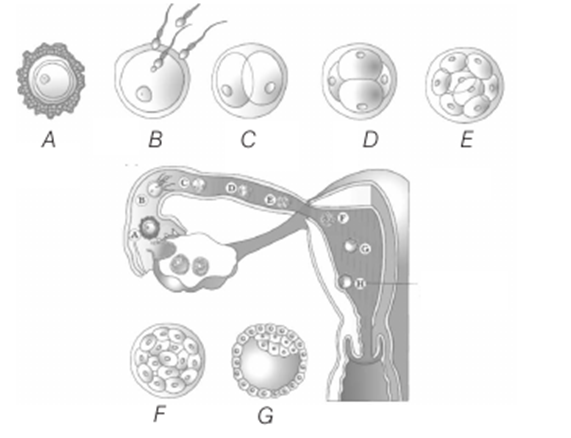
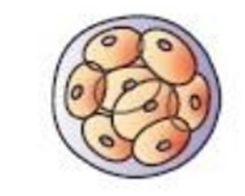
(a) Morula Blastula(b) Morula Blastocyst(c) Gastrula Blastocyst(d) Gastrula Blastula189. Identify A and B and their respective functions.A B Function of A Function of B
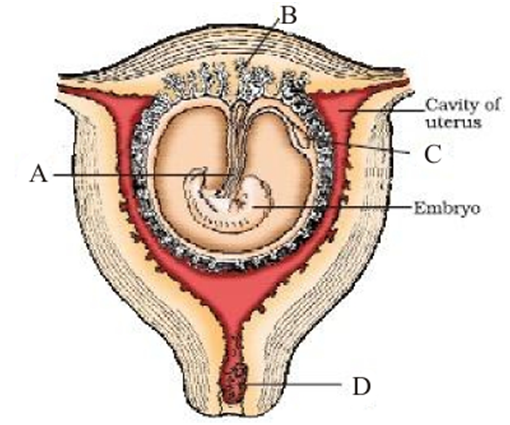
190. After implantation, finger-like projections appear on the trophoblast called … A… . They are surrounded by … B… and maternal blood. Here, A and B refer to(a) A–chorion, B–foetal cell(b) A–chorionic villi, B–uterine tissue(c) A–uterine tissue, B–chorionic villi(d) A–foetal cell, B–chorion191. Chorionic villi and uterine tissue become interdigitated with each other and jointly form(a) trophoblast(b) inner cell mass(c) placenta(d) embryo192. In the given diagram, find out A, B and C.
(a) A–Plug of mucus in cervix, B– Placental villi C–Umbilical cord(b) A–Umbilical cord, B–Placental villi, C–Plug of mucus in cervix(c) A–Umbilical cord, B–Plug of mucus in cervix, C–Placental villi(d) A–Placental villi, B–Plug of mucus in cervix–Umbilical cord193. Several hormones like hCG, hPL, oestrogen, progesterone are produced by(a) ovary(b) placenta(c) Fallopian tube(d) pituitary194. Hormones secreted by the placenta to maintain pregnancy are(a) hCG, hPL, progestogens, oestrogens(b) hCG, hPL, oestrogens, relaxin, oxytocin(c) hCG, hPL, progestogens, prolactin(d) hCG, progestogens, oestrogens, glucocorticoids195. Which one is present in the urine of pregnant woman?(a) hCG(b) LH(c) Oestrogen(d) FSH196. The figure given below shows the sectional view of ovary. Select the option which gives correct identification of marked structure
(A to D) and its feature.(a) A: Primary follicle, it is also called gamete mother cell.(b) B: Corpus luteum, it cannot be formed and added after birth.(c) C: Graafian follicle, mature follicle which ruptures to release secondary oocyte.(d) D: Tertiary follicle, a large number of this follicle degenerates during the phase from birth to puberty.197. The given figure shows the diagrammatic representation ofn oogenesis. Identify the option which shows the correct label marked as A, B, C and D.
(a) A: Tertiary; B: I; C: Fertilization; D: Primary oocyte.(b) A: Primary; B: II; C: Ovulation; D: Secondary oocyte.(c) A: Secondary; B: II; C: Fertilization; D: Primary oocyte.(d) A: Primary; B: I; C: Ovulation; D: Secondary oocyte.198. The figure given below shows the various events occurring during a menstrual cycle with few structures marked as A, B, C and D. Which of the following options shows the correct labelling?
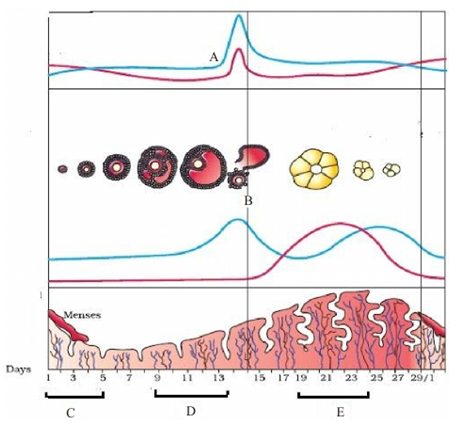
(a) A-->LH, B-->Ovulation, C-->Menstruation, D--> Proliferative phase, E-->Luteal phase(b) A-->FSH, B-->Implantation, C-->Follicular phase, D-->Menstruation phase, E-->Luteal phase(c) A-->Estrogen, B-->Parturition, C-->Luteal phase, D-->Follicular phase, E-->Follicular phase(d) A-->Progesterone, B-->Fertilization, C--> Menstruation phase, D-->Secretory phase, E-->Follicular phase199. In the given figure the structure of ovum is surrounded by few sperms and some art are labelled as A, B, C and D. Which of the following options shows the correct labelling?
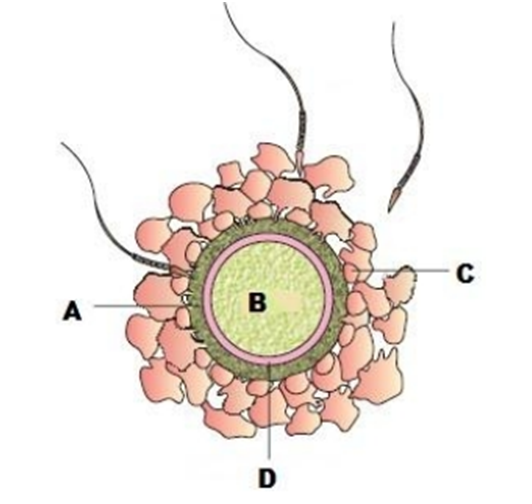
(a) A-->Zona pellucida, B-->Ovum, C-->Cells of corona radiata, D-->Perivitelline space(b) A-->Perivitelline space, B-->Antrum, C-->Zona pellucida D-->Ovum(c) A-->Zona pellucida, B-->Ootid, C-->Cells of corona radiata D-->Perivitelline space(d) A-->Cells of corona radiata, B-->Morula, C--> Perivitelline space D-->Zona pellucida200. Which of the following human evelopmental stage becomes embedded in the uterine endometrium by a process called implantation and leads to pregnancy?
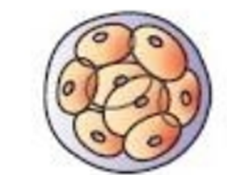
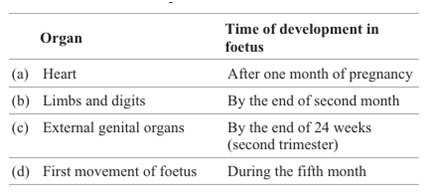
(a)
(b)
(c)
(d)201. The given figure shows the human foetus within the uterus with few structures marked as A, B, C and D Which of the following options shows the correct labelling?
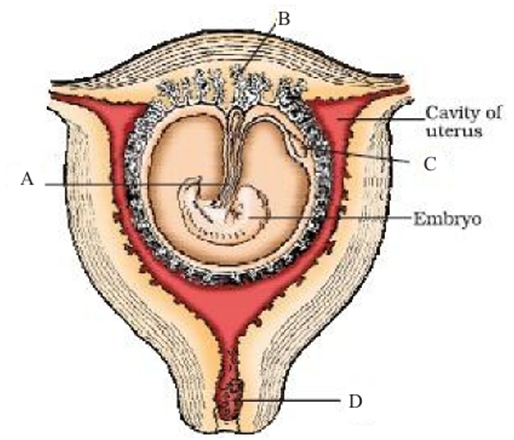
(a) A-->Umbilical cord with its veins, B--> Chorionic villi, C-->Antrum, D-->Plug of mucus in cervix(b) A-->Umbilical cord with its vessels, B-->Fimbriae, C--> Oocyte, D-->Plug of mucus in vagina(c) A-->Umbilical cord with its vessels, B-->Placental villi C-->Yolk sac, D-->Plug of mucus in cervix(d) A-->Umbilical cord with its veins, B-->Placental villi C-->Trophoblast, D-->Plug of mucus in vagina202. Study the given figure and conclude the correct explanation from the options given below:
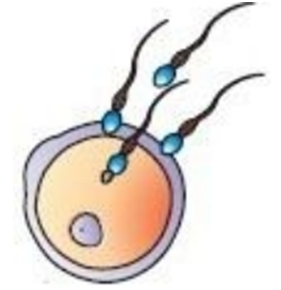
(a) All the sperm attaches with ovum.(b) Transport of sperm towards the ovum.(c) Ovum and surrounded sperms were going to take part in fertilization.(d) Sperm induces changes in the cells of corona radiata and blocks the entry of other additional sperms.203. Identify the structure marked as “X” and its function in the given figure of male reproductive system.
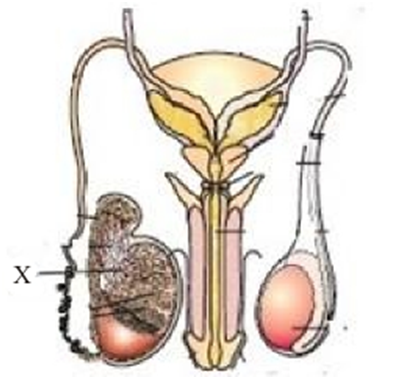
(a) Rete testis: It helps seminiferous tubule to open into vas efferentia.(b) Bulbourethral gland: It secretes alkaline mucus for lubricating the reproductive tract.(c) Vas efferentia: They have contractile mechanism that aids in the emission of seminal fluid.(d) Seminal vesicle: It synthesizes and secrete testicular hormone.204. The given figure shows the diagrammatic sectional view of female reproductive system with few structures marked as A, B, C, and D. Select the option which shows the correct identification of the structure with its characteristics.
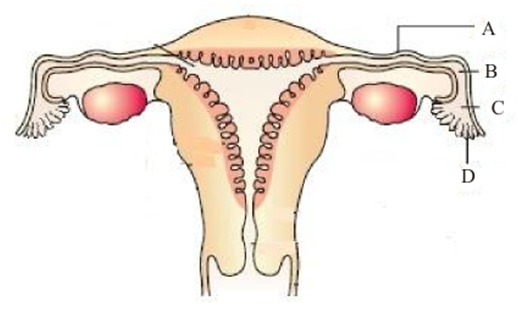
(a) A: Infundibulum, funnel shaped structure surrounded by finger like projection.(b) B: Ampulla, wider part of oviduct where fertilization occurs.(c) C: Isthmus, it has a narrow lumen and joins with uterus.(d) D: Fimbriae, it collects ovum before ovulation.205. “X” is a hormone which is secreted under the influence of GnRH.Identify “X” and the correct marked structures (A to D) from the figure given below on which “X” acts to stimulate secretion of some factors to help in spermiogenesis.
(a) “X” - LH, A(b) “X” - GH, B(c) “X” - ACTH, C(d) “X” - FSH, D206. Study the given figure and identify the correct event occurring in this.
(a) Role of pituitary hormones levels.(b) Events occurring in uterine tissues.(c) Role of ovarian hormone levels and growth of ovarian follicles.(d) Both (a) and (c).207. The given figure shows the human foetus within the uterus. Identify the marked label (A to D) through which placenta is connected to the embryo.
(a)A(b)B(c)C(d) D208. The given figure represents a stage of embryonic development. Identify the stage with its feature.
(a) Blastocysts, ready to fertilize with sperm.(b) Secondary oocyte, implants on endometrial layer of uterus.(c) Morula, formed by mitotic division of zygote(d) Ovary, produces female gamete and secretes hormones like estrogen etc.209. In the given figure, which two marked structure (A to D) is present in the lining of seminiferous tubule?
(a) A and D(b) B and D(c) C and D(d) A and B210. The given figure shows the structure of sperm whose tail enables it to swim. Why the sperm does needs to swim?
(a) In order to get the ovum for fertilization.(b) It helps the foetus to come out of the uterus.(c) It helps blastocysts to attach in endometnum in the process of implantation.(d) It helps the sperm to enter into the cytoplasm of the ovum through the zona pellucida and plasma membrane.211. Structure analogous to the placenta in mammals.(a) Chorion(b) Amnion(c) Yolk sac(d) Allantois212. Relaxin (a hormone) is secreted by(a) placenta(b) ovary(c) anterior lobe of pituitary(d) posterior lobe of pituitary213. Soon after implantation, the inner cell mass differentiates into outer …middle …B… and an inner …C…. A, B and C in the given sentence are(a) A–mesoderm, B–ectoderm, C–endoderm(b) A–ectoderm, B–mesoderm, C–endoderm(c) A–ectoderm, B–endoderm, C–mesoderm(d) A–mesoderm, B–endoderm, C–ectoderm214. Identify the correctly matched pair/pairs of the germ layers and their derivatives.I. Ectoderm – EpidermisII. Endoderm – DermisIII. Mesoderm – MusclesIV. Mesoderm – CartilageV. Endoderm – Enamel of teethChoose the option containing thecorrectly matched pairs.(a) I and IV(b) I and II(c) I, III and IV(d) I, II, III and V215. The amnion of mammalian embryo is derived from(a) mesoderm and trophoblast(b) endoderm and mesoderm(c) ectoderm and mesoderm(d) ectoderm and endoderm216. Gastrulation means(a) conversion of blastula into morula(b) formation of three germ layers(c) a phase in which organogenesis takes places(d) a phase characterised by inner cell mass217. The correct sequence is(a) Zygote → Cleavage → Morula→ Blastula → Gastrula(b) Cleavage → Zygote → Morula→ Blastula → Gastrula(c) Zygote → Morula → Blastula →Cleavage → Gastrula(d) Zygote → Blastula → Morula→ Cleavage → Gastrula218. Choose the incorrect pair.
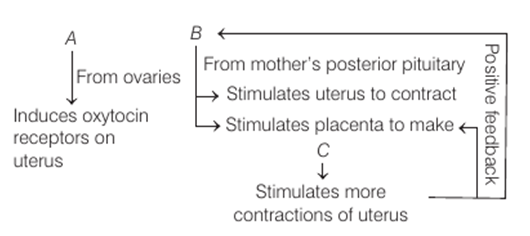
219. Parturition is induced by(a) neural mechanism(b) endocrine mechanism(c) neuroendocrine mechanism(d) hormonal mechanism220. Signals for parturition originate from(a) Both placenta as well as fully developed foetus(b) oxytocin released from maternal pituitary(c) placenta(d) fully developed foetus221. Identify the correct sequence in which the various stages of parturition take place.(a) Shedding of placenta → Dilation of cervix → Delivery of the baby(b) Dilation of the cervix →shedding of placenta → Delivery of the baby(c) Dilation of the cervix →Delivery of the baby → shedding of placenta(d) None of the above222. Which of the following hormones is responsible for both the milkejection reflex and the foetalejection reflex?(a) Oestrogen(b) Prolactin(c) Oxytocin(d) Relaxin223. Which one of the following is not the function of placenta?(a) facilitates supply of oxygen and nutrients to embryo(b) secretes oestrogen(c) facilitates removal of carbon dioxide and waste material from embryo(d) secretes oxytocin during parturition224. Name A, B and C hormones in the given figure.
(a) A–Prostaglandin, B–Oxytocin,C–Oestrogen(b) A–Oestrogen, B–Oxytocin, C–Prostaglandin(c) A–Oestrogen, B–Prostaglandin,C–Oxytocin(d) A–Prostaglandin, B–Oestrogen,C–Oxytocin225. Colostrum is important for newly born because(a) it contains essential antigen(b) it contains essential antibodies(c) Both (a) and (b)(d) it has more nutrients than ordinary milk226. The given diagram shows a human female’s reproductive system. Select the part (labelled as A, B, C & D) where semen is released into the female by the penis during copulation.
(a) A(b) B(c) C(d) D227. The figure given below shows a flowchart on spermatogenesis.Identify the correct label marked as
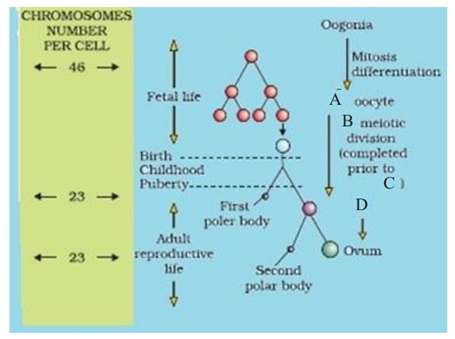
A, B, C and D(a) A: Ist meiotic division; B: 2nd meiotic division; C: Differentiation; D: 23.(b) A: 2nd meiotic division; B: Differentiation; C: Ist meiotic division; D: 46.(c) A: Differentiation; B: 2nd meiotic division; C: Ist meiotic division; D: 46.(d) A: Mitosis differentiation; B: Ist meiotic division; C: 2ndmeiotic division; D: 23.228. The feature of some structures of male reproductive system is given below. Identify the structure on the basis of the characteristics which surrounds the primary sex organ of male reproductive system.(a) Its enlarged end is called glans penis.(b) It travels through the penis and carry semen as well as urine.(c) It is responsible for maintaining the low temperature by about 2 –2.5º C from normal body temperature to mature sperm.(d) Stores sperms prior to ejaculation.229. Read the following statement and answer the question. “The urethra originates from a structure (called ‘X’) and extends through the male external genitalia (called ‘Y’ which helps in introducing semen into the vagina) to its external opening called urethral meatus.” Identify X and Y(a) X - Urinary bladder ; Y – Penis(b) X - Vas efferentia ; Y – Penis(c) X - Ejaculatory duct ; Y – Ureter(d) X - Bulbourethral gland ; Y -Ureter230. Which of the following is not a uterine function?(a) Waste removal for the developing embryo.(b) Nutritional support of the growing embryo.(c) Place of fusion of male and female gametes.(d) Mechanical protection of the developing embryo.231. Milk secreted from the cells of alveoli of mammary lobes reaches nipple through lactiferous duct (L), mammary duct (M), mammary tubule (T) and mammary ampulla (A) in the following order.(a) TMAL(b) MTLA(c) MTAL(d) ATML232. A gonadotropin hormone, “X” acts on interstitial cells and stimulates synthesis and secretion of “Y”. Identify X and Y from the given option.(a) X - LH; Y – Androgen(b) X - FSH; Y – Testosterone(c) X - TSH; Y – Progesterone(d) X - GH; Y - Estrogen233. Secretion of which of the following are essential for maturation and motility of sperm?(a) Ureter, vas deferens, urinary bladder and prostate.(b) Seminal vesicle, vas deferens, ejaculatory ducts and ureter.(c) Epididymis, seminal vesicle, vas deferens and prostate.(d) Epididymis, ejaculatory ducts, vas efferentia and seminal vesicle234. Which of the following shows the correct sequence of events leading to the formation of mature sperm?(a) Spermatogonium --> Secondary spermatocyte --> Primary spermatocyte --> Spermatids --> Sperms.(b) Spermatogonium --> Spermatids --> Secondary spermatocyte --> Primary spermatocyte --> Sperms.(c) Spermatids --> Primary spermatocyte --> Secondary spermatocyte --> Spermatogonium - -> Sperms.(d) Spermatogonium --> Primary spermatocyte --> Secondary spermatocyte --> Spermatids --> Sperms.235. How many ova are released during the middle of the menstrual cycle?(a) One(b) Two(c) Three(d) Four236. Study the given statement and answer the question. “During ‘P’ phase of the menstrual cycle, if pregnancy doesn’t happen, the ‘Q’ withers and dies, usually around day22 in a 28-day cycle. The drop in ‘R’ levels causes the lining of theuterus to fall away. This is known as ‘S’. Identify P, Q, R and S.(a) P --> Menstrual, Q --> Graafian follicle, R--> Estrogen, S --> Menarche(b) P --> Luteal, Q --> Corpus luteum, R --> Progesterone S --> Menstruation(c) P --> Ovulatory, Q -->Endometrium, R --> Follicle stimulating hormone, S --> Menopause(d) P --> Follicular, Q -->Secondary oocyte --> Luteinizing hormone S --> Menstruation237. Which of the following hormones attains a peak level in the middle of menstrual cycle?(a) LH and estroge(b) FSH and progesterone(c) FSH and LH(d) Estrogen and progesterone238. Select the correct sequence of menstrual cycle.(a) Menstruation, Secretory,Follicular, New cycle.(b) Menstruation, Follicular, Luteal, New cycle.(c) Follicular, Menstruation, Luteal, New cycle.(d) Luteal, Menstruation, Follicular, New cycle.239. Menstrual cycle is controlled by(a) LH and FSH only(b) estrogen, LH & FSH only(c) estrogen & progesterone only(d) LH, FSH, estrogen & progesterone.240. Which of the following is the first change that occurs to the zygote after fertilization?(a) It divides to form a hollow ball of cells, called the blastocyst.(b) It begins to secrete the hormones.(c) It contacts the endometrial wall of the uterus and becomes buried inside it.(d) It initiates the formation of a placenta.■ Direction In each of the following questions, a statement of Assertion (A) is given and followed by corresponding statement of Reason (R). Of the statements, mark the correct answer as(a) If both A and R are true and R is the correct explanation of the A(b) If both A and R are true, but R is not the correct explanation of the A(c) If A is true, but R is false(d) If A is false, but R is true241. Assertion (A) the testes are situated outside the abdominal cavity within scrotum.Reason (R) Muscles in scrotum helps to maintain low temperature of testes, necessary for spermatogenesis.242. Assertion (A) In the testis, spermatogenesis occurs in the seminiferous tubules and testosterone secretion takes place from the Sertoli cellsReason (R) Testosterone brings growth and maturation of secondary sex organs and also the development of accessory sex characters.243. Assertion (A) the Sertoli cells are present in seminiferous tubules.Reason (R) Sertoli cells provide nutrition to the germ cells and spermatozoa.244. Assertion (A) the bulbourethral gland is a male accessory gland.Reason (R) its secretion helps in the lubrication of the penis, thereby facilitating reproduction.245. Assertion (A) Fimbriae are fingerlike projections of infundibulum part of oviduct which is closest to ovary.Reason (R) they are important for the collection of ovum after ovulation from ovary.246. Assertion (A) in females, parturition is the act of giving birth to a baby.Reason (R) Signals for parturition originate from a fully developed foetus.247. Assertion (A) Ovum retains most of the contents of the primary oocyte and is much larger than spermatozoa.Reason (R) Ovum needs energy to go about in search of spermatozoa for fertilisation.248. Assertion (A) Menstrual phase is also compared to shedding tears for the lost ovum.Reason (R) in the menstrual phase, loss of endometrial lining takes place due to reduced titre of progesterone.249. Assertion (A) Production of FSH and LH increases in the ovulation phase.Reason (R) Due to decrease in the level of LH ovulation (releasing of ova) takes place.250. Assertion Progesterone is essential for maintenance of the endometrium.Reason (R) Endometrium is essential for implantation of fertilised ovum.251. Assertion not all copulations lead to pregnancy.Reason (R) Fertilisation can only occur if the ovum and sperms are transported simultaneously to the ampullary-isthmic junction.252. Assertion (A) in humans, the gamete contributed by the male determines whether the child produced will be male or female.Reason (R) Sex in humans is a polygenic trait, depending upon a cumulative effect of some genes on X-chromosome.253. Assertion (A) Placenta is an endocrine gland.Reason (R) it secretes many hormones essential for pregnancy.254. Assertion (A) the presence of hCG in woman urine is the basis for pregnancy test.Reason (R) a woman passes out hCG in the urine during pregnancy.255. Assertion (A) Breastfeeding during initial period of infant growth is recommended.Reason (R) Colostrum contains several antibodies, essential to render immunity in newborns.256. Fertilization can only occurs if(a) sperm reaches to the ampullary – isthmic junction before the ovum.(b) Ovum reaches to the ampullary– isthmic junction before the sperm.(c) Sperms are transported to the uterus and ovum to the fallopian tube simultaneously.(d) Sperm and ovum are transported simultaneously to the ampullary –isthmic junction.257. Which of the following does not occur in the time during and immediately following fertilization?(a) Fusion of the sperm and ovum nuclei.(b) Division of the oocyte cell by meiosis(c) Implantation of the ovum in the uterus.(d) Digestion of cell layers around the oocyte by sperm.258. The acrosome enables the sperm to(a) help in motility.(b) Produce energy for activity.(c) Penetrate Vitelline membrane of ovum.(d) Fertilize more than one ovum.259. At the time of fertilization, chromosome number(a) is halved(b) remains haploid(c) becomes diploid(d) does not change260. Foetal ejection reflex in human female is induced by(a) placenta only.(b) Fully developed foetus and placenta.(c) Release of oxytocin from pituitary gland.(d) Release of full developed corpus luteum.261. Study the statement given below and answer the question. “Vigorous contraction of the ’X’ at the end of the ‘Y’ causes expulsion of the foetus.” Identify X and Y.(a) X -Vagina ; Y – Fertilization(b) X - Uterus ; Y – Pregnancy(c) X - Placenta ; Y – Implantation(d) X - Embryo ; Y - Ovulation262. Each spermatogonium which is diploid contains how many chromosomes?(a) 23(b) 26(c) 4(d) 48263. Which of the following group of cells involved in spermatogenesis represent haploid cells?(a) Spermatogonium(b) Primary spermatocyte(c) Both (a) and (b)(d) Secondary spermatocyte264. After the transformation of spermatids into sperm, their heads become embedded in a cell called “X” and are finally released from the “Y” by the process called “Z”. Identify X, Y and Z.
265. Select the option which shows the correct part of a sperm with its corresponding function.(a) Head: Stimulate Leydig cell to produce androgen hormone.(b) Neck: Essential for maturation and motility of sperm.(c) Middle piece: Produces energy from mitochondria for tail movement which facilitate sperm motility.(d) Tail: Help in fertilization with the help of enzyme present in acrosome.266. “A” cells start division and enter in “B” stage of meiotic division and get temporarily “C” at this stage, called “D”. Identify A, B, C and D.(a) A: Oogonia; B: Metaphase I; C: Arrested; D: Primary oocyte.(b) A: Oogonia; B: Anaphase I; C: Released; D: Secondary oocyte.(c) A: Oogonia; B: Prophase I; C: Arrested; D: Primary oocyte.(d) A: Oogonia; B: Telophase I; C: Released; D: Secondary oocyte.267. What happens during fertilization in humans after many sperms reach close to the ovum?(a) Cells of corona radiata trap all the sperms except one(b) Only the closest sperm to the ovum penetrates the zona pellucida.(c) Secretions of acrosome helps one sperm enter cytoplasm of ovum through zona pellucida and plasma membrane(d) all sperms except the one nearest to the ovum lose their tails.268. Study the following statements and answer the question. In a process called ‘A’, ‘B’ division starts as the zygote moves through the ‘C’ of the ‘D’ towards the ‘E’. Identify A, B, C, D and E.(a) A-->Blastulation, B-->Meiotic, C-->Ampulla, D-->Fallopian tube, E-->Uterus(b) A-->Parturition, B-->Meiotic, C- ->Infundibulum, D-->Uterus, E-- >Vagina(c) A-->Implantation, B-->Mitotic, C-->Fimbriae, D--> Ovary E-- >Cervix(d) A-->Cleavage, B--> Mitotic, C-- >Isthmus, D--> Oviduct E-->Uterus269. What will happen to pregnancy if placenta fails to function during the gestation?(a) The pregnancy would not continue.(b) The foetus would be born prematurely.(c) There would be no effect on the pregnancy.(d) The corpus luteum would continue produce hormone as an alternative source until birth.270. Choose the correct statement.(a) Size of testis is 4-5 cm in length and 1 cm in width(b) The scrotum is maintained at body temperature(c) The testes are situated outside the abdominal cavity in humans(d) The earliest stages of spermatogenesis occur outside the testis271. Choose the incorrect statement (s).(a) Oogonia are formed and added after birth(b) Oogenesis is initiated during the embryonic development(c) No more gamete mother cells are formed in females after birth(d) All of the above272. Which of the following statement is incorrect?(a) Each ovary is about 2 to 4 cm in length and is connected to the pelvic wall and uterus by ligaments(b) Each ovary is covered by a thin epithelium which encloses the ovarian stroma(c) Ovaries produce several steroid hormones only(d) the stroma of ovary is divided into a peripheral cortex and an inner medulla273. Read the following statements.I. The uterus is present in single pair and is also called womb.II. The shape of uterus is like an inverted pear.III. The uterus opens into vagina through a narrow cervix.IV. Birth canal is formed by cervical canal and vagina.V. Perimetrium of uterus wall is external and thick; myometrium is middle thin layer of smooth muscles and endometrium is inner glandular layer.Which of the above statements are correct?(a) I, II and III(b) II, III and IV(c) IV and V(d) I and V274. Read the following statements.I. Spermatogonia and spermatids are diploid.II. The extrusion of second polar body from nucleus occurs after the entry of sperm and completion of fertilisation.III. Spermatogenesis and sperm differentiation under the control of FSH and testosterone.IV. A change in ovum after penetration of sperm the formation of second polar body.V. The secondary oocyte in the Graafian follicle forms a new membrane called zona pellucida surrounding it.Which of the above statements are correct?(a) I, II, III and V(b) I and III(c) Only III(d) II, III, IV and V275. Read the following statements.I. Each testis has about 25 compartments called testicular lobules.II. Each testicular lobule contains one to three highly coiled seminiferous tubules in which sperms are produced.III. Sertoli cells act as nurse cells of testicles.IV. Sertoli cells are activated by FSH secreted by the adenohypophysis.Which of the above statements are incorrect?(a) I and III(b) Only I(c) II and IV(d) III and IV276. Which of the following statement/s is not correct?(a) The external opening of penis is called urethral meatus(b) Glans penis is covered by loose fold of skin called foreskin(c) Secretion of bulbourethral gland helps in lubrication of penis(d) None of the above277. Which of the following statement is false for uterus?(a) It is also called womb and its shape is like an inverted pear(b) It is supported by ligaments attached to the pelvic wall(c) It opens into oviducts through cervix whose cavity is called cervical canal(d) It is bound by three layers, outer perimetrium, middle myometrium and inner endometrium278. Which one of the following statement is false in respect of viability of mammalian sperm?(a) Sperm is viable for only up to 24 hrs.(b) Survival of sperm depends on the pH of the medium and is more active in alkaline medium(c) Viability of sperm is determined by its motility(d) Sperms must be concentrated in a thick suspension279. Which of the following statement is not correct for oogonia?(a) They are million gamete mother cells(b) They are formed within each foetal ovary(c) They are formed throughout the life of female(d) They start division and get arrested at prophase-I of meiotic division280. Select the incorrect statement.(a) LH and FSH trigger ovulation in ovary(b) LH and FSH decrease gradually during the follicular phase(c) LH triggers secretion of androgens from the Leydig cells(d) FSH stimulates the Sertoli cells which help in spermiogenesis281. Identify the correct statement(s) for placenta.(a) It facilitates the supply of O2 and nutrients to embryo(b) It is connected to embryo through umbilical cord(c) It removes CO2 and excretory material produced by embryo (d)All of the above282 Identify the correct statement on ‘inhibin’.(a) It is produced by granulosa cells in ovary and inhibits the secretion of FSH(b) It is produced by granulosa cells in ovary and inhibits the secretion of LH(c) It is produced by nurse cells in testes and inhibits the secretion of LH(d) It inhibits the secretion of LH, FSH and prolactin283. Select the correct option describing gonadotropin activity in a normal pregnant female.(a) High level of FSH and LH stimulates the thickening of endometrium(b) High level of FSH and LH facilitates implantation of the embryo(c) High level of hCG stimulates the synthesis of oestrogen and progesterone(d) High level of hCG stimulates the thickening of endometrium284. Consider the following three statements related to the human male reproductive system and select the correct option stating which ones are True (T) and which ones is False (F).I. Middle piece of spermatozoon is also termed as power house of spermatozoon.II. Vas deferens joins a duct from seminal vesicle and form vasa efferentia.III. Semen is a collection of secretions from the seminal vesicles, prostate gland, Cowper’s glands and sperms from testes.I II III(a) T F T(b) F F T(c) T T F(d) F T T285 Read the following statements and select the correct option(s).I. Maintenance of hygiene and sanitation during menstruation is very important.II. Primary oocytes surrounded by a layer of granulosa cells and called primary follicle.III. Seminal plasma is rich in fructose, calcium and certain enzymes.IV. In females, uterus is single and also called womb.(a) Only I(b) I and II(c) Only III(d) All of these286. Given below are four statements (IIV) regarding embryonic development in humans.I. Cleavage divisions bring about considerable increase in the mass of protoplasm.II. With more cleavage divisions, the resultant blastomeres become smaller and smaller.III. The blastomeres in the blastocyst are arranged into two layers, i.e. trophoblast and endometrium.IV. Cleavage divisions result in a solid ball of cells called morula.Which of the above two statements are correct?(a) I and III(b) II and IV(c) I and II(d) III and IV287 Read the given statements and select the correct option.I. The production of sperms and ovum by the testis in males and the ovaries in female, respectively, called gametogenesis.II. Each spermatogonium in seminiferous tubule is diploid and contains 46 chromosomes.(a) Both statements are incorrect(b) Statement I is correct, but statement II is incorrect(c) Both statements are correct(d) Statement I is incorrect, but statement II is correct.288 Which of the following statements is correct?I. Oogenesis is initiated during the embryonic development stage.II. At puberty only 60, 000-80, 000 primary follicles are left in each ovary.III. The primary follicles surrounded with many layers of granulosa cells and form a new the called secondary follicles.IV. Changing of sanitary napkins or pads after every 4-5 hours is necessary for maintaining menstrual hygiene.(a) I and II(b) I, II, III and IV(c) I and III(d) None of these289. Regarding male pronucleus which among the following statement is correct?I. It is the sperm nucleus after entering the ovum at fertilisation.II. Both head and neck of sperm contribute to pronucleus formation.III. Male pronucleus contains mitochondria.IV. Sperm head contains pronucleus having diploid set of chromosomes.(a) Only II(b) III and IV(c) Only I(d) II and IV290. Study the figure of the human female reproductive system given below. Read the following statements and select the option containing the incorrect statement(s).I. A–ovary produces oestrogen required for the development of female primary sex characters.II. A–Vagina receives the penis during copulationIII. B–Uterus serves as the site for implantation of the fertilised egg.IV. C–Oviduct serves as the site for fertilisation of the egg.(a) I and II(b) Only I(c) only II(d) II and IV291. Match the following columns.
292. Match the following columns.
293. Match the following columns.
294. Match the following columns.
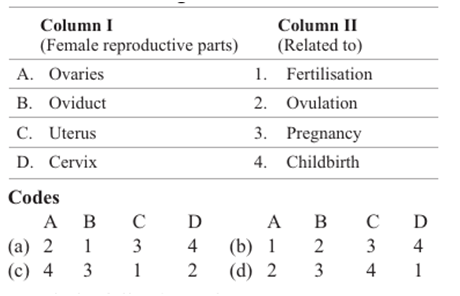
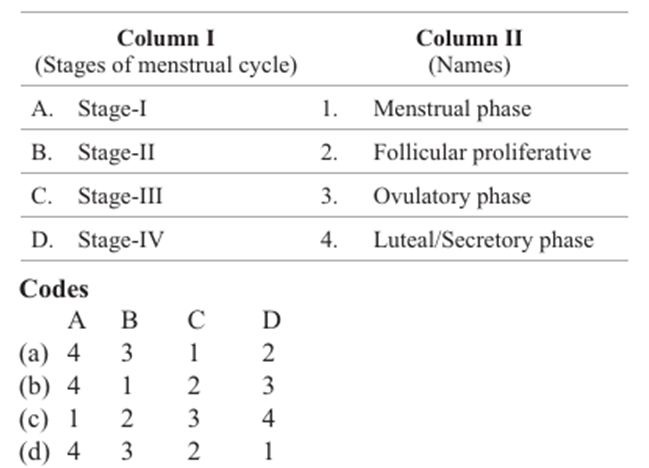
295. Match the following columns.
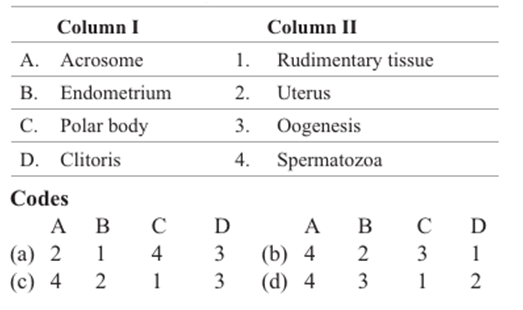
296. Match the following columns.
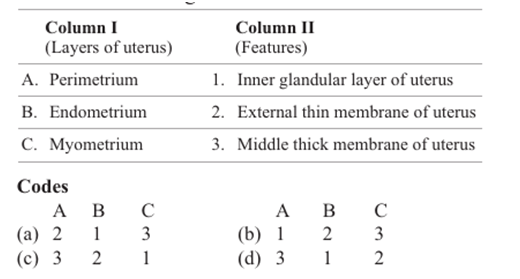
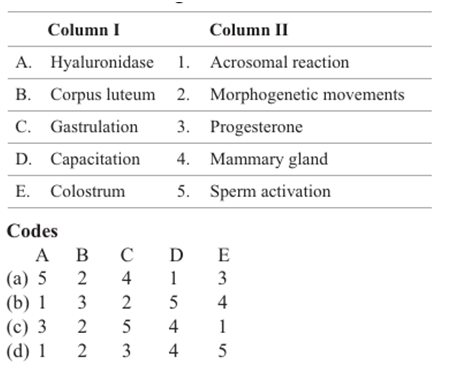
297. Match the following columns.
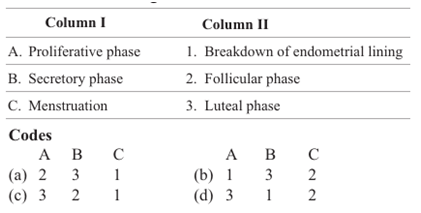
298. Match the following columns.
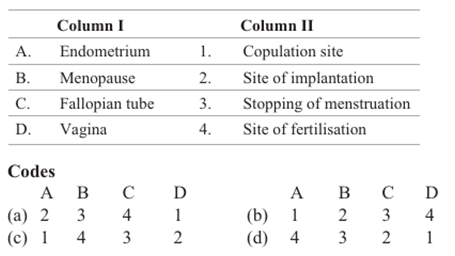
299. Match the following columns.
300. Match the following columns.
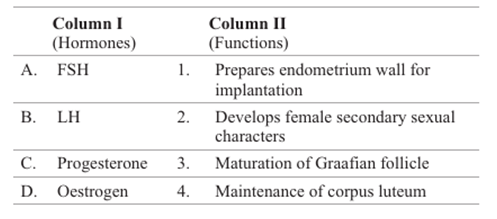
301. Match the following columns.
302. Name the hormones involved in the regulation of spermatogenesis.(a) LH and FSH(b) Testosterone only(c) Testosterone and LH(d) LH only303. Read the following statements.I. Androgens are produced by Sertoli cells.II. Presence or absence of hymen is not a reliable indicator of virginity or sexual experience.III. Leydig cells synthesise androgens.IV. Oogenesis takes place in corpus luteum. Identify whether the given above statements are true or false.I II III IV I II III IV(a) T F F T(b) T F T F(c) F T T F(d) F F T T304. How many eggs do you think would have been released by human ovary if the mother gave birth to identical twins?(a) One, fertilised by two sperms(b) Two, fertilised by different sperms(c) One, fertilised by single sperm(d) Two, fertilised by single sperm305. How many eggs do you think were released by the ovary of a female dog which gave birth to 6 puppies?(a) One(b) Three(c) Six(d) Indefinite306. Spot the odd one out from the following structures with reference to the male reproductive system.(a) Rete testis(b) Epididymis(c) Vasa efferentia(d) Isthmus307. The vasa deferens receives duct from the seminal vesicle and opens into urethra as(a) epididymis(b) ejaculatory duct(c) efferent ductule(d) ureter308. Urethral meatus refers to the(a) urinogenital duct(b) opening of vas deferens into urethra(c) external opening of the urinogenital duct(d) muscles surrounding the urinogenital duct309. Seminal plasma, the fluid part of semen is contributed byI. seminal vesicleII. Prostate glandIII. UrethraIV. Bulbourethral gland(a) I and II(b) I, II and IV(c) II, III and IV(d) I and IV310. Which one of the following is not a male accessory gland?(a) Seminal vesicle(b) Mammary gland(c) Prostate(d) Bulbourethral gland311. Mature Graafian follicle is generally present in the ovary of a healthy human female around(a) 5-8 days of menstrual cycle(b) 11-17 days of menstrual cycle(c) 18-23 days of menstrual cycle(d) 24-28 days of menstrual cycle312. Spermiation is the process of the release of sperms from(a) seminiferous tubules(b) vas deferens(c) epididymis(d) prostate gland313. Acrosomal reaction of the sperm occurs due to(a) its contact with zona pellucida of the ova(b) reactions within the uterine environment of the female(c) reactions within the epididymis environment of the male(d) androgens produced in the uterus314. Which of the following hormones is not secreted by human placenta?(a) hCG(b) Oestrogens(c) Progesterone(d) LH315. Morula is a developmental stage(a) between the zygote and blastocyst(b) between the blastocyst and gastrula(c) after the implantation(d) between implantation and parturition316. Match the following columns.Column I Column IIA. Trophoblast 1. Embedding of blastocyst in the endometriumB. Cleavage 2. Group of cells that would differentiate as embryoC. Inner cell mass 3. Outer layer of blastocyst attached to the endometriumD. Implantation 4. Mitotic division of zygoteCodes A B C D(a) 2 1 3 4(b) 3 4 2 1(c) 3 1 2 4(d) 2 4 3 1317. Choose the incorrect statement from the following.(a) In birds and mammals, internal fertilisation takes place(b) Colostrum contains antibodies and nutrients(c) Polyspermy in mammals is prevented by the chemical changes on the egg surface(d) In the human female, implantation occurs almost seven days after fertilisation318. Identify the correct statement from the following.(a) High levels of oestrogen triggers the ovulatory surge(b) Oogonia cells start to proliferate and give rise to functional ova in regular cycles from puberty onwards(c) Sperms released from seminiferous tubules are highly mobile(d) Progesterone level is high during the post ovulatory phase of menstrual cycle319. The spermatogonia undergo division to produce sperms by the process of spermatogenesis.Choose the correct one with reference to above.(a) Spermatogonia have 46 chromosomes and always undergo meiotic cell division(b) Primary spermatocytes divide by mitotic cell division(c) Secondary spermatocytes have 23 chromosomes and undergo second meiotic division(d) Spermatozoa are transformed into spermatids320. Match between the following representing parts of the sperm and their functions and choose the correct option.Column I Column IIA. Head 1. EnzymesB. Middle piece 2. Sperm motilityC. Acrosome 3. EnergyD. Tail 4. Genetic materialCodes A B C D(a) 2 4 1 3(b) 4 3 1 2(c) 4 1 2 3(d) 2 1 3 4321. Which among the following has 23 chromosomes?(a) Spermatogonia(b) Zygote(c) Secondary oocyte(d) Oogonia322. The membranous cover of the ovum at ovulation is(a) corona radiata(b) zona radiata(c) zona pellucida(d) chorion323. Identify the odd one from the following.(a) Labia minora(b) Fimbriae(c) Infundibulum(d) IsthmusAnswer key
1
D
51
C
101
B
151
C
201
C
251
A
301
B
2
A
52
A
102
B
152
C
202
C
252
C
302
A
3
A
53
A
103
A
153
C
203
A
253
B
303
C
4
A
54
B
104
D
154
A
204
B
254
A
304
C
5
A
55
B
105
A
155
C
205
D
255
A
305
C
6
D
56
A
106
B
156
B
206
C
256
D
306
D
7
D
57
D
107
D
157
D
207
A
257
C
307
B
8
C
58
D
108
C
158
D
208
C
258
C
308
C
9
B
59
B
109
B
159
A
209
A
259
C
309
B
10
C
60
D
110
B
160
A
210
A
260
B
310
B
11
B
61
D
111
A
161
C
211
A
261
B
311
B
12
A
62
A
112
A
162
B
212
B
262
C
312
A
13
D
63
D
113
B
163
D
213
B
263
D
313
A
14
C
64
A
114
B
164
B
214
C
264
C
314
D
15
A
65
A
115
C
165
A
215
C
265
C
315
A
16
B
66
AD
116
D
166
D
216
B
266
C
316
B
17
B
67
A
117
C
167
B
217
A
267
C
317
B
18
D
68
B
118
B
168
D
218
C
268
D
318
D
19
C
69
D
119
B
169
B
219
C
269
A
319
C
20
B
70
C
120
D
170
C
220
A
270
C
320
B
21
A
71
D
121
A
171
D
221
C
271
A
321
C
22
D
72
A
122
D
172
C
222
A
272
C
322
A
23
B
73
D
123
A
173
D
223
D
273
B
323
A
24
D
74
DD
124
C
174
C
224
B
274
D
25
C
75
A
125
B
175
B
225
B
275
B
26
D
76
A
126
D
176
B
226
D
276
D
27
C
77
B
127
A
177
C
227
D
277
C
28
B
78
A
128
A
178
A
228
C
278
A
29
B
79
B
129
A
179
B
229
A
279
C
30
C
80
D
130
C
180
A
230
C
280
B
31
B
81
D
131
B
181
B
231
A
281
D
32
D
82
C
132
B
182
B
232
A
282
A
33
D
83
D
133
A
183
B
233
C
283
C
34
C
84
A
134
A
184
A
234
D
284
A
35
B
85
B
135
C
185
A
235
A
285
D
36
D
86
A
136
C
186
B
236
B
286
B
37
A
87
B
137
A
187
C
237
C
287
C
38
C
88
D
138
B
188
B
238
B
288
B
39
B
89
D
139
A
189
A
239
D
289
C
40
A
90
C
140
C
190
B
240
A
290
B
41
B
91
B
141
A
191
C
241
A
291
D
42
B
92
B
142
A
192
B
242
D
292
A
43
C
93
B
143
B
193
B
243
B
293
A
44
D
94
D
144
C
194
A
244
A
294
B
45
A
95
D
145
D
195
A
245
B
295
A
46
D
96
A
146
C
196
C
246
B
296
A
47
A
97
B
147
D
197
D
247
C
297
C
48
C
98
D
148
C
198
A
248
A
298
B
49
C
99
C
149
B
199
A
249
C
299
A
50
B
100
D
150
D
200
C
250
B
300
A
APREVIOUS YEAR QUESTIONS1. The shared terminal duct of the reproductive and urinary system in the human male is: [2014] (a) Urethra (b) Ureter (c) Vas deferens (d) Vasa efferentia2. The Leydig cells found in the human body are the secretory source of [2012](a) Progesterone(b) Intestinal mucus(c) Glucagon(d) Androgens3. If for some reason, the vasa efferentia in the human reproductive system gets blocked, the gametes will not be transported from [2011](a) Testes to epididymis(b) Epididymis to vas deferens(c) Ovary to uterus(d) Vagina to uterus4. The testes in humans are situated outside the abdominal cavity insides pouch called scrotum. The purpose served is for [2011](a) Maintaining the scrotal temperature Lower than the internal body temperature(b) Escaping any possible compression by The visceral organs(c) Providing more space for the growth of epididymis(d) Providing a secondary sexual feature for exhibiting the male sex5. Sertoli cells are found in [2010](a) Ovaries and secrete progesterone(b) Adrenal cortex and secrete adrenaline(c) Seminiferous tubules and provide Nutrition to germ cells(d) Pancreas and secrete cholecystokinin6. Vasa efferentia are the ductules leading from(a) Testicular lobules to rete testis [2010](b) Rete testis to vas deferens(c) Vas deferens to epididymis(d) Epididymis to urethra7. Seminal plasma in human males is rich In: [2010](a) Fructose and calcium(b) Glucose and calcium(c) DNA and testosterone(d) Ribose and potassium8. Seminal plasma in humans is rich in [2009](a) Fructose and calcium but has no enzymes(b) Glucose and certain enzymes but has no calcium(c) Fructose and certain enzymes but poor in calcium(d) Fructose, calcium and certain enzymes9. Given below is a diagrammatic sketch of a portion of human male reproductive system. Select the correct set of the names of the parts labelled A, B, C, D. [2009]
(a) Vas deferens (A); seminal vesicle (B) Prostate (C); bulbourethral gland (D).(b) Vas deferens (A); seminal vesicle (B) Bulbourethral gland (C); prostate (D).(c) Ureter (A); seminal vesicle (B); prostate (C); bulbourethral gland (D)(d) ureter (A); prostate(B); seminal vesicle (C); bulbourethral gland (D).10. Grey crescent is the area [2005](a) At the point of entry of sperm into ovum(b) Just opposite to the site of entry of sperm into ovum(c) At the animal pole(d) At the vegetal pole11. Location and secretion of Leydig’s cells are(a) Liver – cholesterol [1991](b) Ovary – estrogen(c) Testes – testosterone(d) Pancreas – glucagon12. Capacitation occurs in: [2017](a) Epididymis(b) Vas deferens(c) Female reproductive tract(d) Rete testis13. Capacitation refers to changes in the: [2015 RS] (a) Ovum before fertilization (b) Ovum after fertilization (c) Sperm after fertilization (d) Sperm before fertilization14. Which of the following layers in an antral follicle is acellular? [2015 RS](a) Theca interna(b) Stroma(c) Zona pellucida(d) Granulosa15. The main function of mammalian corpus luteum is to produce: [2014](a) Estrogen only(b) Progesterone(c) Human chorionic gonadotropin(d) Relaxin only16. The figure given below depicts a diagrammatic sectional view of the female reproductive system of humans. Which one set of three parts out of I-VI has been correctly identified? [2011]
(a) (II) Endometrium(III) Infundibulum, (IV) Fimbriae(b) (III) Infundibulum, (IV) Fimbriae, (V) Cervix,(c) (IV) Oviducal funnel, (V) Uterus, (VI) Cervix(d) (I) Perimetrium, (II) Myometrium, (Ill) Fallopian tube17. The part of fallopian tube closest to the ovary is [2010](a) Isthmus (b) infundibulum(c) Cervix (d) ampulla18. Fertilization in humans is practically feasible only if [2016](a) The sperms are transported into vagina just after the release of ovum in fallopian tube(b) The ovum and sperms are transported simultaneously to ampullary isthmic junction of the fallopian tube(c) The ovum and sperms are transported simultaneously to ampullary - isthmic junction of the cervix(d) The sperms are transported into cervix within 48 hrs of release of ovum in uterus19. Select the incorrect statement: [2016] (a) FSH stimulates the sertoli cells which help in spermiogenesis(b) LH triggers ovulation in ovary(c) LH and FSH decrease gradually during the follicular phase(d) LH triggers secretion of androgens from the Leydig cells20. Which of the following cells during gametogenesis is normally diploid? [2015 RS](a) Spermatid(b) Spermatogonia(c) Secondary polar body(d) Primary polar body21. Which of the following events is not associated with ovulation in human female? [2015 RS](a) Full development of Graffin follicle(b) Release of secondary oocyte(c) LH surge(d) Decrease in estradiol22. In human females, meiosis-II is not complete until? [2015 RS](a) Fertilization(b) Uterine implantation(c) Birth(d) Puberty23. Select the correct option describing gonadotropin activity in a normal pregnant female: [2014](a) High level of FSH and LH stimulates the thickening of endometrium.(b) High level of FSH and LH facilitate implantation of the embryo.(c) High level of hCG stimulates the synthesis of estrogen and progesterone.(d) High level of hCG stimulates the thickening of endometrium.24. Menstrual flow occurs due to lack of: [NEET 2013](a) FSH (b) Oxytocin(c) Vasopressin (d) Progesterone25. What is the correct sequence of sperm formation? [NEET 2013](a) Spermatogonia, spermatocyte, spermatozoa, spermatid(b) Spermatogonia; spermatozoa, spermatocyte, spermatid(c) Spermatogonia, spermatocyte, spermatid, spermatozoa(d) Spermatid, spermatocyte, spermatogonia, spermatozoa26. Which of the following best illustrates feedback in development? [NEET Kar. 2013](a) As tissue (X) develops, it secretes something that slows down the growth of tissue (Y)(b) Tissue (X) secretes RNA which changes the development of tissue (Y)(c) As tissue (X) develops, it secretes enzymes that inhibit the development of tissue (Y)(d) As tissue (X) develops, it secretes Something that induces tissue (Y) to develop27. The figure shows a section of human ovary. Select the option which gives the correct identification of A and B withfunction/characteristic [NEET Kar. 2013]A , B(a) A – Primary oocyte – it is the prophase – I of the meiotic division(b) B – Corpus luteum – secretes progesterone(c) A – Tertiary follicle – forms Graafian follicle(d) B – Corpus luteum – secretes estrogen28. Which one of the following statements is false in respect of viability of mammalian sperm? [2012](a) Sperm is viable for only up to 24 hours.(b) Survival of sperm depends on the pH of the medium and is more active in alkaline medium.(c) Viability of sperm is determined by its motility.(d) Sperms must be concentrated in a thick suspension.29. In a normal pregnant woman, the amount of total gonadotropin activity was assessed. The result expected was [2012](a) High level of circulating FSH and LH in the uterus to stimulate implantation of the embyro(b) High level of circulating HCG to stimulate endometrial thickening(c) High level of FSH and LH in uterus to stimulate endometrial thickening(d) High level of circulating HCG to stimulate estrogen and progesterone synthesis30. The secretory phase in the human menstrual cycle is also called [2012M](a) Luteal phase and lasts for about 6 days(b) follicular phase lasting for about 6 days(c) Luteal phase and lasts for about 13 days(d) Follicular phase and lasts for about 13 days31. What happens during fertilisation in humans after many sperms reach close to the ovum? [2011M](a) Secretions of acrosome helps one sperm enter cytoplasm of ovum through zona pellucida(b) All sperms except the one nearest to the ovum lose their tails(c) Cells of corona radiata trap all the sperms except one(d) Only two sperms nearest the ovum penetrate zona pellucida32. About which day in a normal human menstrual cycle does rapid secretion of LH (Popularly called LH-surge) normallyoccurs? [2011M](a) 14th day(b) 20th day(c) 5th day(d) 11th day33. The second maturation division of the mammalian ovum occurs [2010](a) Shortly after ovulation before the ovum makes entry into the fallopian tube(b) Until after the ovum has been penetrated by a sperm(c) Until the nucleus of the sperm has fused with that of the ovum(d) In the graafian follicle following the first maturation division34. Which one of the following statements about human sperm is correct? [2010](a) Acrosome has a conical pointed structure used for piercing and penetrating the egg, resulting in fertilisation(b) The sperm lysine in the acrosome dissolve the egg envelope facilitating fertilisation(c) Acrosome serves as a sensory structure leading the sperm towards the ovum(d) Acrosome serves no particular function35. Which one of the following is the correct matching of the events occurring during menstrual cycle? [2009](a) Proliferative phase: Rapid regeneration of myometrium and maturation of Graffian follicle.(b) Development of corpus luteum: Secretory phase and increased secretion of progesterone.(c) Menstruation: Breakdown of myometrium and ovum not fertilised.(d) Ovulation: LH and FSH attain peak level and sharp fall in the secretion of progesterone36. The correct sequence of spermatogenetic stages leading to the formation of sperms in a mature human testes is: [2009](a) Spermatogonia - spermatocyte - spermatid -sperms(b) Spermatid - spermatocyte - spermatogonia - sperms(c) Spermatogonia - spermatid - spermatocyte – sperms(d) Spermatocyte - spermatogonia - spermatid – sperms progesterone.37. Which one of the following is the most likely root cause why menstruation is not taking place in regularly cycling human female? [2009](a) Maintenance of the hypertrophical endometrial lining(b) Maintenance of high concentration of sex hormones in the blood stream(c) Retention of well -developed corpus luteum(d) Fertilisation of the ovum38. In humans, at the end of the first meiotic division, the male germ cells differentiate into the [2008](a) Primary spermatocytes(b) Secondary spermatocytes(c) Spermatids(d) Spermatogonia39. Which one of the following statements is incorrect about menstruation? [2008](a) During normal menstruation about 40 ml blood is lost(b) The menstrual fluid can easily clot(c) At menopause in the female, there is especially abrupt increase in gonadotropic hormones(d) The beginning of the cycle of menstruation is called menarche.40. In the human female, menstruation can be deferred by the administration of [2007](a) combination of FSH and LH(b) Combination of estrogen and progesterone(c) FSH only(d) LH only41. Withdrawal of which of the following hormones is the immediate cause of menstruation? [2006](a) FSH(b) FSH-RH(c) Progesterone(d) Estrogen42. If mammalian ovum fails to get fertilized, which one of the following is unlikely? [2005](a) Corpus luteum will disintegrate(b) Progesterone secretion rapidly declines(c) Estrogen secretion further decreases(d) Primary follicle starts developing43. After ovulation the collapsed ovarian follicle shrinks and becomes filled with cell to form [1999](a) Corpus luteum (b) corpus albicans(c) Corpus atresia (d) corpus adiposum44. The growth of corpus luteum is initiated by(a) Human chorionic gonadotropin [1999](b) Follicle stimulating hormone(c) Luteinizing hormone(d) Prolactin45. In 28 day human ovarian cycle, ovulation occurs on [1994, 1997](a) Day 1 (b) Day 5(c) Day 14 (d) Day 2846. Fertilizins are emitted by [1991, 1997](a) Immature eggs (b) mature eggs(c) Sperms (d) polar bodies47. The estrous cycle is a characteristic of [1995](a) Human males only(b) Human females only(c) Mammalian males other than primates(d)Mammalian females other than primates48. At the end of first meiotic division, male sperm differentiates into [1994](a) Secondary spermatocyte(b) Primary spermatocyte(c) Spermatogonium(d) Spermatid49. Extrusion of second polar body from egg nucleus occurs [1993](a) After entry of sperm before completion of fertilization(b) After completion of fertilization(c) Before entry of sperm(d) Without any relation of sperm entry50. Acrosome reaction in sperm is triggered by [1993](a) Capacitation(b) Release of lysine(c) influx of Na+(d) Release of fertilizing51. Freshly released human egg has [1991](a) One Y-chromosome(b) One X-chromosome(c) Two X-chromosomes(d) One X-chromosome & one Ychromosome52. Middle piece of mammalian sperm possesses [1991](a) Mitochondria and centriole (b) Mitochondria only(c) Centriole only(d) Nucleus and mitochondria53. How many sperms are formed from a secondary spermatocyte? [1990](a) 4 (b) 8 (c) 2 (d) 154. Sperm and egg nuclei fuse due to [1990](a) Base pairing of their DNA and RNA(b) Formation of hydrogen bonds(c) Mutual attraction(d) Attraction of their protoplasts55. Human eggs are [1989](a) Alecithal (b) Microlecithal(c) Mesolecithal (d) Macrolecithal56. Egg is liberated from ovary in [1989](a) Secondary oocyte stage(b) Primary oocyte stage(c) Oogonia stage(d) Mature ovum stage57. Which of these is not an important component of initiation of parturition in humans?[2015 RS](a) Synthesis of prostaglandins(b) Release of oxytocin(c) Release of prolactin(d) Increase in estrogen and progesterone ratio58. Which one of the following is not the function of placenta? It: [NEET 2013](a) Secretes estrogen(b) Facilitates removal of carbon dioxide and waste material from embryo.(c) Secretes oxytocin during parturition(d) Facilitates supply of oxygen and nutrients to embryo59. The foetal ejection reflex in humans triggers release of [NEET Kar. 2013](a) Oxytocin from maternal pituitary(b) Oxytocin from foetal pituitary(c) Human Chorionic Gonadotropin (hCG) from placenta(d) Human Placental Lactogen (hPL) from placenta60. Signals for parturition originate from : [2012](a) Both placenta as well as fully developed foetus(b) Oxytocin released from maternal pituitary(c) Placenta only(d) Fully developed foetus only61. Identify the human developmental stage shown below as well as the related right place of its occurrence in a normalpregnant woman, and select the right option for the two together. [2012M]
62. In vitro fertilisation is a technique that involves transfer of which one of the following into the fallopian tube? [2010](a) Embryo only, upto 8 cell stage(b) Either zygote or early embryo upto 8 cell stage(c) Embryo of 32 cell stage(d) Zygote only63. The signals for parturition originate from(a) placenta only [2010](b) Placenta as well as fully developed foetus(c) oxytocin released from maternal pituitary(d) Fully developed foetus only64. The first movements of the foetus and appearance of hair on its head are usually observed during which month of pregnancy?[2010](a) Fourth month (b) Fifth month(c) Sixth month(d) Third month65. Which one of the following statements about morula in humans is correct? [2010](a) It has almost equal quantity of cytoplasm as an uncleaved zygote but much more DNA(b) It has far less cytoplasm as well as less DNA than in an uncleaved zygote(c) It has more or less equal quantity of cytoplasm and DNA as in uncleaved Zygote(d) It has more cytoplasm and more DNA than an uncleaved zygote66. Foetal ejection reflex in human female is induced by [2009](a) release oxytocin from pituitary(b) fully developed foetus and placenta(c) differentiation of mammary glands(d) pressure exerted by amniotic fluid67. A change in the amount of yolk and its distribution in the egg will affect [2009](a) Pattern of cleavage(b) Number of blastomeres produced(c) Fertilization(d) Formation of zygote68. Which extra-embryonic membrane in humans prevents desiccation of the embryo inside the uterus? [2008](a) Chorion(b) Allantois(c) Yolk sac(d) Amnion69. During embryonic development, the establishment of polarity along anterior/posterior, dorsal/ventral or medial/lateralaxis is called [2003](a) Pattern formation(b) Organizer phenomena(c) Axis formation(d) anamorphosis70. Cleavage in mammalian egg is [2000](a) Superficial meroblastic(b) Discoidal meroblastic(c) Unequal holoblastic(d) Equal holoblastic71. Extra-embryonic membranes of the mammalian embryo are derived from [1994](a) Inner cell mass (b) Trophoblast(c) Formative cells (d) Follicle cells72. Gonads develop from embryonic [1990](a) Ectoderm(b) Endoderm(c) Mesoderm(d) Both mesoderm and endodermAnswer key- Previous year questions
1
a
11
c
21
d
31
a
41
c
51
b
61
c
71
b
2
d
12
c
22
a
32
a
42
c
52
a
62
a
72
c
3
a
13
d
23
c
33
b
43
a
53
c
63
b
4
a
14
c
24
d
34
b
44
c
54
d
64
b
5
c
15
a
25
c
35
b
45
c
55
a
65
a
6
b
16
b
26
d
36
a
46
b
56
a
66
b
7
a
17
b
27
b
37
d
47
d
57
c
67
a
8
d
18
b
28
d
38
b
48
a
58
c
68
d
9
a
19
c
29
d
39
b
49
a
59
a
69
b
10
b
20
b
30
c
40
b
50
d
60
a
70
c
Subscribe
Would you like to receive our Newsletter, NEET- IIT Videos, STEM Materials, NEET-IIT Solved previous year question papers.
Book Your Demo Class
Try for 1 Month @
Rs 2,000 only few seats available. Offer Ends Soon.
Book now and get your free unlimited TeenEinstein Portal Access.
You are now subscribed to our Newsletter etc.
Would you like to continue Free Trial.
TeenEinstein Stem Platform Portal access for 30 days Would you like to get the Portal access free trial for 30 days .
TakeBreak
You have watched Screen for 30 minutes, please relax your eyes by watching any other object at 20 feet for 20 secs.